
By Dipak Kurmi
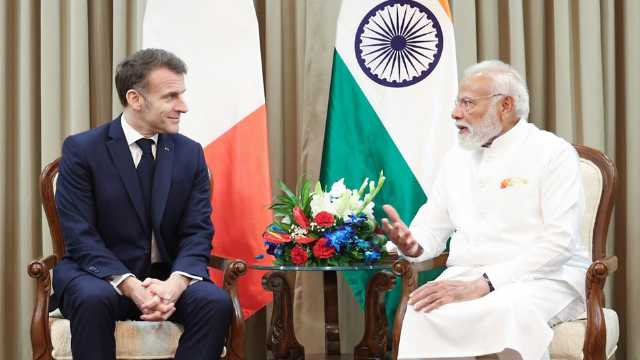
The elevation of ties between India and France to a Special Global Strategic Partnership marks a defining moment in the evolution of one of the world’s most resilient bilateral relationships. At a time when international alignments are increasingly shaped by great-power competition and rigid bloc politics, the partnership between India and France stands out for its emphasis on strategic autonomy and pragmatic cooperation. The latest engagement between Prime Minister Narendra Modi and President Emmanuel Macron in Mumbai reflects not merely diplomatic continuity but a conscious effort by both capitals to future-proof their partnership against an increasingly uncertain global order. The new designation signals that the relationship has matured beyond transactional cooperation into a multidimensional alignment anchored in shared geopolitical assessments and long-term ambitions.
The renewed momentum in India-France ties has been building steadily over the past year. Exactly twelve months ago, Modi was in Paris for his sixth visit to France as head of government, where he co-chaired the AI Action Summit alongside Macron. That meeting produced a series of forward-looking commitments, including joint development of nuclear reactors and expanded defence collaboration. The symbolism of Modi’s repeated visits underscores the premium New Delhi places on Paris as a trusted strategic partner in Europe. The Mumbai talks this year reinforced that trajectory, with defence cooperation and artificial intelligence once again dominating the agenda. Both sides increasingly frame their engagement as extending well beyond bilateral concerns, positioning the partnership as a stabilising force in an international system where power politics is becoming more pronounced.
Central to this evolving relationship is the Horizon 2047 Roadmap, a long-term framework designed to guide cooperation across strategic, technological and economic domains. The roadmap reflects a shared reading of global flux and a mutual desire to support each other’s rise in a world where, as many policymakers fear, the principle of “might is right” is gaining ground. For India, France offers a rare combination of advanced technological capability, diplomatic independence and willingness to engage without imposing political conditionalities. For France, India represents a pivotal Indo-Pacific partner capable of reinforcing Europe’s strategic presence in a region increasingly shaped by US-China rivalry. The convergence is therefore not accidental but rooted in complementary geopolitical calculations.
Defence cooperation remains the most visible pillar of this partnership, and recent developments have given it fresh impetus. Days before Macron’s visit, India’s Defence Acquisition Council, chaired by Defence Minister Rajnath Singh, cleared a long-pending proposal to procure 114 Rafale fighter aircraft from France. This decision builds on an existing fleet of 36 Rafale jets already inducted into the Indian Air Force and the planned acquisition of 26 Rafale Marine aircraft for the Indian Navy. The scale and continuity of these purchases underline the depth of trust that has developed between the two defence establishments. More importantly, the move aligns with New Delhi’s broader strategic objective of diversifying its military imports and gradually reducing its long-standing dependence on Russia as its principal defence supplier.
The Rafale decision also reflects a wider shift in India’s defence modernisation strategy. Rather than relying on a single dominant supplier, New Delhi is increasingly pursuing a diversified procurement architecture that balances capability, reliability and geopolitical flexibility. France has benefited from this recalibration because of its consistent willingness to transfer technology and engage in co-development, features that India has long sought in its defence partnerships. The Indian Navy’s planned induction of the Rafale Marine variant further expands the maritime dimension of bilateral defence ties, particularly significant in the context of the Indo-Pacific’s growing strategic salience. Taken together, these developments indicate that defence cooperation is likely to remain the anchor of the India-France relationship well into the next decade.
Yet the joint statement issued after the Modi-Macron talks makes clear that the partnership is no longer confined to hard security. The two sides outlined collaboration across an expansive spectrum that includes emerging technologies, critical minerals, space cooperation, climate action, global health and artificial intelligence. This broadening agenda reflects an understanding that future geopolitical influence will be shaped as much by technological ecosystems and supply-chain resilience as by military capability. In the AI domain especially, both countries are seeking to position themselves as advocates of responsible innovation that balances economic opportunity with ethical safeguards. Their earlier collaboration at the Paris AI Action Summit laid the groundwork for this ambition, and the Mumbai discussions suggest that implementation is now moving into a more operational phase.
What gives the India-France partnership unusual durability is the deep mutual respect for strategic autonomy that underpins it. Paris has historically avoided pressuring New Delhi on its relations with Moscow, even after the deterioration of France-Russia ties following the Ukraine conflict. This restraint resonates strongly in India’s foreign policy tradition, which places a premium on independent decision-making. At the same time, France has maintained robust economic engagement with China, its largest trading partner in Asia, even while aligning with India on the importance of a rules-based order in the Indo-Pacific. The ability of both countries to compartmentalise differences while advancing shared interests has become one of the defining strengths of their relationship.
The timing of the Modi-Macron meeting is also geopolitically significant because it comes soon after the signing of the India–EU free trade agreement in January. That development signals New Delhi’s growing confidence in engaging Europe as an autonomous strategic pole rather than merely an adjunct to a US-led Western bloc. In this context, France serves as India’s principal gateway to the European strategic landscape. Paris has consistently supported stronger India-EU engagement and has often acted as a bridge between Brussels and New Delhi on sensitive issues ranging from trade to Indo-Pacific security. The Special Global Strategic Partnership therefore functions not only as a bilateral mechanism but also as a conduit for India’s deeper integration with European economic and technological networks.
The Indo-Pacific dimension of the partnership deserves particular attention. Both Modi and Macron reaffirmed their commitment to maintaining a rules-based order in the region, a phrase that carries implicit concern about unilateral assertions of power. France, with its overseas territories and resident military presence in the Indian Ocean and Pacific, is uniquely positioned among European nations to act as an Indo-Pacific stakeholder. India, for its part, views France as one of the few Western partners capable of contributing meaningfully to regional stability without the baggage of alliance politics. Their expanding maritime cooperation, joint naval exercises and shared interest in secure sea lanes suggest that the Indo-Pacific will remain a central theatre for strategic collaboration.
Looking ahead, the success of the Horizon 2047 Roadmap will depend on how effectively both countries translate high-level political alignment into tangible industrial and technological outcomes. Defence co-production, semiconductor collaboration, civil nuclear progress and AI partnerships will be key indicators to watch. Equally important will be the ability of both governments to sustain political momentum amid domestic economic pressures and shifting global dynamics. If current trends hold, the India-France partnership is likely to deepen further, not only because of converging interests but also because both nations increasingly see each other as essential pillars in their respective strategies for navigating a more fragmented world.
In an era marked by volatile alliances and transactional diplomacy, the steady elevation of India-France ties offers a contrasting model built on trust, technological cooperation and respect for autonomy. The raised profile of the relationship is not merely ceremonial; it reflects a deliberate strategic bet by both New Delhi and Paris that their partnership will become more, not less, relevant as global power balances continue to shift.
(the writer can be reached at dipakkurmiglpltd@gmail.com)