
New Delhi, Jan 26: India ushered in its 77th Republic Day on Monday with a grand display of its cultural diversity, economic growth, and military prowess that included missiles, warplanes, newly-raised units and lethal weapon systems used during Operation Sindoor.
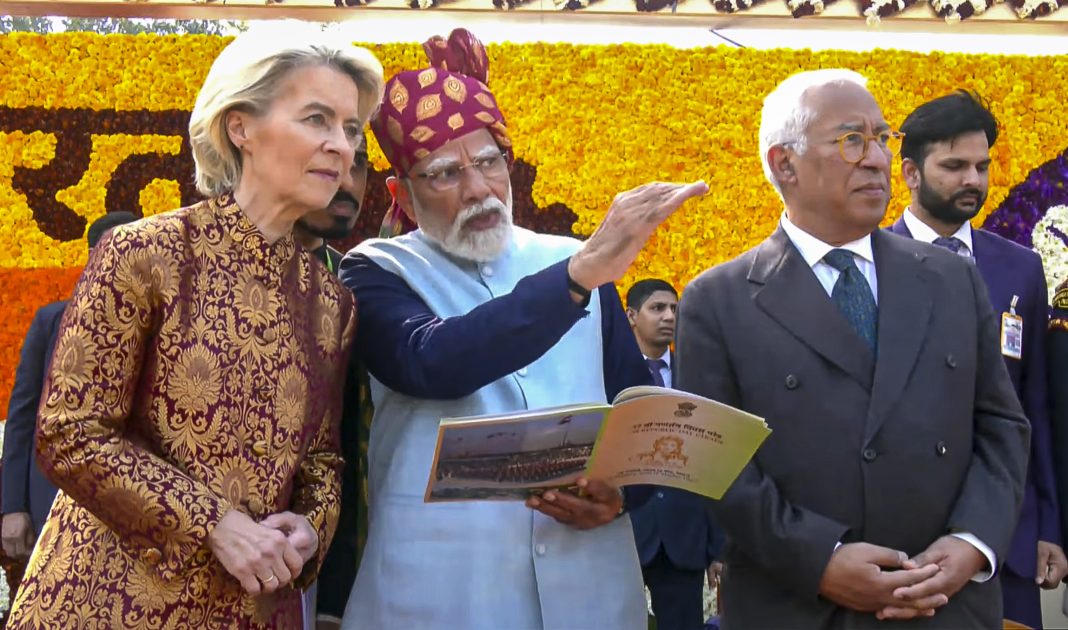
President of the European Council, Antonio Costa, and President of the European Commission, Ursula von der Leyen, graced the celebrations as chief guests, marking a significant diplomatic moment alongside the military display.
Although the overarching theme of the event was 150 years of ‘Vande Mataram’, the Indian military’s Operation Sindoor too found prominence at the parade on the Kartavya Path, the centrepiece boulevard of the national capital.
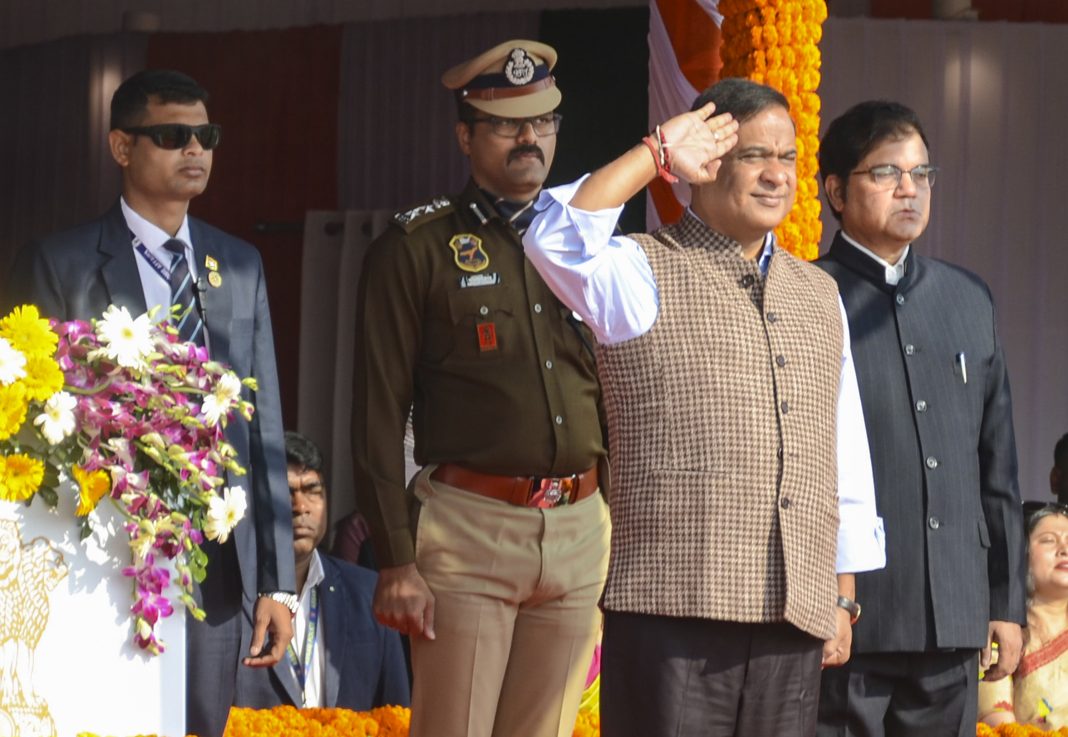
The parade commenced with the President Droupadi Murmu taking the salute shortly after she, Costa and von der Leyen, flanked by the Indian president’s bodyguards, arrived at the Kartavya Path in a traditional buggy.
Prime Minister Narendra Modi, Defence Minister Rajnath Singh, several other Union ministers, the country’s top military brass, foreign diplomats, and senior officials were among the spectators.
The major weapon systems displayed included BrahMos and Akash weapon systems, rocket launcher ‘Suryastra’, Main Battle Tank Arjun and an array of indigenously-built military platforms and hardware.
Around 100 artistes heralded the parade, on the theme ‘Vividata Mein Ekta (Unity in Diversity) that featured a grand presentation of musical instruments, demonstrating the nation’s unity and rich cultural diversity.
The parade then began with President Murmu taking the salute. The parade was led by Parade Commander Lt General Bhavnish Kumar, General Officer Commanding, Delhi Area, a second-generation officer.
A tri-services tableau showcasing replicas of major weapon systems deployed by the Indian military during Operation Sindoor in early May was a major attraction.
A glass-cased integrated operational centre, depicting the conduct of Operation Sindoor with the use of weapons systems such as BrahMos and S-400 missiles rolled down Kartavya Path.
For the first time, the parade showcased a phased ‘Battle Array Format’ of the Indian Army, including its aerial component. The recce element consisted of the 61 Cavalry in active combat uniform.
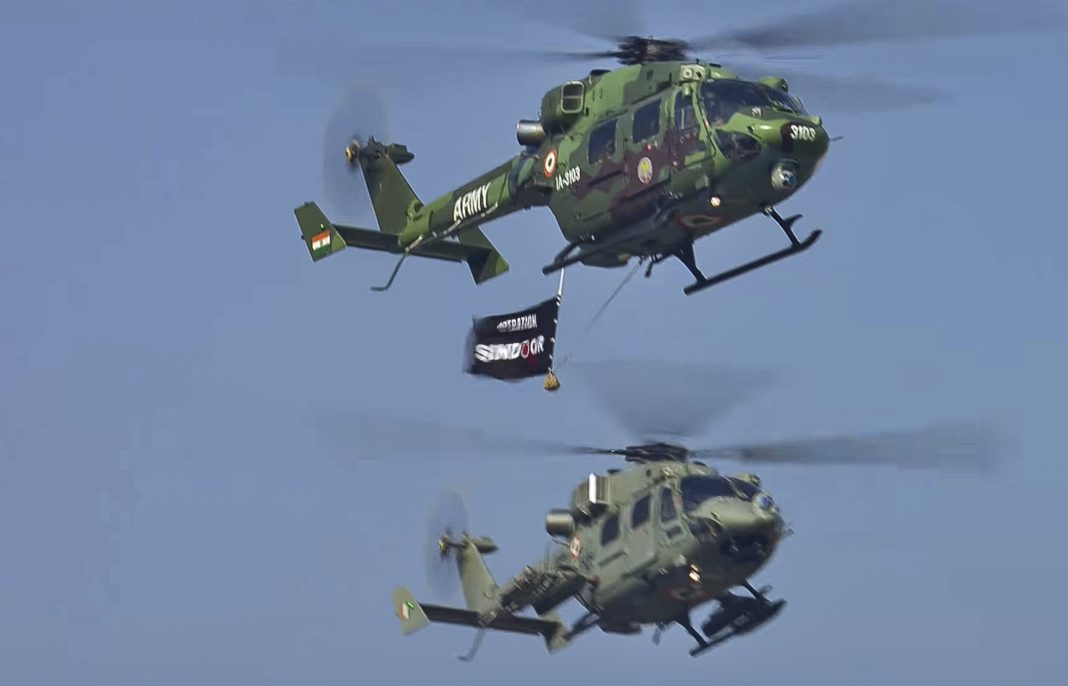
It was followed by a high mobility reconnaissance vehicle. Providing aerial support was the indigenous Dhruv Advanced Light Helicopter and its armed version, Rudra, in Prahar formation, demonstrating battlefield shaping.
The combat elements then followed with T-90 Bhisma and Main Battle Tank Arjun rolling past the saluting dais with aerial support from Apache AH-64E and Prachand light combat helicopters.
Other mechanised columns included BMP-II Infantry Combat Vehicle, along with Nag missile system (Tracked) Mk-2.
A military contingent from the EU, carrying the military staff flag and flags of Operations Atalanta and Aspides, the naval operations of the grouping, also featured at the parade. It was the EU’s first participation in such an event outside of Europe.
Among the major weapon systems showcased at the parade were Suryastra Universal Rocket Launcher System (URLS), Brahmos Supersonic cruise missiles and Akash missile systems.
The Indian Navy contingent comprised 144 young personnel, led by Lt Karan Nagyal as contingent commander, and Lt Pawan Kumar Gandi, Lt Priti Kumari and Lt Varun Dreveriya as platoon commanders.
It was followed by the Naval tableau that presented a vivid depiction of the theme ‘Strong Navy for a Strong Nation’. It depicted a stitched ship from the fifth century CE, now christened INSV Kaundinya, Gurab-class ships of the Maratha Navy, and frontline indigenous platforms, including the aircraft carrier INS Vikrant and INS Udayagiri.
The tableau featured a depiction of the circumnavigation route followed by INSV Tarini as part of the Navika Sagar Parikrama-II expedition.
In addition to naval personnel, young cadets from the Sea Cadets Corps, a non-governmental organisation that imparts basic nautical skills to youth in Mumbai, marched alongside the tableau.
The Indian Air Force contingent comprised four officers and 144 airmen. The contingent commander was Squadron Leader Jagdesh Kumar with Squadron Leader Nikita Choudhery, Flt Lt Prakhar Chandrakar and Flt Lt Dinesh as supernumerary officers.
Syncing with the marching contingent was a thrilling fly-past by two Rafale jets, two MiG-29s, two Su-30s and one Jaguar aircraft in ‘Spearhead’ formation, symbolising the “Sindoor Formation”.
The Defence Research and Development Organisation (DRDO) showcased its hypersonic glide missile LR-AShM. It is capable of engaging static and moving targets and is designed to carry various payloads.
The missile has a first-of-its-kind indigenous avionics system and high-accuracy sensor packages.
A total of 30 tableaux — 17 of states and Union Territories and 13 of various ministries and departments rolled down the Kartavya Path. The tableaux showcased a unique mix of 150 years of the national song Vande Mataram and the nation’s rapid progress.
A joint ‘DareDevils’ team of motorcycle riders drawn from the Central Reserve Police Force and the Sashastra Seema Bal enthralled the audience with their manoeuvres.
The aerial fly-past, one of the most eagerly-awaited events of the parade, witnessed the participation of a total of 29 aircraft, including 16 fighter jets, four transport aircraft and nine helicopters.
These include Rafale, Su-30 MKI, MiG-29 and Jaguar aircraft, complemented by strategic assets – C-130 and C-295, as well as the Indian Navy’s P-8i aircraft. The formations include Arjan, Vajraang, Varuna and Vijay. (PTI)