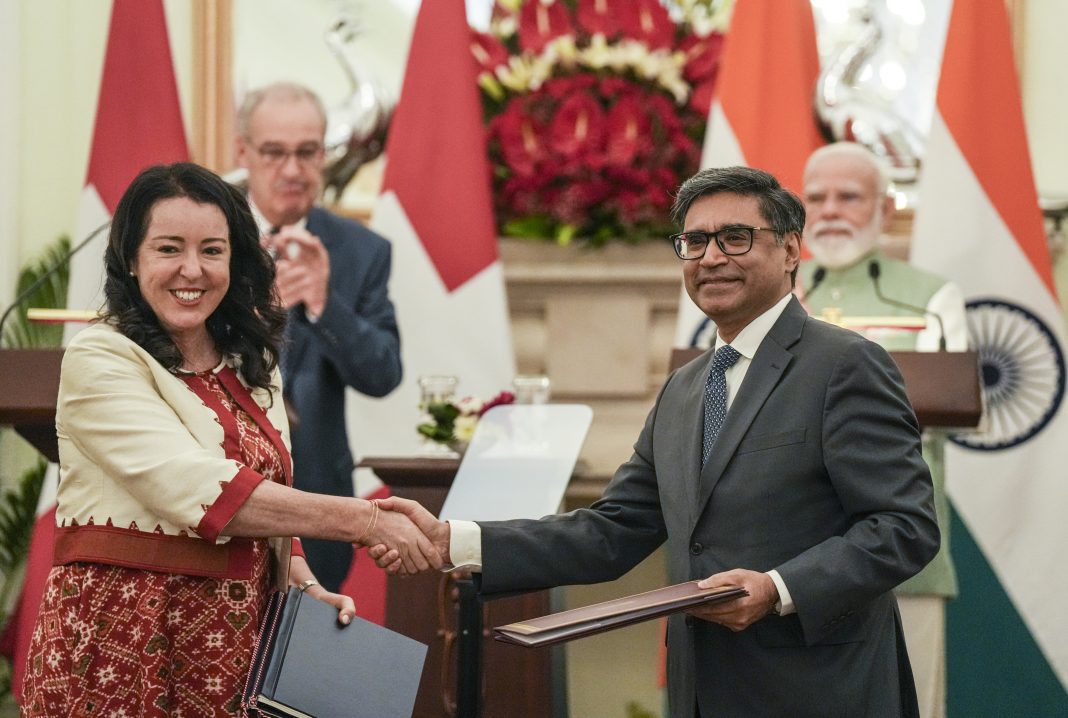

New Delhi, Oct 5: India and Switzerland on Monday signed a migration and mobility partnership pact, decided to expand Swiss market access for Indian exports and agreed to further deepen cooperation in nuclear energy and defence domains following talks between Prime Minister Narendra Modi and Swiss President Guy Parmelin.
Parmelin kick-started his three-day trip to India this morning in his first state visit to the country and his second visit this year, having previously attended the AI Impact Summit in February.
Alongside the mobility and migration pact, the two sides inked four other agreements, including a young professionals exchange scheme and a major deal to foster collaboration on transportation technologies, mobility systems, and infrastructure development.
The Ukraine conflict and the situation in West Asia also figured prominently in the discussions, with Modi emphasising that both sides support all meaningful efforts toward peace.
In his media statement, Modi said a series of important decisions were taken to expand market access for Indian exports to Switzerland and further facilitate investment between the two countries.
Switzerland is a major economic partner for India in Europe. Over 330 Swiss companies are currently operating in India in sectors such as engineering, services, precision instruments, chemicals and pharmaceuticals, while Indian companies are present in Switzerland in sectors such as IT, pharmaceuticals, and machinery.
The Swiss leader said boosting trade ties was a key focus of the talks. Parmelin noted that Switzerland hopes to conclude an investment protection agreement with India soon to facilitate greater flow of investments into various sectors of the Indian economy.
The bilateral trade and investment ties received a further boost following the coming into force in October of the Trade and Economic Partnership Agreement (TEPA) between India and the European Free Trade Association (EFTA) States of Iceland, Liechtenstein, Norway and Switzerland.
Modi said the TEPA is an “ambitious blueprint” for investment, innovation, jobs, and shared prosperity.
“Through this, we will realise our goals of USD100 billion in investment and one million direct jobs in India over the next 15 years,” he said.
The prime minister, describing innovation, infrastructure and advanced technology as strong pillars of India-Switzerland partnership, said both sides are going to give engagement a “new impetus”.
“We have taken several important decisions to expand market access for Indian exports to Switzerland and further facilitate investment between the two countries,” he said.
“This will increase India’s exports of agriculture, pharmaceuticals, textiles and engineering goods to Switzerland. At the same time, we will attract new Swiss investment in key sectors like biotech, life sciences, banking, insurance, food processing, and sustainability,” he said.
Through these initiatives, “we will jointly develop trusted supply chains and reliable solutions for the entire world,” he added.
PM Modi said the two sides identified “new possibilities” for cooperation in military exchanges and defence production besides agreeing to further deepen cooperation in nuclear energy.
“The ropeway in Varanasi, the Jewar Airport in Noida, and railways and tunnelling projects in hilly areas are shining examples of our infrastructure cooperation.”
An agreement was inked for collaboration on transport and infrastructure. “We invite Swiss infrastructure companies to invest in India on a large scale, and to participate in capacity building, design, and manufacturing,” Modi said.
The prime minister, calling the India-Switzerland science and technology cooperation a strong pillar of the ties, said new joint research projects in priority areas such as health, clean energy, and space will be launched soon.
Modi also touched upon the importance of people-to-people connect, characterising it as the “greatest strength of the partnership”.
“The migration and mobility partnership agreement and the young professionals agreement signed today will open up many new opportunities in Switzerland for Indian students, researchers, professionals, and youth,” he said.
The MoU on migration and mobility aims to promote mobility “under equal treatment principles”, and to combat irregular migration and human trafficking in accordance with national laws.
It provides for multiple-entry visas for up to five years, including stays of up to six months on each visit, and renewable one-year student permits.
The agreement on the exchange of young professionals is aimed at those taking up temporary employment to enhance their professional and language skills. It provides for the exchange of 300 people annually per country, which may increase to 500.
Modi said India and Switzerland believe in democratic values, the rule of law, dialogue and diplomacy, and both sides will continue to work together for global peace and stability.
“Whether in Ukraine or West Asia, India has supported every meaningful effort towards peace. We also agree that reform of global institutions is essential to address growing global challenges,” he said. (PTI)