
By Dipak Kurmi
The intensifying conflict in West Asia has begun to cast a long shadow over India’s export economy, particularly the highly significant trade in rice. As the crisis enters its sixth day, Indian exporters are facing a growing wave of uncertainty regarding payments from importers in the Gulf region, while at the same time grappling with rising demurrage charges caused by containers stranded across different stages of the supply chain. What began as a geopolitical crisis has now spilled over into the commercial sphere, creating disruptions that threaten both short-term shipments and long-term trade relationships. For India, which has built a dominant presence in the global rice market over the past two decades, the situation represents not merely a logistical inconvenience but a serious economic concern. Exporters, traders, and policymakers are now watching developments closely, aware that the fragile link between geopolitics and commerce has once again become visible in the most immediate way.
The Gulf region has historically been one of the largest and most dependable destinations for Indian rice exports, especially for the globally celebrated aromatic variety known as Basmati Rice. Countries such as Saudi Arabia, Iraq, United Arab Emirates, and Iran collectively account for a substantial share of India’s rice imports. For decades, this trade relationship has been reinforced not only by economic ties but also by deep cultural connections, as rice forms an essential component of culinary traditions across the Middle East. The timing of the present disruption has made the situation even more delicate, because shipments to the Gulf typically rise during Ramadan, when food consumption patterns change and demand for staple grains such as basmati rice increases significantly. Under normal circumstances, exporters carefully plan shipments during this period to ensure timely arrival in Gulf markets. However, the unfolding crisis has thrown these carefully organised logistics into disarray.
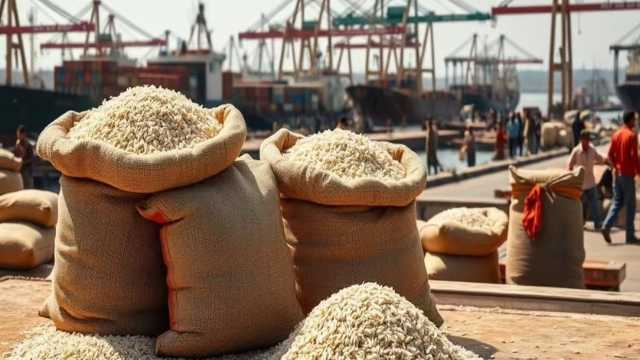
One of the most immediate consequences of the crisis has been the large number of shipments that have become stranded across various points in the export chain. Exporters estimate that approximately two to four lakh tonnes of rice are currently stuck at different nodes within the supply network. According to industry representatives, more than 3,000 containers filled with rice are presently stalled at Indian ports alone, while other consignments remain trapped either in transit or at destination ports in West Asia. This multi-layered disruption means that exporters are confronting challenges not just in dispatching new shipments but also in managing consignments that have already left the country. The situation is complicated by the fact that each stage of the logistics chain operates under separate contractual and regulatory frameworks, making it difficult for exporters to simply recall shipments or redirect them without incurring substantial costs.
Representatives from the Indian Rice Exporters Federation have highlighted the gravity of the situation and the limited options currently available to exporters. Dev Garg, Vice President of the federation, has pointed out that shipments are effectively trapped across three critical nodes: at Indian ports, while in transit across sea routes, and at the destination ports in West Asia. Exporters are therefore exposed to mounting demurrage charges, which are penalties levied when containers remain in port beyond the allotted free period. As the duration of the crisis remains uncertain, calculating the potential scale of these charges has become extremely difficult. The federation has approached the government seeking relief measures, including the waiver of port charges and regulatory adjustments that could allow exporters to call back their shipments if necessary. Some exporters with diversified trade networks are exploring the possibility of rerouting their consignments to markets in North America, though such alternatives remain limited due to differences in demand patterns and contractual commitments.
Earlier estimates provided by the All India Rice Exporters’ Association indicate that nearly two lakh tonnes of basmati rice alone are currently stranded at Indian ports. According to Satish Goel, president of the association, India exports roughly sixty lakh tonnes of basmati rice annually, of which nearly forty lakh tonnes are destined for the Gulf region. These figures underline the scale of India’s dependence on West Asian markets for its premium rice exports. The sudden disruption of shipments therefore affects not only exporters but also farmers, millers, logistics providers, and financial institutions connected to the agricultural export ecosystem. Delays in shipments can lead to payment uncertainties, contractual disputes, and financial strain for companies operating on tight margins. In some cases, exporters who have already locked in fixed-price contracts with overseas buyers may face losses if rising freight costs or currency fluctuations alter the economics of the deal.
Recognising the seriousness of the situation, the Government of India has begun to coordinate a response involving multiple ministries and regulatory bodies. Piyush Goyal confirmed that a consultation meeting had been held with stakeholder ministries along with key logistics and trade facilitation partners to assess the evolving geopolitical environment and its potential impact on India’s exports and imports. The discussions focused on identifying immediate logistical bottlenecks and exploring mechanisms that could help exporters navigate the current uncertainty. The meeting also underscored the importance of maintaining close communication with shipping companies, port authorities, and international trade partners in order to minimise disruptions.
In a significant institutional step, the government has established the Inter-Ministerial Group for Supply Chain Resilience to monitor the situation and ensure effective coordination among different agencies. The group includes representatives from the Department of Financial Services, Ministry of External Affairs, Ministry of Ports, Shipping and Waterways, Ministry of Petroleum and Natural Gas, and the Central Board of Indirect Taxes and Customs. This collaborative framework aims to facilitate timely monitoring, policy coordination, and follow-up actions that may be required as the geopolitical situation evolves. By bringing together departments responsible for finance, diplomacy, shipping, energy, and customs regulation, the government hopes to respond more effectively to the cascading effects of the conflict on trade flows.
The wider economic implications of the crisis extend beyond the immediate issue of stranded shipments. Developments in countries such as Iran and the United Arab Emirates have the potential to influence bunker fuel prices, which are the costs associated with the fuel used by cargo vessels. If oil prices rise sharply as a result of geopolitical tensions, shipping companies may pass on the additional costs to exporters through higher freight rates. The Indian Rice Exporters Federation has warned that such developments could disrupt both container and bulk vessel availability, leading to sudden increases in freight charges. For exporters operating under fixed delivered-price contracts, such cost increases could translate into significant financial losses, as they may be unable to renegotiate prices with overseas buyers once agreements have been finalised.
Another potential consequence of the crisis is a steep increase in insurance premiums for cargo shipments passing through conflict-prone regions. Maritime insurance providers typically reassess risk levels whenever geopolitical tensions escalate near critical shipping routes. Higher risk classifications often lead to increased war-risk insurance premiums, which must be paid by exporters or shipping companies. These additional expenses further strain exporters who are already dealing with delays, logistical complications, and payment uncertainties. In response, industry bodies have advised exporters to exercise caution when concluding new orders and to avoid entering into open-ended or unhedged contractual positions until the situation stabilises.
The significance of the Middle East and African markets for India’s rice trade further underscores the potential economic impact of prolonged disruption. According to industry estimates, these two regions together account for roughly half of India’s total rice exports. During the period between April and December 2025, exports to the Middle East alone reached approximately 3.90 million metric tonnes, while shipments to Africa totalled about 7.16 million metric tonnes. These figures highlight the extent to which India’s agricultural export strategy is intertwined with demand patterns in these regions. Any disruption affecting shipping routes, payment channels, or logistical infrastructure therefore has the potential to reverberate across India’s agricultural economy.
India has long been the world’s largest exporter of rice, supplying a significant portion of the global demand for both basmati and non-basmati varieties. The country’s competitive advantage stems from a combination of fertile agricultural regions, established milling infrastructure, and deep trade connections with markets across Asia, Africa, and the Middle East. However, this leadership position also makes India particularly vulnerable to geopolitical disruptions affecting key maritime routes. The present crisis illustrates how swiftly international trade networks can be destabilised when regional conflicts intersect with global supply chains.
Ultimately, the unfolding situation in West Asia serves as a reminder of the fragile equilibrium upon which international commerce depends. Agricultural exports may appear distant from geopolitical conflicts, yet the movement of food across oceans is deeply intertwined with political stability, energy markets, and maritime logistics. For Indian rice exporters, the coming weeks will likely determine whether the present disruption remains a temporary setback or evolves into a longer-term challenge. Policymakers, industry associations, and exporters themselves must therefore navigate a complex landscape of diplomatic developments, economic calculations, and logistical constraints. As the crisis continues to unfold, the fate of thousands of containers stranded across ports and sea lanes stands as a vivid symbol of how global trade, like the oceans it crosses, is shaped by forces far beyond the control of those who depend upon it.
(the writer can be reached at dipakkurmiglpltd@gmail.com)