
By Satyabrat Borah
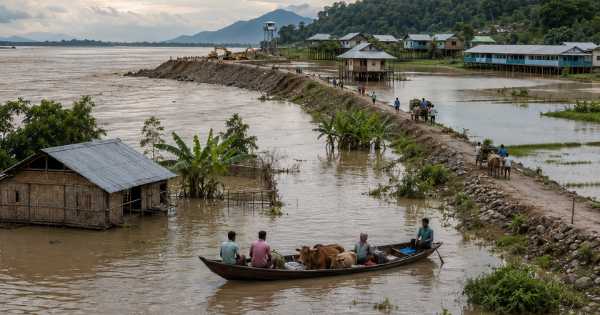
Assam faces a recurring nightmare every single year as the monsoon rains arrive and the Brahmaputra River overflows its banks, swallowing vast stretches of land, homes, and livelihoods. Millions of people find themselves displaced, struggling to secure basic necessities while watching their hard-earned assets wash away in the muddy brown water. The sheer scale of destruction impacts agriculture, infrastructure, and human life, making it one of the most critical challenges the state experiences annually. To understand the gravity of this disaster, one must look at how geography and climate work together to create a complex ecological puzzle.
The topography of the region plays a massive role in making the valley vulnerable to such intense overflowing. Streams and tributaries rush down from the surrounding hills of neighbouring states and countries, carrying immense volumes of water along with heavy sediment loads. As these fast-moving streams hit the flat plains of Assam, they slow down and deposit enormous quantities of silt onto the riverbed. Over decades, this continuous deposition has raised the riverbeds significantly, reducing the water-carrying capacity of the main channels. When heavy monsoon downpours hit the catchment areas, the shallow riverbeds simply cannot hold the surging water, forcing it to spill over into human settlements and agricultural fields.
Human interventions and poor land management have made the situation noticeably worse. Unplanned urban development, deforestation in upper catchment areas, and the destruction of natural wetlands have disrupted the natural drainage systems that once absorbed excess rainfall. Wetlands and local water bodies used to act as natural sponges, holding back millions of liters of storm water and releasing it slowly over time. With these natural buffers paved over for buildings and roads, rainwater has nowhere to go except into residential areas, causing severe flash floods in cities alongside the traditional riverine flooding in rural districts.
The traditional approach to controlling these surging waters has long relied almost entirely on building embankments along the riverbanks. Thousands of kilometers of these earthen dykes were constructed over the last several decades as a temporary shield against the floods. Many of these structures have outlived their intended lifespan, becoming weak and prone to breaches during high water levels. When an embankment breaks under pressure, the resulting rush of water is far more destructive than a gradual rise in water levels, flattening entire villages within minutes and leaving behind thick layers of infertile sand on fertile farmland.
Addressing this monumental crisis requires moving away from piecemeal solutions and adopting a comprehensive, long-term strategy that works with nature rather than trying to forcefully contain it. A fundamental shift must happen in how the river basin is managed, starting from the upper catchment regions all the way down to the plains. Massive afforestation drives along hill slopes can slow down soil erosion, directly reducing the sediment that ends up clogging the riverbeds below. Protecting existing forest cover and restoring degraded forest lands across the entire river basin will naturally regulate the flow of rainwater during intense weather events.
Dredging key river channels and managing sediment scientifically offers another practical pathway to mitigate the damage. While complete dredging of a giant river like the Brahmaputra is neither financially feasible nor ecologically sound, targeted dredging at critical choke points can help maintain deeper channels for water flow. The silt removed from the riverbed can be repurposed to raise the height of vulnerable villages or to strengthen riverbanks in areas facing extreme erosion. Combining sediment management with proper river training techniques can stabilize bank lines and protect communities living close to the edges.
Reclaiming and rejuvenating the natural wetland network is equally vital for creating long-term resilience against heavy rains. Oxbow lakes, local ponds, and marshlands must be desilted, cleared of encroachments, and reconnected to the main river systems through natural channels. During the peak monsoon season, these rejuvenated wetlands can store enormous amounts of excess water, significantly reducing the peak flood levels in nearby towns and villages. In the dry winter months, the stored water can serve as a crucial resource for local agriculture and fishing communities, creating a sustainable ecological cycle.
Modernizing early warning systems and leveraging advanced technology can save countless lives and minimize economic losses. Installing real-time hydrological sensors, weather radars, and satellite monitoring systems allows authorities to track rainfall patterns and water levels with high accuracy. Translating this data into hyper-local, easy-to-understand alerts sent directly to villagers’ mobile phones gives families precious hours to move their cattle, essential documents, and belongings to safer grounds. Community-based disaster management teams, trained in quick evacuation and basic first aid, can ensure that emergency responses are swift and well-coordinated.
Building flood-resilient infrastructure is another essential pillar for long-term adaptation in the floodplains. Traditional housing designs, such as houses built on raised stilts, have allowed local indigenous communities to live alongside the river for generations without facing total destruction. Promoting these climate-resilient architecture styles for public buildings, schools, and homes in high-risk zones ensures that basic life can continue even when water enters the village. Raising the height of roads, electrical sub-stations, and drinking water sources above historical flood levels prevents the complete collapse of essential services during emergencies.
International and inter-state cooperation must be strengthened to manage the shared river basin effectively. Rivers do not recognize administrative boundaries, and decisions made upstream directly impact communities living downstream. Sharing real-time hydrological data during the monsoon season among all regional stakeholders enables better preparation and dam water management. When hydroelectric reservoirs upstream need to release water, doing so in a controlled, phased manner with advance warnings prevents sudden artificial floods from overwhelming downstream areas.
Securing sustainable livelihoods for vulnerable populations requires a complete rethinking of regional agricultural practices. Promoting short-duration crop varieties or flood-tolerant rice strains enables farmers to harvest their produce before the peak flood season arrives or survive prolonged submergence without losing the entire crop. Diversifying rural incomes through flood-resistant fish farming, backyard poultry, and handloom handicrafts reduces total financial dependence on traditional seasonal farming, helping families recover much faster after the water recedes.
Ultimately, living with floods requires a fundamental mindset shift from attempting total control to building systemic resilience and harmony with natural water cycles. The river system is a living ecological entity that brings fertility, life, and culture to the region, alongside its seasonal fury. By combining traditional ecological wisdom with modern engineering, robust regional cooperation, and proactive community participation, the state can transform a annual disaster into a manageable natural event, safeguarding the future of its people for generations to come.