
By Dipak Kurmi
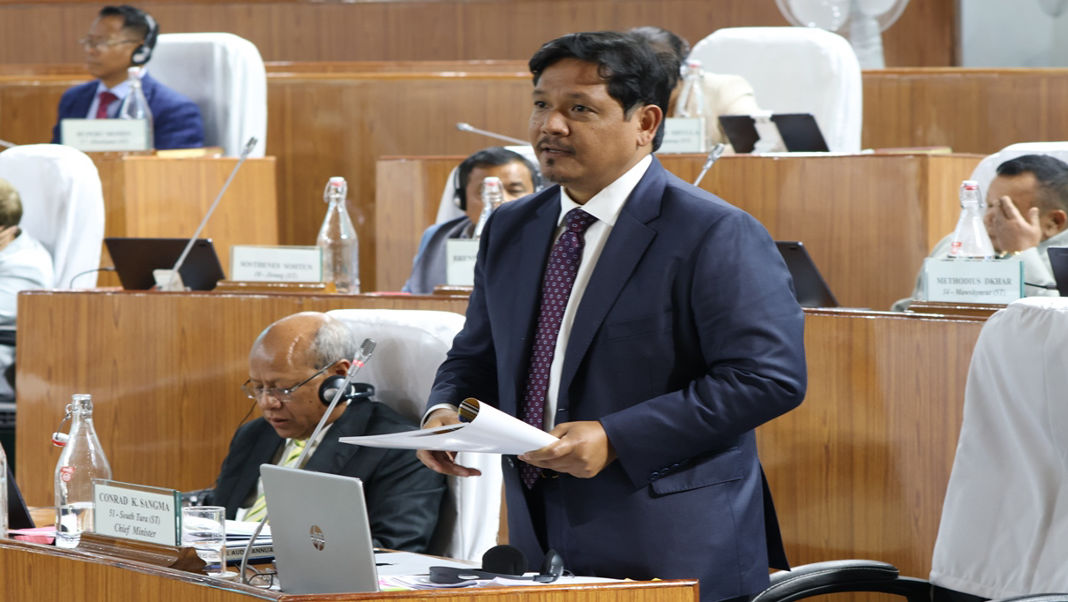
When Meghalaya Chief Minister and Finance Minister Conrad K Sangma rose on February 23, 2026 to present his ninth consecutive state budget, he sought to do more than outline fiscal arithmetic. The ₹32,023 crore budget for 2026–27 was framed as a statement of intent, a document meant to capture what he described as the state’s five defining attributes—stable, aspirational, collaborative, caring and sustainable. In an era when smaller states often struggle to balance ambition with fiscal prudence, the speech attempted to project Meghalaya as a polity that is not merely managing growth but consciously shaping its developmental narrative. The emphasis throughout was on disciplined expansion, targeted welfare and infrastructure-led transformation, all while maintaining fiscal parameters within permissible limits.
At the core of the budget lies a careful balancing act. Total expenditure for 2026–27 is estimated at ₹32,023 crore against total receipts pegged at ₹32,000 crore, underscoring the tight fiscal space within which the government is operating. Sangma announced a fiscal deficit of ₹2,672 crore, roughly 3.5 percent of the Gross State Domestic Product (GSDP), stressing that the figure remains within the permissible threshold. In India’s federal fiscal architecture, adherence to deficit norms has become a key indicator of financial credibility, particularly for smaller, grant-dependent states. By highlighting compliance with the 3.5 percent ceiling, the Meghalaya government is clearly signalling to both New Delhi and financial markets that expansionary spending will not come at the cost of macroeconomic stability.
The revenue architecture presented in the budget reflects the state’s continued dependence on central transfers while also showing incremental strengthening of its own revenue base. Total receipts of ₹32,000 crore include revenue receipts estimated at ₹26,583 crore and capital receipts of ₹5,417 crore. Excluding borrowings of ₹5,379 crore, receipts stand at ₹26,621 crore. On the expenditure side, revenue spending is projected at ₹21,812 crore and capital expenditure at ₹10,211 crore, indicating the government’s sustained push toward asset creation. The estimated total expenditure excluding loan repayments of ₹2,731 crore comes to ₹29,293 crore. Interest payments are expected to reach ₹1,540 crore, while pension liabilities are projected at ₹1,980 crore—figures that highlight the growing weight of committed expenditure in the state’s fiscal structure.
A notable feature of the budget is the continued expansion of thematic or “dedicated” budgeting. The climate budget has been set at ₹5,572 crore, marking a 2.8 percent increase over the previous year. The Youth Budget, at ₹4,824 crore, registers a sharp 45 percent jump, signalling a policy pivot toward employment, skills and demographic dividends. The Gender Budget stands at ₹6,849 crore, up by 10 percent. Together, these allocations reflect an attempt to align fiscal planning with broader social and environmental priorities, mirroring a trend visible in several Indian states where budgeting is increasingly being used as a tool for targeted developmental signalling rather than merely financial bookkeeping.
Sangma’s macroeconomic projections are equally ambitious. Meghalaya’s GSDP is expected to reach ₹76,320 crore in 2026–27, representing a 13.1 percent rise from 2024–25. The government remains confident of touching ₹85,000 crore by 2028 and ₹1,35,000 crore by 2032, the latter forming part of the broader “Meghalayan Decade” vision announced earlier. The Chief Minister asserted that the state is now the second-fastest growing economy in the country after Tamil Nadu, citing nearly 10 percent real GSDP growth for three consecutive post-COVID years and nominal growth of 12 percent in 2025. While such claims will inevitably invite scrutiny from economists, the broader trend of improved growth momentum in Meghalaya over the past decade is difficult to dismiss outright.
Central transfers continue to dominate the revenue landscape, with expected inflows of ₹21,229 crore. However, the state’s share of central taxes is projected to decline to ₹9,631 crore under the Sixteenth Finance Commission’s devolution formula. Sangma struck an optimistic note, arguing that as the national tax pool expands, Meghalaya’s absolute share will strengthen even if the percentage allocation moderates. Meanwhile, the state’s own tax revenue is projected at ₹4,720 crore—of which ₹2,351 crore will come from GST—marking a significant rise from ₹1,450 crore in 2017–18. Non-tax revenue is expected to reach ₹634 crore, aided in part by progress in mining licence issuance. These figures suggest gradual but steady movement toward improving fiscal self-reliance, though Meghalaya remains structurally dependent on federal transfers.
Capital expenditure remains the centrepiece of the government’s growth strategy. At ₹10,211 crore, it represents a seven-fold increase compared to 2017–18 levels and a 4.4-fold rise during Sangma’s tenure. The Chief Minister explicitly linked this surge to Vision 2032 and Meghalaya Mission 10, frameworks that identify ten opportunity sectors alongside ten inclusivity commitments. The emphasis on infrastructure—roads, urban expansion, sports facilities and tourism assets—was reinforced through references to projects such as the Mawkdok bridge, the new Mawkhanu stadium and the ongoing development of New Shillong City. The push for UNESCO recognition of the Living Root Bridges also reflects an attempt to combine ecological heritage with tourism-led growth.
Public investment, Sangma argued, will remain the principal engine of the state’s economic expansion. Expenditure under the Special Assistance to States for Capital Investment (SASCI) is projected to jump by 67 percent to ₹4,500 crore in 2026–27. Centrally sponsored and central sector schemes together are expected to reach ₹6,833 crore. Looking ahead, the government aims to mobilise ₹15,000 crore worth of new externally aided projects across roads, power, healthcare, urban development and human development during the next Finance Commission cycle. This strategy underscores Meghalaya’s continued reliance on externally funded infrastructure to accelerate structural transformation.
Employment generation featured prominently in the Chief Minister’s narrative. According to estimates based on the Reserve Bank of India’s KLEMS methodology, around 3.66 lakh jobs were created between 2019 and 2025. Agriculture alone accounted for 1.90 lakh jobs, with contributions from floriculture (789), mushroom cultivation (4,078), fruit development (12,714), organic farming (47,927) and the Lakadong mission (15,333). Sangma emphasised the geographical spread of gains, citing organic farming employment in West Garo Hills (5,279), Ri-Bhoi (4,301) and East Khasi Hills (4,728). Outside agriculture, the hospitality sector added 12,683 jobs, transport 9,835 and manufacturing and recycling 24,926, indicating modest but broad-based diversification of the employment base.
The government’s flagship schemes were also presented as key livelihood drivers. Approximately 10,000 beneficiaries were supported under YES Meghalaya, 11,050 under the Aqua Mission, 1.7 lakh under CM-CARE and 9,000 under PRIME, bringing the total outreach to nearly eight lakh people. Sangma acknowledged the inherent limits of welfare delivery, remarking that satisfying every citizen is difficult but insisting that the administration is attempting to expand coverage steadily. In a politically significant claim, he noted that Meghalaya’s minimum wage of ₹525 is now the second highest in the country after Karnataka’s ₹581 and the highest in the Northeast, positioning the policy as evidence of the government’s commitment to protecting the poorest workers.
Despite the upbeat tone, the Chief Minister conceded that Meghalaya’s per-capita GSDP remains relatively low, though the state has improved its national ranking from 28th in 2019 to 26th at present. High population growth of 0.95 percent continues to dilute per-capita gains, a structural challenge that will require sustained productivity improvements rather than merely higher aggregate output. Sangma nevertheless highlighted that Meghalaya ranked fifth nationally in per-capita GDP growth between 2019 and 2025, arguing that the trajectory indicates meaningful progress compared to the situation in 2018.
Beyond macroeconomics, the budget speech also carried political symbolism. Sangma pointed to several “firsts” achieved during his tenure, including the adoption of a state anthem and official state symbols after five decades, the revival of legacy projects such as the Croborough Hotel and the construction of a new Assembly building. Spending on minor works aimed at local contractors has risen sharply from ₹454 crore in 2019 to ₹1,286 crore, a three-fold increase designed to support small operators who often struggle to compete in large centralised tenders. The linkage between public works and local entrepreneurship was repeatedly emphasised as part of the government’s inclusive growth narrative.
Social protection and housing received attention as well. The Chief Minister announced plans to build houses for families too poor to purchase land, framing the initiative as part of the administration’s commitment to ensure that “the poorest of the poor are not left behind.” The announcement comes at a time when Shillong is undergoing rapid spatial transformation, raising concerns about affordability and displacement. If implemented effectively, the housing push could help cushion vulnerable households from the pressures of urban expansion, though the fiscal and land availability implications will need close monitoring.
Connectivity infrastructure forms another pillar of the government’s forward strategy. Sangma described improved air connectivity as a potential “game changer” and highlighted the planned expansion of Umroi Airport’s runway to 2,400 metres. The budget allocates ₹150 crore for Umroi Airport and ₹50 crore for Baljek Airport in Tura, both handed over to the Airports Authority of India for operationalisation. For a hill state where terrain has historically constrained mobility and investment, enhanced aviation infrastructure could significantly alter tourism flows, logistics efficiency and investor perception—provided complementary road and urban infrastructure keeps pace.
Throughout the address, Sangma repeatedly returned to the philosophical framing of Meghalaya as embodying five “thoughts.” The state, he argued, is stable in its fiscal discipline, aspirational in its infrastructure ambitions, collaborative in its governance processes, caring in its welfare orientation and sustainable in its environmental commitments. The closing invocation of a Garo proverb—urging steady movement along a winding path—was clearly intended to reinforce the image of cautious but determined progress. Whether the narrative will translate into durable structural transformation remains an open question, but the government has unmistakably positioned public investment as the central lever.
Taken together, the 2026–27 budget presents Meghalaya as a state attempting to transition from grant dependence toward a more investment-driven growth model while still relying heavily on central support. The numbers reveal both promise and constraint: rising capital expenditure and improving revenue mobilisation on one hand, but persistent dependence on transfers and mounting committed liabilities on the other. If the projected growth momentum holds and infrastructure investments yield productivity gains, the vision of the “Meghalayan Decade” may acquire substantive credibility. For now, the budget stands as a carefully calibrated statement of ambition—confident in tone, disciplined in arithmetic and conscious of the long road that still lies ahead.
(the writer can be reached at dipakkurmiglpltd@gmail.com)