
By Satyabrat Borah
The phrase “distressing regularity” fits Meghalaya’s rat hole mining with painful accuracy because the tragedy does not shock anymore, it repeats. Every few months, news emerges of workers trapped underground, bodies recovered after days, or families waiting endlessly for answers that never fully come. Each incident briefly jolts public attention, prompts official statements and ritual expressions of concern, and then quietly fades, leaving the system unchanged. The mines remain. The tunnels remain. The desperation that drives men into these holes remains. What changes is only the count of the dead.
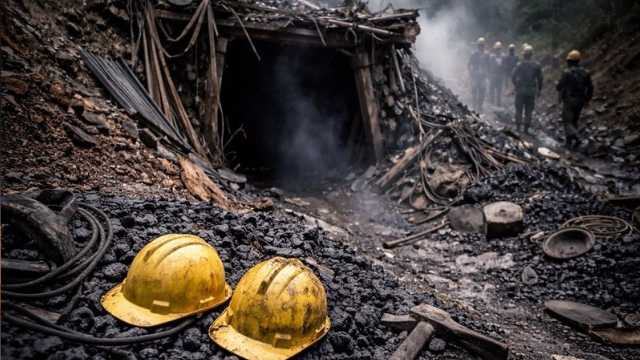
Rat hole mining is not an accidental byproduct of development. It is a deliberate, organised, and sustained activity carried out despite a clear ban by the National Green Tribunal. The method involves digging narrow vertical shafts and horizontal tunnels just wide enough for a person to crawl through, often without ventilation, structural support, or safety equipment. Coal is extracted manually in conditions that are closer to suffocation than labour. The earth above is unstable, water can rush in without warning, and oxygen levels can drop suddenly. Anyone entering such a tunnel knows, at least vaguely, that death is a real possibility. Yet people continue to go down because hunger is more immediate than fear.
Meghalaya’s geology and land ownership patterns are often cited as reasons for why rat hole mining took root. Much of the land is privately or community owned, and coal seams lie close to the surface, making small scale extraction appear easy and profitable. Over time, what began as informal local mining turned into a networked economy involving contractors, transporters, traders, and political patrons. The coal extracted through these illegal means feeds industries far beyond the state. It powers kilns, factories, and markets that prefer cheap fuel without asking uncomfortable questions about its origin.
This is why the problem cannot be reduced to a few irresponsible mine owners or rogue labour contractors. Rat hole mining survives because it is economically convenient for many and socially tolerated by even more. The workers are often migrants from Assam, Bihar, West Bengal, and Bangladesh. They are invisible in everyday life and remembered only when they die. Their deaths are described as accidents, as if the danger were unpredictable, rather than as outcomes built into the very design of the activity. Language itself softens the crime. A tunnel collapse sounds unfortunate. A flood inside a mine sounds natural. In reality, these are foreseeable consequences of illegal and reckless extraction.
The ban on rat hole mining, though legally sound, has struggled in implementation. Enforcement agencies face a complex mix of terrain challenges, political pressure, and economic dependence. Local communities that rely on mining fear loss of livelihood. Officials tasked with enforcement often operate within social environments where everyone knows everyone else, making strict action personally risky. Corruption further weakens oversight. Trucks carrying coal move openly on highways. Stockpiles appear near roadsides. Documents are forged, coal is relabelled as pre ban stock, and accountability dissolves into paperwork.
What makes the situation particularly tragic is that deaths in rat hole mines are rarely sudden shocks. They are slow emergencies. When a tunnel floods or collapses, rescue is almost impossible. Narrow shafts prevent the use of modern equipment. Oxygen levels drop quickly. Water pumping takes days. By the time rescue teams reach the site, survival chances are minimal. Families wait outside mine entrances for days, clinging to hope while knowing the odds. When bodies are finally retrieved, compensation becomes another struggle, delayed by disputes over employment records and legal status.
The recurring nature of these tragedies should have triggered a deeper moral reckoning by now. Instead, they have become part of the background noise of governance failure. Each incident is treated as an isolated event rather than as evidence of a systemic crime that continues with impunity. This normalisation is perhaps the most disturbing aspect. When deaths repeat with regularity, society adapts by lowering its expectations of justice.
Making illegal mining socially expensive is therefore as important as making it legally risky. As long as rat hole mining is seen as an unfortunate necessity or a local issue best ignored, it will continue. Social expense means changing the way communities, consumers, and institutions perceive and respond to the activity. It means that benefiting from illegal coal should carry reputational damage. Industries that use such coal should face public scrutiny. Transporters and traders should be named and held accountable, not quietly fined and released. Silence should no longer be the comfortable option.
Operationally prohibitive enforcement requires more than periodic raids. It demands sustained surveillance, transparent data on coal movement, and coordination between state agencies. Technology can play a role through satellite monitoring, GPS tracking of transport vehicles, and digital records of coal stocks. But technology alone cannot overcome political reluctance. Enforcement will only work if there is a clear message from the top that illegal mining will not be tolerated, regardless of who is involved. Selective action breeds cynicism and encourages the belief that rules apply only to the weak.
At the same time, any serious attempt to end rat hole mining must address livelihoods. Simply shutting mines without creating alternatives pushes workers into deeper precarity. Many miners accept the risks because safer employment is unavailable or poorly paid. Skill development, alternative employment in agriculture, forestry, infrastructure, and regulated mining must be part of the transition. This requires investment, planning, and patience. It also requires listening to local communities rather than treating them only as subjects of enforcement.
Legal mining, if conducted responsibly, could offer a way forward. Meghalaya does have coal resources, and completely denying their extraction may not be realistic. What is unacceptable is extraction that treats human lives as disposable. Scientific mining methods, environmental safeguards, and labour protections are not luxuries. They are the minimum requirements of a society that claims to value life. Transitioning from illegal rat hole mining to regulated practices will be complex, but complexity cannot be an excuse for inaction.
There is also a need to recognise the human cost beyond numbers. Each miner who dies leaves behind a family whose economic and emotional stability collapses overnight. Children drop out of school. Debts multiply. Widows struggle to claim compensation in unfamiliar bureaucracies. These stories rarely make headlines, but they are the true legacy of rat hole mining. When society tolerates such deaths, it implicitly decides whose lives are worth protecting and whose are expendable.
Media attention plays a crucial role in shaping public response. Reporting on rat hole mining often peaks during disasters and fades quickly afterward. Sustained investigative journalism that follows the money, exposes networks, and tracks enforcement failures can help keep pressure alive. Civil society organisations, too, have a role in advocating for miners’ rights and environmental protection. Courts can issue orders, but without public vigilance, those orders risk remaining on paper.
Education and awareness within local communities are equally important. When mining deaths are seen as inevitable or as the price of survival, resistance weakens. Highlighting alternative livelihoods, sharing information about health and safety, and involving communities in monitoring can slowly shift attitudes. Social disapproval can be a powerful force. When illegal mining brings shame rather than acceptance, participation declines.
Ultimately, the question is not whether rat hole mining can be stopped, but whether there is sufficient collective will to stop it. The knowledge of its dangers is widespread. The legal ban exists. The repeated tragedies provide undeniable evidence. What remains lacking is moral urgency translated into consistent action. Distressing regularity should not become destiny.
Illegal mining must become operationally prohibitive through strict enforcement, technological oversight, and accountability that reaches beyond the lowest rung. It must become socially expensive through public scrutiny, ethical consumer behaviour, and community engagement. And it must be replaced by economic alternatives that do not force people to choose between starvation and suffocation.
Meghalaya’s rat hole mines are not just holes in the ground. They are holes in governance, empathy, and justice. Filling them requires more than condolences after each death. It requires a decision to value human life above cheap coal, and to act on that decision every day, not just when tragedy briefly captures attention. Until that happens, the regularity of distress will continue, and with it, the quiet acceptance of a crime that should never have been allowed to become normal.