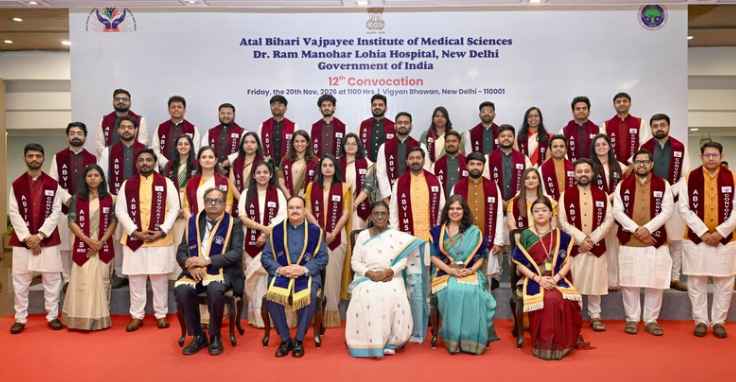

New Delhi, Nov 20: President Droupadi Murmu on Friday urged young doctors to uphold the highest standards of professional ethics and place compassion, sensitivity and service to humanity at the heart of healthcare.
Addressing the 12th convocation of the Atal Bihari Vajpayee Institute of Medical Sciences (ABVIMS) and Dr Ram Manohar Lohia (RML) Hospital here, Murmu called upon graduating doctors to extend quality healthcare to people in remote and underserved areas and contribute to medical research and innovation.
She highlighted India’s transformation in healthcare over the past decade, noting the expansion of primary and tertiary care facilities as well as medical education beyond metropolitan cities.
Murmu said approximately 1.75 lakh Ayushman Arogya Mandirs were operational across the country, expanding access to primary healthcare services.
She emphasised the importance of telemedicine in bridging geographical barriers and ensuring that quality medical consultations reach people in remote areas.
The president said India’s healthcare approach had shifted towards preventive and promotive healthcare, in line with the National Health Policy, 2017. She stressed the growing importance of early screening, detection and management of non-communicable diseases, including diabetes, mental health conditions and various forms of cancer.
She said large-scale screening initiatives across the country were essential to identifying health conditions at an early stage and ensuring timely treatment, particularly among vulnerable populations.
Referring to government initiatives to strengthen financial protection in healthcare, Murmu highlighted the role of the Ayushman Bharat Pradhan Mantri Jan Arogya Yojana (AB PM-JAY), which provides health coverage of Rs 5 lakh per family per year, helping reduce the financial burden of hospitalisation and improve access to quality healthcare for economically vulnerable families.
She also highlighted the Ayushman Vaya Vandana Yojana, which extends health coverage of Rs 5 lakh to all senior citizens aged 70 years and above, irrespective of their socio-economic status.
The president underscored the importance of integrating traditional systems of medicine with modern healthcare.
She said efforts to promote Ayurveda and Yoga alongside modern medical practices had strengthened the country’s holistic approach to health and well-being. She also highlighted the co-location of Ayush services in government healthcare institutions and the growing emphasis on collaborative research.
She referred to international cooperation through the Ministry of Ayush and the World Health Organization’s Global Centre for Traditional Medicine in advancing research and promoting evidence-based traditional healthcare practices.
Addressing the graduating medical professionals, Murmu urged them to uphold the highest standards of professional ethics, sensitivity and compassion in their careers.
She stressed that access to quality healthcare must not remain limited to urban centres and privileged sections of society, and called upon doctors to extend their services to people in remote and underserved areas.
She encouraged the graduates to contribute not only to clinical care but also to medical research, innovation and the development of solutions suited to India’s specific socio-economic, nutritional and environmental conditions.
Murmu also emphasised the transformative potential of emerging technologies, particularly artificial intelligence (AI), in improving the accessibility, affordability and efficiency of healthcare delivery.
Drawing lessons from the COVID-19 pandemic, she urged medical professionals to remain adaptable and embrace technological advancements while ensuring that healthcare remained people-centric.
Emphasising the significance of the One Health approach, the president said human health was closely interconnected with animal health, vegetation and the environment. Referring to emerging zoonotic diseases, environmental pollution and climate change, she stressed the need for coordinated efforts among medical professionals, veterinarians, environmental scientists and other stakeholders.
She called for greater interdisciplinary collaboration to strengthen disease surveillance, enable early detection and build resilience against future public health challenges.
Addressing the gathering, Union Health Minister J P Nadda described ABVIMS and Dr RML Hospital as a pioneering institution and a beacon of excellence in medical education and healthcare.
Nadda also appreciated the institution’s contributions to medical research, infrastructure development and specialised clinical services.
He said the institution provided an exceptional learning environment by combining a high volume of patient care with quality medical standards, thereby offering students valuable clinical exposure and practical experience.
He also highlighted the institution’s achievements in organ donation, organ retrieval and complex surgical procedures, along with the continuous development of its infrastructure and various departments. (PTI)