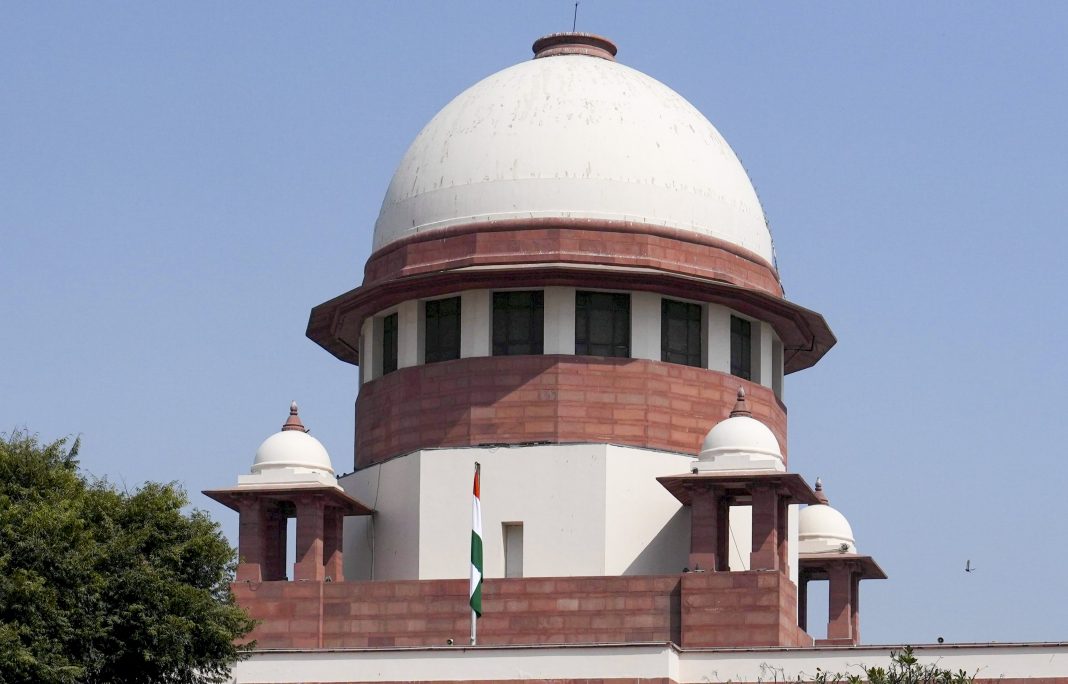

New Delhi, Aug 5: In a significant verdict, the Supreme Court has upheld the powers of the pollution control boards to impose restitutionary and compensatory damages for environmental harm, saying that prevention and remediation must be at the heart of environmental governance.
A bench comprising justices PS Narasimha and Manoj Misra held that under provisions of the Water Act and the Air Act, pollution control boards are constitutionally and statutorily empowered to levy damages for actual or potential environmental harm.
“Having considered the principles that govern Indian environmental laws, we have held that the environmental regulators, the Pollution Control Boards exercising powers under the Water and Air Acts, can impose and collect restitutionary or compensatory damages in the form of fixed sum of monies or require furnishing of bank guarantees as an ex-ante measure to prevent potential environmental damage,” Justice Narasimha wrote in the judgement delivered on Monday.
The verdict said these powers are incidental and ancillary to the empowerment under Sections 33A and 31A of the Water and Air Acts. “At the same time, we have directed that the powers must be exercised as per procedure laid down by subordinate legislation incorporating necessary principles of natural justice, transparency and certainty,” it added.
The bench, however, clarified that such damages differ from criminal penalties, as they are civil in nature and intended to restore or prevent environmental degradation rather than punish violators.
The top court set aside a 2012 Delhi High Court decision that had curtailed the powers of pollution control boards to demand environmental damages.
The verdict reinforced the “polluter pays” and precautionary principles as central tenets of environmental law.
“Environmental regulators have a compelling duty to adopt and apply preventive measures irrespective of actual environmental damage. Ex-ante action shall be taken by these regulators and for this purpose a certain measure in exercise of powers under Sections 33A and 31A of the Water and Air Acts is necessary,” it said.
The bench referred to the legal position and said, “There is a distinction between a direction for payment of restitutionary and compensatory damages as a remedial measure for environmental damage or as an ex-ante measure towards potential environmental damage on the one hand; and a punitive action of fine or imprisonment for violations under …Water Act and …Air Act on the other hand.”
It said if directions are issued as restitutionary and compensatory measures then these are not to be considered as punitive in nature.
“Punitive action can only be taken through the procedure prescribed in the statute for example under chapters VII and VI of the Water and Air Acts respectively,” it said.
It said Indian environmental law has assimilated the principle of ‘Polluter Pays’ and there is also a statutory incorporation of this principle in our laws.
The principle of ‘Polluter Pays’ can be invoked when an established threshold or prescribed requirement is exceeded or breached, and it does result in environmental damage.
It can also be used “when an established threshold or prescribed requirement is not exceeded or breached, nevertheless the act in question results in environmental damage”.
The bench said the principle can be used when a potential risk or a likely adverse impact to the environment is anticipated, irrespective of whether or not prescribed thresholds or requirements are exceeded or breached.
Setting aside the high court verdict, the bench said, “We are of the opinion that these regulators in exercise of these powers can impose and collect, as restitutionary or compensatory damages, fixed sum of monies or require furnishing bank guarantees as an ex-ante measure towards potential or actual environmental damage.”
To ensure that pollution boards impose restitutionary and compensatory environmental damages in a fair and transparent manner, necessary subordinate legislation in the form of rules and regulations must be notified, it said. (PTI)