
By Dr. Nipam Kumar Saikia
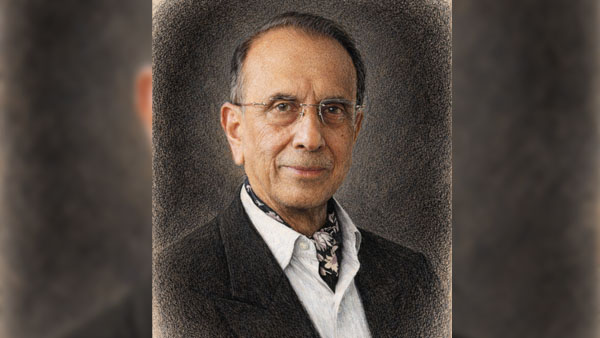
Pradip Baruah’s (1938–2026) light may have dimmed in this world on January 14th, 2026, but it will continue to shine brightly through the countless Asomiya readers and writers he created. He was an author, a genuinely impartial journalist, an exceptional editor, and a true gentleman. The founding editor and publisher of the international Assamese fortnightly magazine Prantik, he can be regarded as a towering, pioneering figure in Assamese journalism and literature. As the editor of Prantik for over four decades since its inception in 1981, Baruah transformed Prantik into an iconic, independent, and respected platform for literature, culture, and social thought, becoming a household name in Assam. His absence leaves a heartache no one can heal, but the legacy he leaves behind no one can steal. His Prantik, a fortnightly magazine in the Asomiya language, demonstrates that a publication can truly be international without being in English. It is his real Asomiagiri! It can undoubtedly be regarded as an international magazine in the Asomiya language, as it enjoys a unique and expansive readership that cuts across all social strata, from high-profile intellectuals and politicians to chowkidars and motor mechanics, across the globe. It addresses all the local issues of the North East. Many call it the encyclopaedia of the big Assam. It also delves deeper into the global issues. His range was limited to Prantik. But within that range, he was supreme. Prantik was his world. In that world, he did everything possible within his capacity. It was his obsession. He lived for it. He sacrificed everything for it. Prantik is Pradip Baruah; Pradip Baruah is Prantik.
He established Prantik not to do business. When the Asomiya literary magazine Ramdhenu stopped publication, Baruah felt the dire necessity of an Asomiya magazine to cultivate good taste, foster a scientific temperament, and preserve the dignity of the Asomiya language among its readership. He stuck to it without compromising. Even at the age of 87, he toiled for it, sitting on the editor’s chair.
An accomplished editor, he acted as a crucial partner and guide to authors, possessing a rare blend of discerning vision, empathy, and an infallible sense of the poetics of good writing, fictional or nonfictional. Meeting him in person can be an inspirational experience for an author. As a person, he demonstrated that true aristocracy is an inherent quality of character and spirit, rather than simply a matter of birth, wealth, or social status. His lack of pretentiousness or arrogance, down-to-earthness, nobility of heart, integrity, and personal conduct were so infectious!
While Dr. Bhabendra Nath Saikia, one of the great storytellers in the Assamese language, is often credited with the success of Prantik, who joined it as its founding chief editor, the efforts of Baruah were vital to the magazine’s lasting impact. None can deny the immense contribution of Dr. Bhabendra Nath Saikia to the growth and rise of the magazine. But it was the brainchild of Baruah. He was the backbone of it. It was Baruah who requested Dr. Saikia to become its founding chief editor in 1981. After the untimely demise of Dr. Bhabendra Nath Saikia, Pradip Baruah continued to uphold the high standards of Prantik.
Apart from writing editorials for Prantik, Baruah also wrote some books. The most remarkable book is his autobiography, Swagotukti, which is a must-read for Assamese readers. Published in 2010, Swagotukti, through the glimpses of his life, documents the developments in the greater Assamese society, reflecting upon the aspirations and failures of the society in the past 5-6 decades. It also throws a flood of light on the life of Radha Gobinda Baruah, the founder of The Assam Tribune groups and publications, who is considered to be one of the greatest Assamese personalities of the 20th century. Pradip Baruah was the youngest son of Radha Gobinda Baruah.
Once, I asked Baruah Sir, “Why don’t you emphasize your own writing for your magazine?” His reply echoed with raw honesty, leaving a lasting impression on me. The brilliance of his words painted a vivid picture in my mind, clarifying what it means to be an editor. He said, “An editor is like a thread of a garland. In a garland, we admire the flowers and ignore the essential thread that binds them together. There can never be a garland without flowers and the thread. Both are equally important.” The irony is that underlying elements are often overlooked in favour of the more visible or appealing aspects. He could have published his autobiography in his magazine. He didn’t.
As an editor, Pradip Baruah had a comprehensive soul who understood that a true writer writes with life, not with a pen, and to imbue text with vitality demands significant effort, a task both challenging and painstaking. Editing such a work, with the terrible neutrality, presents a unique and significant challenge for an editor. In this process, the editor has to become the invisible co-author.
As an editor, Baruah Sir possessed the discerning ability to elevate and transform a writer’s work. Most importantly, he had a passion for emerging voices, excellent judgment, strong organizational skills, and the ability to maintain a consistent publishing schedule. He used to read every word of the writings to be published in Prantik.
Acknowledge it or not, virtually every Assamese writer, from the novice to the established, aspires to see their work published in the esteemed pages of Prantik. Why is it so? The reason is simple: the readers read Prantik passionately. Even today, it is read by many. For a considerable period, it didn’t have to depend on advertisements. It depends on readers’ love. It not only shaped generations of writers but also generations of readers. It is not only a platform for literature, but also for socio-political discourse, culture, science, and progressive thought. It does not look at the writer’s fame. It looks at the quality of the writing. It is not just a magazine. It is a silent revolution. It is an institution. It’s a big family. Anyone can read it. It is deceptively simple. At its core, it’s a serious magazine. Anyone can write for it. Prantik wants two things from the writer: honesty and sincerity. It respects the writers. It ensures timely payment to all writers. It must continue its journey.
(The author is Associate Professor and Head, Department of English, Biswanath College, Assam, He can be reached at professorsaikia@gmail.com)