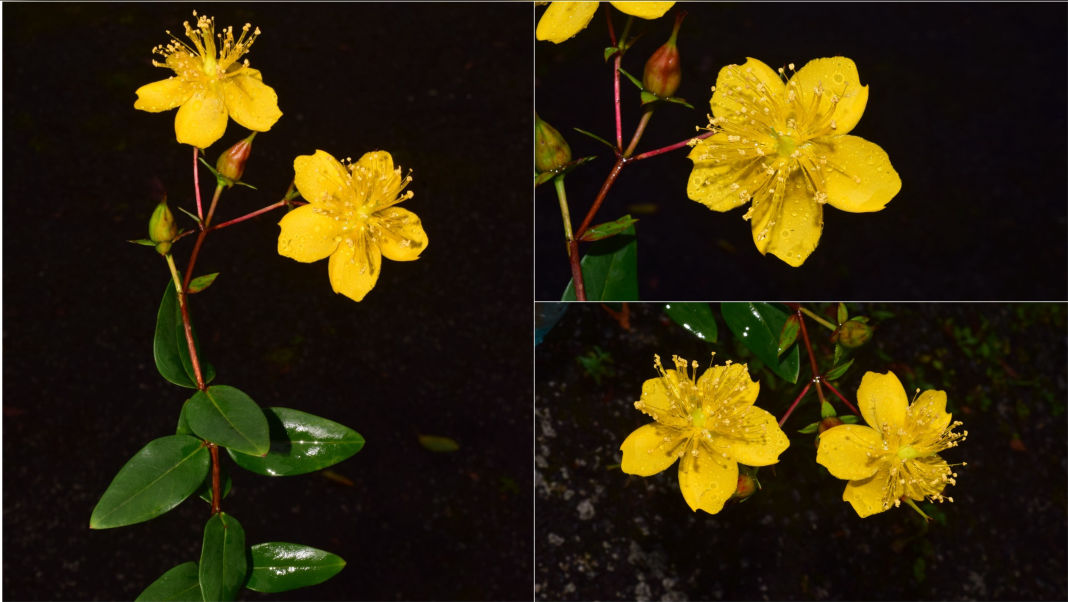

Originally described in 1959 from Kalimpong, the species had virtually disappeared from scientific records for decades before being rediscovered in Sikkim in 2021.
ROOPAK GOSWAMI
Shillong, Jan 13: Discovery of a rare flowering plant species, Hypericum benghalense, on the outskirts of Shillong has further enriched Meghalaya’s rich natural heritage. Being the first-ever recorded presence of the species in the state, the finding has further extended its known distribution in India and underscored Meghalaya’s importance as a biodiversity hotspot.
The rarely found flowering plant was discovered during a routine botanical field visit at Lumpyngngad Motinagar in the East Khasi Hills, where scientists from the Botanical Survey of India (BSI) collected unusual plant specimens growing at an elevation of over 1,600 metres. After detailed examination and verification with national herbaria and historical botanical literature, the plant was confirmed as Hypericum benghalense—a species earlier believed to be restricted to parts of Sikkim and West Bengal.
The finding has been reported by Yalatoor Mahesh, Harekrushna Swain, Ramalingam Kottaimuthu, and Nripemo Odyuo, all scientists from the Botanical Survey of India (BSI). Their study has been published in the Indian Forester journal.
Hypericum benghalense, commonly known as Bengal Saint John’s Wort, is a delightful plant that not only enchants landscapes but also plays a pivotal role in regional ecosystems. Thie perennial herbaceous plant belongs to the Hypericaceae family and is well-loved for its bright yellow flowers that burst forth in stunning displays during its blooming season.
The name Hypericum comes from the Greek words “hyper” meaning ‘above’ or ‘over’ and “eikon” meaning ‘image’ or ‘apparition,’ referring traditionally to the plant’s historical use as a protective herb to ward off evil spirits. The specific epithet benghalense indicates its native association with the Bengal region, highlighting its roots in South Asia.
Originally described in 1959 from Kalimpong, the species had virtually disappeared from scientific records for decades before being rediscovered in Sikkim in 2021. Its presence in Meghalaya now significantly widens its known natural range and adds a new chapter to the state’s documented flora
Botanists describe Hypericum benghalense as a shrub with bright yellow flowers that bloom between June and August, often forming clusters along forest edges and open slopes. Though not widely known outside scientific circles, members of the Hypericum genus are globally recognised for their ecological and medicinal importance.
Experts say the find highlights how urban fringes and lesser-explored pockets around Shillong continue to harbour undocumented biodiversity, even as development pressures mount. “Such discoveries remind us that Meghalaya’s landscapes still hold many botanical secrets, and sustained field research is crucial,” researchers noted in their study.
“Information on the distribution and habitats of endemic species is very important for developing important conservation measures. Therefore, the range extension of endemic species will provide a wealth of research opportunities for ecologists and conservation biologists in understanding the key drivers of endemism. Moreover, Hypericum benghalense bears beautiful flowers that are worthy of introduction into gardens which could promote its conservation” the researchers noted.
The addition of Hypericum benghalense to Meghalaya’s flora strengthens calls for greater conservation attention to the state’s high-altitude ecosystems, particularly around rapidly expanding urban areas. Scientists believe that further systematic surveys could reveal more rare or endemic species hidden in plain sight across the Khasi and Jaintia hills.
For Meghalaya, the discovery is more than a scientific footnote—it is a reaffirmation of the state’s standing as one of India’s most biologically diverse regions, where even familiar landscapes can still yield remarkable surprises.