
ROOPAK GOSWAMI
SHILLONG, Nov 16: Meghalaya’s endangered pitcher plant, known for its unusual ability to trap insects, may have a far more complex relationship with its surroundings than previously understood.
Researchers at the CSIR-Institute of Himalayan Bioresource Technology (CSIR-IHBT), Palampur, have identified a diverse community of bacteria and fungi living within different parts of Nepenthes khasiana, a carnivorous plant native to Meghalaya.
The study identified 43 distinct bacterial and 41 distinct fungal endophytes — microorganisms that live inside plant tissues without causing apparent harm — and examined how microbial communities are distributed across the plant, its insect-trapping pitchers and the surrounding soil.
The findings offer fresh insights into the microscopic partnerships associated with the plant and suggest that some microorganisms may move between the soil, roots and pitcher fluid.
The research was authored by Kiran Dhiman, Manisha Devi, Arun Kumar, Shiv Shanker Pandey and Jeremy Dkhar. The researchers are affiliated with CSIR-IHBT and the Academy of Scientific and Innovative Research (AcSIR).
The paper, published in the journal Archives of Microbiology, explores the microbial communities associated with the plant, adding to scientific understanding of the ecology of one of Meghalaya’s distinctive botanical species.
Microbes in roots, seeds and pitchers
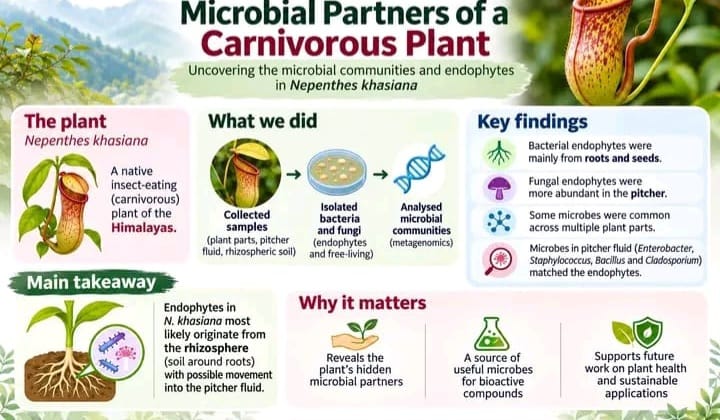
The researchers found that bacterial endophytes were mainly associated with the roots and seeds, while fungal endophytes were more abundant in the pitcher.
The study also found that some microorganisms were common across multiple parts of the plant, indicating that microbial communities may not be confined to individual tissues.
To understand these associations, the researchers collected samples from different plant parts, pitcher fluid and rhizospheric soil — the soil surrounding the roots. They isolated bacteria and fungi and analysed microbial communities using metagenomic approaches.
The analysis revealed similarities between microorganisms found in the soil and those detected within the plant, pointing towards the rhizosphere as a possible source of some of its microbial partners.
Among the microorganisms identified in the pitcher fluid were Enterobacter, Staphylococcus and Bacillus, along with the fungus Cladosporium. These were also found among the endophytes isolated from the plant.
The researchers suggest that some microorganisms may originate in the soil around the roots and subsequently move into the pitcher fluid.
However, the study does not establish the exact route through which these microorganisms enter the pitchers or whether they directly contribute to insect digestion.
Pitcher fluid may support a microbial ecosystem
The pitcher of Nepenthes khasiana is a modified leaf that functions as an insect trap. Its fluid helps capture and break down prey, allowing the plant to obtain nutrients that may be limited in its natural habitat.
The presence of diverse microbial communities in the fluid suggests that the pitcher may also serve as a habitat for microorganisms.
These microbial associations could be important in understanding how the plant interacts with its environment, including the possible role of microbes in nutrient cycling and the breakdown of organic matter.
The researchers, however, point out that the precise ecological functions of the identified microorganisms require further investigation.
The findings therefore provide a foundation for future research into the relationship between the plant and its microbial partners, rather than establishing a direct role for the microbes in the plant’s digestive process.