
By Satyabrat Borah
Nestled in the heart of Assam’s Sivasagar district, near the historic town once known as Rangpur, stands the Talatal Ghar, a monumental testament to the ingenuity and resilience of the Ahom dynasty. This sprawling palace complex, the largest surviving structure from the Ahom era, evokes a sense of awe and intrigue among visitors who wander its corridors and descend into its shadowy depths. Built primarily in the 18th century, it combines elements of royal residence, administrative hub, and military fortress, reflecting the strategic mindset of a kingdom that ruled the Brahmaputra Valley for nearly six centuries.
The Ahom dynasty’s story begins in the early 13th century when Sukaphaa, a Shan prince from present-day Myanmar and Yunnan regions, crossed the Patkai mountains with a small band of followers and established a foothold in Upper Assam. Over generations, the Ahoms expanded their territory, blending Tai-Shan traditions with local Assamese culture, and repelling numerous invasions, including seventeen attempts by the mighty Mughals. By the late 17th century, under King Rudra Singha, the Ahoms had reached the zenith of their power. Seeking to consolidate his capital and showcase his grandeur, Rudra Singha shifted the royal seat from Garhgaon to Rangpur around 1707. He commissioned the initial construction of what would become the Rangpur Palace, employing an architect named Ghanashyam from Cooch Behar to design a new capital befitting his ambitions.
Originally conceived as a military base, the structure was built using semi-permanent materials like wood and bamboo. Rudra Singha’s vision included multi-storied buildings, but his death in 1714 left the project incomplete. It fell to his successors to elevate it into something extraordinary. King Rajeswar Singha, reigning from 1751 to 1769, undertook extensive renovations and expansions around 1765, fortifying the palace with bricks and transforming it into a durable edifice. Using an indigenous cement made from sticky rice (bora chaul), duck or swan eggs, limestone, and other local ingredients, the builders created a mortar that has withstood centuries of humidity and earthquakes. This organic binding agent exemplifies the Ahoms’ resourceful engineering, allowing massive brick walls to endure where wooden elements have long decayed.
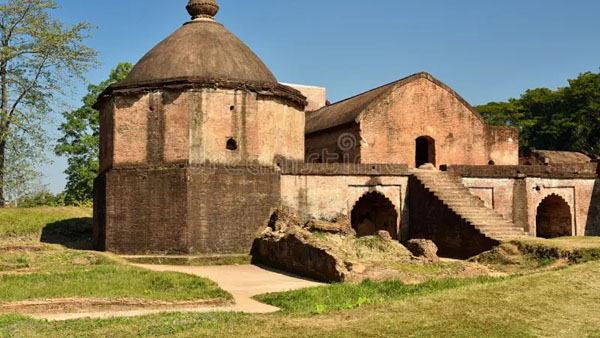
The palace derives its name from its distinctive design: “Talatal” meaning underground levels in Assamese, while the above-ground portion is called Kareng Ghar. Originally a seven-storied complex, it featured four floors above ground for royal apartments, administrative chambers, and ceremonial spaces, and three subterranean floors for defense and storage. The upper Kareng Ghar included ornate rooms, an octagonal prayer house dedicated to Lord Shiva on the northern wing, stables, and granaries. A nearby Gola Ghar, built in the traditional do-chala roof style, served as an ammunition storehouse. The entire complex was once encircled by brick fortifications and earthen ramparts filled with water, forming a moat-like defense.
What truly sets Talatal Ghar apart is its labyrinthine underground architecture, designed with military precision. The lower three floors housed guard rooms, servant quarters, warehouses, and a network of corridors intended to confuse intruders. Historical accounts describe a maze so intricate that enemies breaching the palace would become disoriented, wandering endlessly in the dim passages. This design reflected the Ahoms’ experience in guerrilla warfare and fortification, honed during conflicts like the Moamoria rebellions and Burmese incursions.
The most captivating aspect of Talatal Ghar, however, lies in its reputed secret tunnels. Legends persist of two hidden passages emerging from the underground levels: one stretching approximately three kilometers to the nearby Dikhow River for water access and escape by boat, and another extending sixteen kilometers to the old capital at Garhgaon for reinforcement or retreat. These tunnels were allegedly used during wars as emergency exits for the king, his family, and troops. Stories abound of royal evacuations through these hidden routes, allowing the Ahoms to evade capture and regroup. The underground chambers also served practical purposes, such as isolation rooms for prisoners or confinement during internal strife.
These tunnels contribute significantly to the palace’s aura of mystery. Over time, popular imagination has woven tales of untold riches hidden in sealed chambers. One enduring legend claims that a royal treasury, or Rajbharal, brimming with gold, jewels, and artifacts from the Ahom conquests, remains concealed in an upper sealed room or deep underground vault. Whispers suggest that the Ahoms, foreseeing the kingdom’s fall, buried their wealth to prevent it from falling into enemy hands. During the Moamoria rebellion in the late 18th century, which severely weakened the Ahom monarchy, and subsequent Burmese invasions in the early 19th century, such precautions would have been prudent.
The British arrival added another layer to the enigma. After the Treaty of Yandaboo in 1826, which ended the First Anglo-Burmese War and brought Assam under East India Company control, British officers explored the palace. Fearing the maze-like underground could harbor rebels or hide dangers, they reportedly sealed many entrances and filled some passages with earth. Accounts from the colonial era mention people venturing into the depths and never returning, lost in the bewildering corridors. This led to restrictions on access, preserving the mystery but also limiting exploration.
Modern investigations have sought to separate fact from folklore. Archaeological excavations in 2000-2001 uncovered buried platforms, pathways, long walls, terracotta pipes for drainage, and ceramic artifacts, confirming the site’s complexity. In 2015, a groundbreaking Ground Penetrating Radar survey conducted by IIT Kanpur in collaboration with the Archaeological Survey of India scanned Talatal Ghar and nearby sites. Surprisingly, it found no evidence of long secret tunnels, suggesting that while underground chambers and short passages exist, the extensive escape routes may be exaggerated legends or perhaps collapsed over time.
Nevertheless, the absence of confirmed tunnels has not diminished the allure. Visitors today can explore the open ground and first floors, descending into dimly lit underground corridors that branch unpredictably, evoking the disorientation described in old tales. The irregular shape of the surviving structure, with its thick brick walls and arched doorways, hints at additions and alterations over decades. Floral motifs and remnants of carvings on walls speak to a once-opulent interior, blending Ahom, Hindu, and subtle Islamic influences from interactions with Mughal frontiers.
Talatal Ghar’s historical significance extends beyond architecture. It symbolizes the Ahom kingdom’s military prowess and administrative efficiency at its peak. As the seat of the royal court and strategic headquarters, it witnessed key decisions during turbulent times. The palace complex, including nearby attractions like the Rang Ghar amphitheater for royal entertainment, illustrates a sophisticated society that invested in public works, tanks, temples, and roads. The Ahoms’ innovative use of local materials and sustainable construction techniques influenced regional building practices.
In its ruined state, with upper wooden floors destroyed by rebellions, invasions, and natural decay, Talatal Ghar stands as a poignant reminder of impermanence. Earthquakes, floods from the Brahmaputra, and neglect have taken their toll, yet the core brick structure endures. Managed by the Archaeological Survey of India, it attracts historians, architects, and tourists eager to unravel its secrets. The site’s mythic status persists in local folklore, with stories of ghostly guardians protecting hidden treasures or echoes of ancient footsteps in the tunnels.
Exploring Talatal Ghar today offers a journey through layers of time. From the elevated roof providing panoramic views of surrounding ponds and ruins, to the cool, echoing underground halls, one senses the palace’s dual nature: a symbol of glory and a fortress of shadows. The mystery of the unconfirmed tunnels and potential lost treasury invites speculation. Were they deliberately obscured to safeguard secrets? Or did erosion and time erase their traces? Such questions fuel ongoing interest, drawing researchers to propose further non-invasive surveys.
Talatal Ghar encapsulates the Ahom legacy: a blend of pragmatism, innovation, and enigma. In an era when empires rose and fell swiftly, the Ahoms maintained sovereignty for 600 years through adaptability and foresight. This palace, with its visible grandeur and hidden depths, mirrors that enduring spirit. As visitors emerge from the underground, blinking into the Assam sunlight, they carry away not just photographs but a profound appreciation for a civilization that was built not only to rule but to mystify and survive. The Talatal Ghar remains a living chronicle, its history etched in brick and legend, inviting generations to ponder its untold stories.