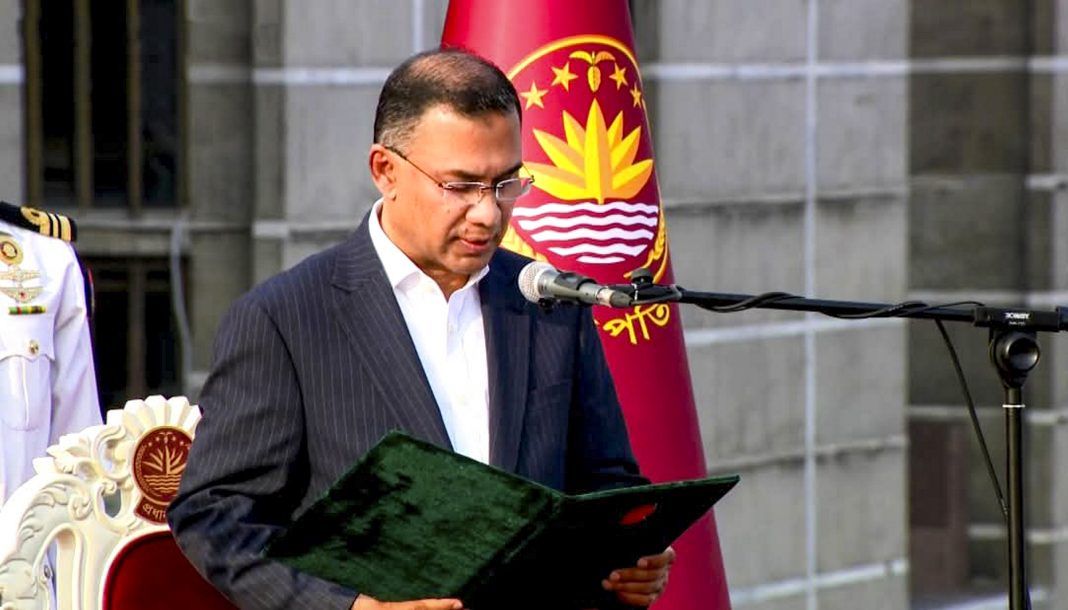

Dhaka, Feb 17: BNP leader Tarique Rahman was on Tuesday sworn in as Bangladesh’s new prime minister, marking a new beginning for the country after a nearly 18-month period of political uncertainty and lawlessness under the rule of the interim government led by Nobel Laureate Muhammad Yunus.
Lok Sabha Speaker Om Birla, accompanied by Foreign Secretary Vikram Misri, represented India at the ceremony held at the open space of the South Plaza of the Jatiya Sangsad in presence of Bangladesh’s top political and military brass.
President Mohammed Shahabuddin administered the oath of office to 60-year-old Rahman at the South Plaza instead of Bangabhaban, in a departure from a long-standing tradition.
“I will faithfully discharge the duties of the office of prime minister of the government in accordance with the law,” said Rahman, who led his party to a forceful victory in the crucial general elections.
After the swearing-in, Rahman signed the oath of office and oath of secrecy. He will serve as the prime minister for the next five years.
Rahman, the son of late President Ziaur Rahman and former prime minister Khaleda Zia, returned home in December after living in London in self-exile for 17 years.
Rahman has become the prime minister for the first time. He replaced the interim government chief Yunus, under whose tenure Dhaka’s relations with New Delhi witnessed a significant downturn. Yunus took charge in August 2024 after the collapse of the Awami League regime.
Earlier in the day, Rahman was elected as leader of the parliamentary party by the BNP lawmakers.
President Shahabuddin also administered the oath to 25 ministers and 24 state ministers at the ceremony, attended by several leaders from neighbouring countries, including India and Pakistan.
The new cabinet includes two minority community members, BNP Vice President Nitai Roy Chowdhury of the Hindu faith and Dipen Dewan, a Buddhist.
In a surprise development, the new cabinet also inducted the outgoing interim regime’s security adviser, Khalilur Rahman, as a technocrat minister, while several senior BNP leaders were left out of the new cabinet.
Cabinet division officials said the portfolios of the ministers and junior ministers would be announced later, though several mainstream media outlets named the portfolios of several of them, quoting unconfirmed sources.
The BNP bagged 209 out of 297 seats, while right-wing Jamaat-e-Islami secured 68 seats in the 13th Parliamentary elections held on February 12 after a period of tumultuous political vacuum, instability and fragile security situation. The Awami League was barred from contesting polls.
The result was a major turnaround for the BNP, long targeted under the 15-year rule of the Awami League government which collapsed following nationwide student-led protests in August 2024.
Earlier in the day, newly elected lawmakers of the 13th Jatiya Sangsad (JS) took oath as members of parliament (MPs).
The Jamaat-e-Islami, which has emerged as the main opposition, boycotted the swearing-in ceremony. Jamaat’s electoral ally student-led national Citizen Party (NCP), which was floated last year with Yunus’ blessings, followed in its footsteps.
In a post-election press conference, Rahman called for “national unity” and “peace” in the national interest, warning that divisiveness would undermine democracy. He said the country faces a fragile economy, weakened institutions, and a deteriorating law and order situation.
“Our paths and opinions may differ, but in the interest of the country, we must remain united. I firmly believe that national unity is our collective strength, while division is our weakness,” he said.
He said the new government faces two major challenges – tackling the economy and ensuring good governance. (PTI)