
By Satyabrat Borah
Kaziranga National Park and Tiger Reserve stands as one of the most remarkable wildlife sanctuaries in Asia, home to the world’s largest population of the great one horned rhinoceros. Tucked away along the lush floodplains of the Brahmaputra River in Assam, this natural wonder represents decades of dedicated conservation success. A fresh wave of intense public debate has erupted over how to protect its edges. Assam Chief Minister Himanta Biswa Sarma recently indicated that the state government intends to fix the width of the Eco-Sensitive Zone around Kaziranga to a minimum of one kilometer rather than relying on the standard ten-kilometer default buffer. This announcement triggered immediate reactions from environmentalists, local residents, legal experts, and wildlife enthusiasts who care deeply about the sanctuary’s survival.
Understanding why this proposal creates such a stir requires looking closely at how Eco-Sensitive Zones work in practice. The Union Ministry of Environment, Forest and Climate Change introduced the concept of buffer zones around protected areas to absorb human impacts. Think of an Eco-Sensitive Zone as a protective cushion around a sanctuary. It softens the transition between dense human settlements and fragile wilderness. Within these zones, polluting industries, large mining operations, and commercial activities face strict bans or tight regulations. The idea is simple: wild animals do not understand human boundaries, so their immediate surroundings must remain safe, quiet, and ecologically intact.
When no specific zone gets officially notified for a national park, guidelines and court directions state that a default ten-kilometer boundary applies automatically. Kaziranga operated under this broad expectation for years. The state government now wants to finalize a clear, customized notification. By proposing a one-kilometer minimum boundary, officials argue they are bringing clarity and relieving surrounding human communities from unnecessary restrictions. Critics fear that shrinking the buffer zone opens up pristine land right on the doorstep of the national park to commercial projects, resort expansion, and urban construction.
The official argument presented by the state government focuses heavily on regional economic growth and human livelihoods.
Towns like Bokakhat, Jakhalabandha, Kaliabor, and nearby settlements have existed for generations alongside the park. Local leaders point out that a blanket ten-kilometer restriction stops essential public infrastructure from being built. Building a municipal stadium, expanding local schools, constructing hospitals, or setting up small scale agro processing units becomes complicated when every project needs high level environmental clearances. Local residents often feel trapped in legal red tape when trying to build homes or small businesses on their ancestral property. The government maintains that narrowing the zone allows long overdue development to proceed smoothly without harming the core park area.
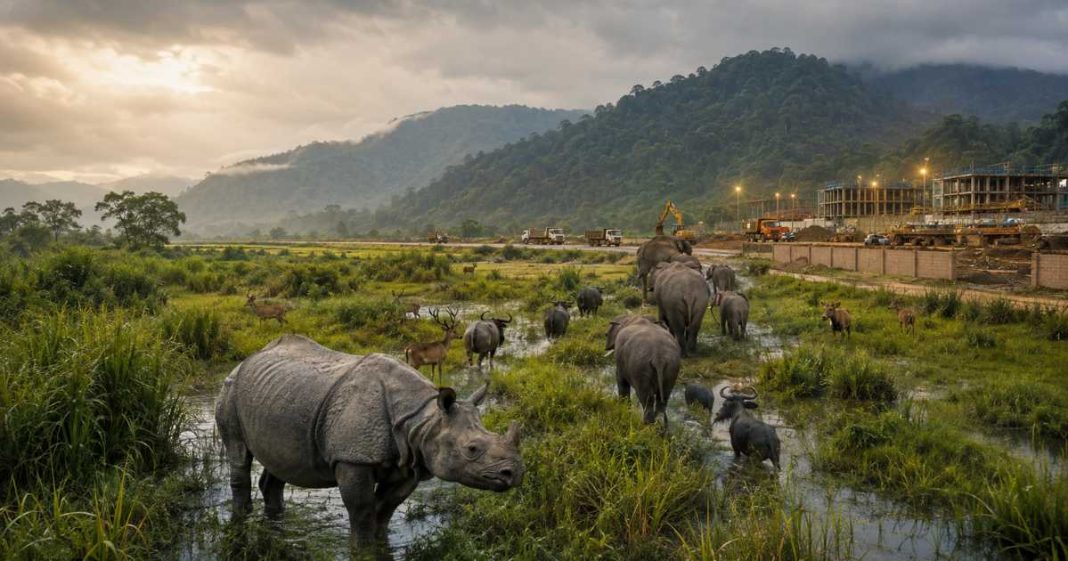
Environmental experts and conservation organizations view the situation through a completely different lens. They argue that Kaziranga cannot be evaluated as an isolated island of grass and forest. The park functions as part of a connected, living ecosystem that extends well south toward the Karbi Anglong hills. Every summer, heavy monsoon rains cause the Brahmaputra River to overflow its banks, submerging vast stretches of the low lying floodplains. When this inundation happens, thousands of animals including rhinos, wild buffaloes, deer, and elephants must leave the flooded park to seek safety on higher ground.
To reach the safety of the Karbi Anglong hills, animals must cross National Highway 715, previously known as National Highway 37. This stretch of road cuts directly through the historical animal movement paths. Over decades, wildlife experts identified specific natural passages, known as corridors, where herds routinely cross the road during floods. If the Eco-Sensitive Zone drops to just one kilometer in these critical locations, commercial developments like luxury resorts, hotels, warehouses, and brick kilns could spring up right alongside the highway.
Heavy construction, bright night lighting, high walls, and constant vehicular traffic could block these vital corridors permanently. Animals fleeing rising floodwaters would find their escape routes cut off, leading to mass drownings or increased vehicle strikes on the highway.
Unregulated commercial activity around the park poses another serious threat through habitat degradation. Over recent years, illegal stone quarrying and sand mining in the Karbi Anglong hills have already disturbed local river streams that flow directly down into Kaziranga. These streams bring fresh water and sediment to the wetlands inside the park. When mining activities muddy the water or alter stream flows, aquatic life suffers, aquatic plants die off, and the delicate balance of the grassland ecosystem degrades. Keeping a wider protective buffer zone helps contain these damaging activities before their impacts reach the heart of the sanctuary.
Tourism adds another layer of complexity to the discussion. Kaziranga attracts hundreds of thousands of visitors from around the world each year, generating significant revenue for Assam and creating jobs for jeep drivers, nature guides, hotel staff, and artisans. The urge to build more resorts, restaurants, and entertainment facilities near the park gates is powerful. Investors see immense financial potential in purchasing land as close to the wilderness as possible. Without a generous Eco-Sensitive Zone, commercial pressure can quickly overwhelm rural landscapes. Unplanned tourism development creates severe garbage management problems, causes noise pollution that stresses wild animals, and drains local groundwater supplies that nearby villages depend on.
Distrust also stems from historical land ownership patterns around the park boundaries. Many local farmers and indigenous communities have lived near Kaziranga for generations, cultivating paddy fields that double as seasonal foraging grounds for birds and herbivores. When large private investors enter the market seeking land for commercial tourism, small landowners face economic pressure to sell. Many conservationists worry that reducing the buffer zone primarily benefits large commercial developers rather than the local villagers who have quietly coexisted with wildlife for decades.
Finding the right path forward requires moving away from an all or nothing mindset. Rigidly enforcing a single fixed distance everywhere around a park rarely works well because natural landscapes are not uniform. A flexible, scientific approach called micro-zoning offers a practical middle path. Instead of applying a flat one-kilometer limit across the entire border, authorities can map out the area based on ecological sensitivity.
In critical animal corridors where elephants and rhinos cross toward the hills during monsoons, the buffer zone could remain wide, extending five or even ten kilometers to prevent any heavy construction. In areas directly adjacent to existing historical towns like Bokakhat, where wildlife movement is minimal and human settlement is already dense, the buffer zone could safely be kept narrower to allow normal civic life and public infrastructure to grow. Micro-zoning respects both natural biology and human needs, offering a balanced compromise based on hard data rather than administrative convenience.
Supreme Court rulings on environment management emphasize that while economic development is necessary, the precautionary principle must guide state policies. Protecting a World Heritage Site like Kaziranga is not just a regional responsibility, it is a global duty. The animals living inside the reserve depend entirely on human foresight to keep their ancient migration paths open.
Open dialogue between government officials, wildlife scientists, local community leaders, and environmental activists remains essential before any final notification gets sealed. Listening to the lived experiences of villagers who share their land with wild animals can yield practical solutions that legal documents often miss. Protecting Kaziranga requires ensuring that local people feel valued as true partners in conservation rather than obstacles to progress. Striking a genuine balance between human ambition and nature’s quiet demands will determine whether Kaziranga remains a thriving sanctuary for generations to come.