
By Satyabrat Borah
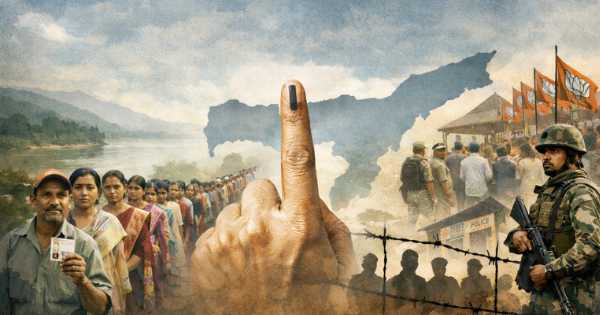
The electoral landscape of Assam recently witnessed a phenomenon that will be discussed for generations to come. As the final phase of voting concluded, the sheer volume of people who turned out to exercise their franchise was nothing short of historic. This was not just a routine administrative exercise but a powerful demonstration of the collective will of a population that understands the weight of a single vote. From the misty banks of the Brahmaputra to the rolling hills of the Barak Valley, the atmosphere was thick with anticipation and a sense of duty. People stood in long, winding queues under the scorching sun and sudden spring showers, proving that their commitment to the democratic process remains unshakable. This record-breaking turnout tells a story of a society that is deeply engaged with its political destiny and refuses to be a silent spectator in the shaping of its future.
While the high participation was a celebration of democracy, the process was not entirely without its shadows. Reports of isolated incidents of violence surfaced from various corners of the state, serving as a reminder of the high stakes involved in this political battle. In a healthy society, differences of opinion are the fuel for growth, but when these differences spill over into physical confrontation, it leaves a scar on the social fabric. These flashes of tension often arise from deep seated anxieties and the intense pressure felt by local workers to secure a victory for their respective camps. Such events invite us to reflect on the need for a more peaceful political culture where arguments are won with logic rather than force.
A particularly sensitive issue that gained traction during and after the polling days was the allegation of suspicious individuals from outside the state participating in the voting process. For the indigenous people of Assam, the question of identity and land rights is not just a political talking point but a matter of survival. The fear that the demographic balance could be altered by those without legitimate standing is a recurring theme in the history of the region. When claims emerge about non-citizens or outsiders influencing the outcome of an election, it triggers a deep sense of insecurity. It raises difficult questions for the authorities regarding the accuracy of electoral rolls and the vigilance of border security. If these allegations hold any truth, they represent a significant challenge to the integrity of the mandate and the security of the nation.
As the state moves into a period of waiting before the results are officially declared on the fourth of May, the air is filled with speculation and debate. Exit polls have already started painting a picture of what the future might look like. Most of these surveys suggest a strong performance by the Bharatiya Janata Party, pointing toward their return to power. This prediction has sparked intense discussions in every marketplace and household across the state. If these projections turn out to be accurate, it would indicate that the current administration’s focus on development and its specific social narratives have resonated with a large portion of the electorate. The various welfare schemes aimed at empowering women and providing financial assistance to the underprivileged seem to have created a loyal support base that values tangible benefits over abstract promises.
The strategy of the ruling party to highlight infrastructure growth, such as the construction of massive bridges and improved road networks, appears to have made a significant impact on the minds of the voters. For many, these visible signs of progress are a reason to maintain the status quo. On the other side, the opposition tried to build a narrative around the protection of secular values and the preservation of regional identity. They sought to tap into the concerns of those who feel that the unique cultural essence of Assam is being diluted. The clash between these two different visions for the state is what made this election so captivating. The wait for the final tally is a test of patience for the candidates and the citizens alike.
It is important to remember that exit polls are based on samples and do not always reflect the final reality. The history of elections in India is full of surprises where the actual results completely overturned the predictions made by analysts. The silent voter often holds the key to the mystery. There are many who do not voice their opinions openly but express their choice decisively inside the polling booth. This hidden layer of the electorate can shift the balance in ways that data models fail to capture. Therefore, while the exit polls provide a talking point, they are not the final word on the matter.
The significance of this election goes far outside the walls of the state assembly. It is a reflection of how the people of Assam view their place in the larger national context. The rise of regionalism was once the dominant force in the state, but the current trend shows a complex interplay between local aspirations and national ideologies. The concern over suspicious voters highlights the ongoing struggle to define who belongs and who has the right to decide the state’s path. This issue is tied to the long-standing demand for a clean and updated National Register of Citizens, a process that has seen its share of controversies and delays. The election results will likely be seen as a mandate on how the people want these sensitive issues to be handled in the coming years.
The social media platforms and local news channels are currently buzzing with experts analyzing every possible permutation and combination. Every small detail, from the voting patterns in tea garden areas to the turnout in urban centers, is being scrutinized to predict the winner. This intense focus shows how much is at stake for the different communities that call Assam home. For the youth, the primary concern remains the lack of adequate employment opportunities and the need for a modern education system that can prepare them for a globalized world. For the farmers, the recurring problem of floods and erosion continues to be a life-altering challenge that requires urgent and innovative solutions. Any government that takes charge on the fourth of May will have to address these fundamental issues with sincerity.
The period between the end of voting and the counting of votes is often a time of quiet reflection. It is a chance for the political parties to look back at their campaigns and for the citizens to think about what they expect from their leaders. The record participation is a gift to the democratic system, and it places a heavy responsibility on the shoulders of those who will eventually be elected. They must remember that they are not just representatives of a party but guardians of the hopes of millions. The trust placed in them by the voters who stood in line for hours must be honored through transparent and effective governance.
As we approach the date of the results, the excitement is palpable. The fourth of May will bring clarity to the many questions that are currently hanging in the air. Will the state continue on its current path of development as predicted by the exit polls, or will there be a shift toward a different political direction? The answer lies inside the electronic voting machines, waiting to be revealed. This election has shown that the people of Assam are vibrant, aware, and ready to take charge of their destiny. They have spoken through their votes, and now the world waits to hear what they have said.
The allegations of irregularities and the incidents of violence serve as lessons for future electoral cycles. There is a need for even greater transparency and stricter enforcement of law and order to ensure that every citizen feels safe and confident while casting their vote. The integrity of the electoral process is the foundation upon which the house of democracy stands. Any attempt to weaken this foundation through the inclusion of ineligible voters or through intimidation must be dealt with firmly. The strength of Assam lies in its diversity and its ability to come together despite differences. This election is a testament to that strength, showing that even in the face of challenges, the spirit of participation remains high.
The role of regional parties in this election is another interesting aspect to consider. While the national parties have a massive presence, the regional voices represent the specific cultural and linguistic nuances of the state. The performance of these smaller groups will indicate whether the people still see regionalism as a viable alternative or if they are moving toward a more centralized political structure. The balance between these forces will determine the internal dynamics of the state’s politics for a long time.
When the results are finally out, the celebrations and the disappointments will follow. It is the nature of the game. But the real victory will be for the people if the new government works toward creating an inclusive environment where every community feels valued. The problems of the state, such as the economic disparities and the environmental crises, do not belong to one party or one group. They are collective challenges that require a collective effort.
The energy seen during the election should be channeled into the constructive task of nation-building.
The wait for the results is also a time for the administration to prepare for the transition or the continuation of the current term. The civil servants and the police force have played a crucial role in conducting this massive exercise, and their efforts deserve recognition. Ensuring a peaceful counting process is their next big task. The eyes of the entire country are on Assam, as its political choices often signal broader trends in the northeastern region.
In the grand narrative of Indian democracy, this election in Assam adds a rich and complex chapter. It highlights the beauty of a system where a common citizen has the power to change the course of history. The record turnout is a badge of honor for the state. It shows that the people are not disillusioned and that they believe in the power of the ballot. As the countdown to the fourth of May begins, there is a sense of hope that the mandate will lead to a brighter and more prosperous future for everyone.
The discussions about exit polls and suspicious voters will eventually fade, but the impact of this collective decision will be felt for years. The people have done their part, and now the stage is set for the final act of this great democratic play. The journey from the polling booth to the counting hall is almost complete, and a new dawn for Assam is just around the corner. Every individual who participated in this process can take pride in knowing that they have contributed to the strength of their state and their country. The outcome will be a reflection of the people’s heart, their fears, and their dreams. It is this human element that makes an election more than just a tally of numbers. It is a living, breathing expression of a society’s soul.