
By Satyabrat Borah
The journey from our home planet to the moon and back represents a profound shift in how we perceive our place in the local neighborhood of the solar system. Artemis 2 is not just a collection of technical maneuvers or a display of engineering power but a clear signal that a fresh era of exploration has truly arrived. While we often think of space travel as a series of cold calculations and metallic parts moving through a vacuum, this specific trip transformed a vessel of fuel and steel into a living statement of intent. As the four people inside that capsule looked out at the lunar surface, they were not just observers of a dead rock but participants in a massive rehearsal for a life lived away from Earth. This mission told us that we are ready to go back to the moon to stay for long stretches and eventually use those lessons to reach for the red sands of Mars.
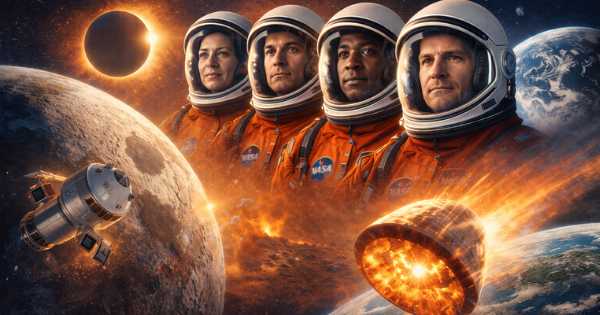
The experience of the crew as they looped around the lunar far side was filled with sights that no person had ever seen in quite that way. They witnessed a rare solar eclipse from a vantage point that felt almost impossible to imagine, seeing the interplay of light and shadow across the stars in a way that grounded observers never could. They watched the silent impact of meteors hitting the gray dust below them, a reminder of the raw and active nature of the universe. When they finally began the return trip, hitting the thick air of our atmosphere in a ball of fire before landing softly in the ocean, it felt like the closing of one door and the opening of a much larger one. This was a turning point for everyone, a moment where the things we dare to try became significantly more ambitious.
Looking at the technical side of the success, the mission showed that our tools are up to the task of deep space travel. The Orion spacecraft did exactly what it was built to do, taking humans further away from their origins than any flight since the days of the Apollo program. Every phase of the trip served to check the strength of the systems that will support the next group of explorers. The machines that keep the air breathable, the gadgets that find the right path through the dark, and the engines that push the craft forward were all put through the ultimate stress test. Sometimes there were small glitches, but the systems recovered and kept the people inside safe. The heat shield itself faced temperatures of nearly 2,800 degrees Celsius during the descent, and it held firm, proving that we can survive the violent return home from the deep.
The people involved were just as vital as the metal surrounding them. These astronauts proved that human beings can still function and thrive far away from the safety of low Earth orbit. They managed complex tasks while dealing with the mental weight of isolation and the physical dangers of space radiation. Their ability to stay focused and work together under such extreme conditions is a massive win for our species. It reminds us that we are capable of adapting to environments that are naturally hostile to our survival.
No great leap happens without a few stumbles, and this mission had its share of learning moments. There was a brief time when the voices from the craft went silent because of a communication drop during the flight back. It was fixed quickly, but it served as a vivid reminder that even a tiny error can turn into a big problem when you are thousands of miles away from help. Then there was the issue with the plumbing. When the toilet on the capsule stopped working, the crew had to roll up their sleeves and fix it themselves.
Christina Koch took on the role of a plumber in orbit, showing a practical side to space travel that often gets left out of the movies. These moments of struggle are actually some of the most useful parts of the entire project. We needed to find the weak spots now so that the people who go down to the surface later are even safer. Every little mistake becomes a piece of data that makes the next flight better.
The crew members themselves showed a remarkable lack of ego regarding their place in history. Reid Wiseman, Victor Glover, Christina Koch, and Jeremy Hansen all expressed a hope that their names might even be forgotten as later missions achieve even bigger goals. They see themselves as a bridge, a necessary step that allows the next generation to stand on their shoulders and reach further. This attitude reflects a collective spirit of progress where the goal matters more than the individual fame.
There is a powerful emotional layer to this return to the deep. For more than fifty years, we stayed close to home, but now we have finally ventured out again. The images sent back of our blue world rising over the curved edge of the moon captured the hearts of people all over the globe. It stirred a sense of what is possible when we work together. This was not just a project for one nation. It involved a wide range of international partners, including India, making it a shared human endeavor. One of the most touching moments occurred when the crew named a lunar crater after Reid Wiseman’s late wife, who had passed away from cancer. This gesture brought a very human sense of love and memory to the cold landscape of the moon. It showed that we take our stories and our hearts with us wherever we go.
The path forward is even more exciting. The next big target is the south pole of the moon, a place where we think there is ice hidden in the shadows. This ice is key because it could provide water and even fuel for future travelers. Unlike the quick visits of the past, the plan now is to build a lasting presence. We are looking at creating a gateway in orbit and habitats on the ground so that people can live there for months at a time. Private companies are also jumping into the mix, building their own landers and tools to turn the moon into a busy center for science and business.
We are seeing a new kind of global interest in the moon. Countries like China are moving fast with their own plans to put people on the lunar surface. India has set a goal to land an astronaut there by 2040. This is different from the old space race of the past century. Now, it is a mix of competing interests and shared goals, driven by a desire for new resources and a better understanding of our solar system. The moon is the perfect training ground. It is where we will learn to harvest what we need from the environment and protect ourselves from the harsh reality of life in space.
As the capsule bobbed in the waves of the Pacific at the end of the trip, it marked the conclusion of a successful journey but also the start of a much longer story. This mission was about proving that we have the courage and the skill to go back to the places we once knew and then push out into the unknown. The technical success was great, and the lessons we learned were even better. The best part of all was the simple reminder that when we decide to reach out, we can truly touch the stars. We are no longer just dreaming about the sky; we are actively building a path into it. The next age of space exploration is not a far-off hope but a reality that is happening right now.