
By Satyabrat Borah
In the quiet rhythm of the Assamese village, time flows according to the subtle changing of the seasons and the ancient customs that bind families together. Among all the months that make up the traditional calendar, one holds a place of unmatched reverence and cultural warmth. Known locally as Bhada, this month brings a distinct spiritual atmosphere that transforms the daily lives of people across the region. Commonly referred to as the month of Bhadiya, it is a period when the busy agricultural cycles slow down just enough for entire communities to turn their attention toward prayer, melody, and collective reflection.
The deep spiritual significance of Bhada is rooted in the sacred histories of the Vaishnavite tradition, which has shaped the moral and cultural identity of Assam for centuries. According to traditional beliefs, this is the auspicious month in which Lord Krishna was born, filling the earth with divine grace. Adding to this sacred heritage, the great saint reformer Srimanta Sankardeva and his most devoted disciple Madhavadeva both took birth during this very month. Their lives, teachings, and artistic legacies laid the foundation for a casteless, inclusive form of devotion that relies on the chanting of the divine name rather than complex rituals.
Because these colossal spiritual figures share their nativity with this specific time of the year, the Assamese people hold Bhada in profound respect, treating every passing day of the month as an opportunity for inner purification and community bonding.
As the heavy rains of early monsoon begin to taper into gentle showers, a unique tranquility settles over the countryside. The hardworking villagers, having completed the exhausting tasks of planting and tending to their paddy fields, find themselves with a rare stretch of relative leisure. This pause in the farming calendar creates the perfect environment for people to gather. In every household, courtyard, and village prayer hall, the air becomes thick with the scent of burning incense, fresh flowers, and wet earth. Women, young men, and elders alike prepare their hearts and minds to participate in the age old tradition of community singing known as Bhadra Mahor Naam.
The center of all this spiritual activity is the Namghar, the traditional prayer house that serves as the heart of every Assamese village. Unlike grand temples filled with intricate stone idols, the Namghar is a clean, spacious hall centered around a sacred throne holding holy scriptures. During the month of Bhada, the daily atmosphere inside these prayer halls shifts dramatically from quiet solitude to vibrant devotional energy. Early in the morning and late into the evening, the rhythmic beating of the traditional drum and the sharp, bright chime of cymbals echo across the fields, signaling to everyone that it is time to assemble.
The devotional gatherings follow a beautiful, unwritten schedule that respects the traditional roles within the community.
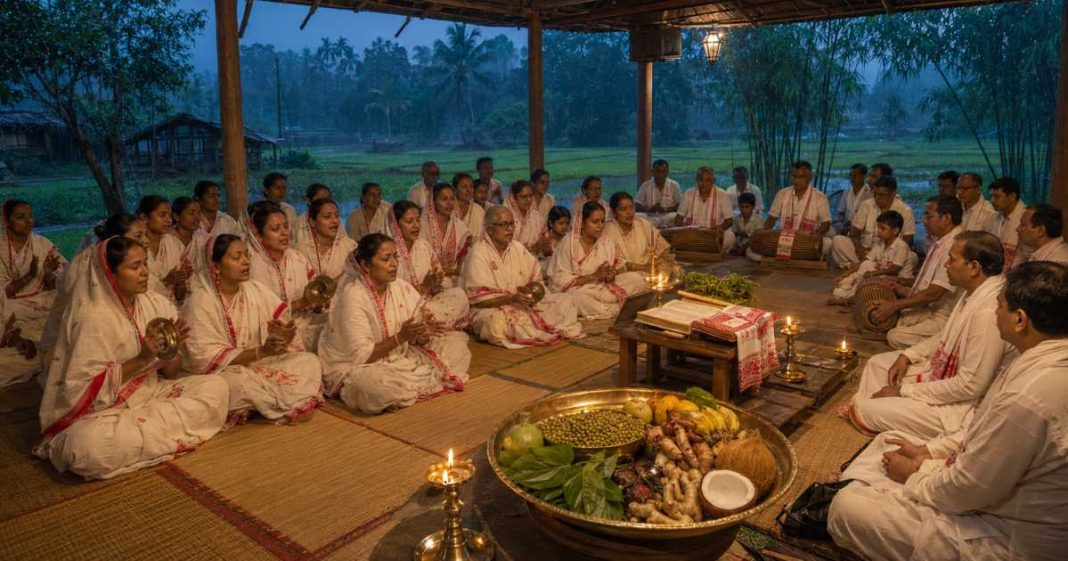
During the late afternoon hours, when the household chores are finished, women gather at the Namghar in large numbers. Dressed in clean, elegant traditional attire, the female singers sit together on woven mats, facing the sacred altar. Led by experienced lead singers who possess deep knowledge of devotional poetry, they begin to chant verses praising Lord Krishna, recounting stories of his childhood, his wisdom, and his compassion. Their voices blend in harmony, creating a soothing melody that carries across the village path as the afternoon sun begins to set.
When night falls, the atmosphere turns even more energetic as the young men and elders take their turn inside the prayer hall. Their evening sessions are marked by powerful vocal chants, synchronized clapping, and dynamic physical expressions of devotion that often continue late into the night. This division of time allows every member of the village to find their own space within the collective act of worship, ensuring that the sound of praise never truly dies down throughout the entire month.
At the center of every prayer session is the offering of the Sharai, a traditional elevated brass platter laden with natural gifts. Devotees present these platters containing soaked pulses, chopped banana, fresh ginger, coconut, and various seasonal fruits. Arranging these offerings is an art form in itself, performed with clean hands and a pure heart. While some families choose to present elaborate offerings individually to mark special family occasions or express gratitude for answered prayers, many days involve simple, collective offerings contributed by the entire village. The formal presence of a massive feast is never a strict requirement. Simple, sincere offerings of humble green grams and fresh fruits are considered more than enough to earn divine blessings, proving that the purity of devotion matters far more than material wealth.
This month of intense devotion is experienced with even greater grandeur within the historic monasteries known as Satras. These institutions, established centuries ago to preserve the artistic and philosophical traditions of the Vaishnavite movement, operate on a scale of profound discipline. Under normal circumstances, the resident monks observe a strict daily schedule of fourteen specific prayer services, known as the Chaudha Prasanga, or a condensed four service routine known as the Chari Prasanga. During the month of Bhada, the energy within these vast monastic campuses rises to an entirely new level. The monks engage in continuous recitations of the sacred scriptures, elaborate performance arts, and non stop choral singing that draws thousands of visitors from distant regions.
Two specific shrines become the focal points of massive pilgrimages during this holy month. Dhekiakhowa Bornamghar in the Jorhat district and Athkhelia Bornamghar in the Golaghat district experience an incredible influx of believers throughout the thirty days of Bhada. Thousands of men, women, and children travel long distances, standing patiently in long queues to light a small mustard oil lamp or lay a leaf of betel nut at the altar. The air in these historical places remains thick with the smoke of aromatic resins and the collective murmur of thousands of voices repeating the divine names. The shared experience of standing side by side with strangers from different walks of life creates a deep sense of oneness, reinforcing the democratic spirit that the ancient saints preached so passionately.
The intensity and expression of these devotional traditions vary interesting ways across different geographical regions of Assam. The traditions associated with the month of Bhada are observed with the highest degree of enthusiasm in the upper regions of the valley, known as Upper Assam. In these areas, the entire social life of the rural population revolves around the local Namghar throughout this specific month. Every household considers it a personal duty to participate actively in the daily evening assemblies, and the cultural life of the village reaches its annual peak during this window.
Moving down the river toward the lower regions of the state, known as Lower Assam, the cultural rhythm takes on a slightly different flavor. In historical regions like Kamrup, the intense focus on the month of Bhada is noticeably less pronounced when compared to the upper districts. Instead of concentrating their devotional singing exclusively in Bhada, the women of Lower Assam hold a parallel, deeply cherished tradition of devotional singing during the autumn month of Kati. This regional variation shows the rich diversity existing within the broader framework of Assamese culture. Different areas have evolved their own seasonal traditions, allowing people to express their spiritual devotion in ways that fit their local historical developments and agricultural rhythms.
The real beauty of this month long observance lies in its ability to bring people together in a world that often feels increasingly fragmented. The daily gatherings at the prayer hall serve as a natural space where social barriers melt away. Rich and poor, young and old sit on the very same floor, share the very same blessed food, and sing the very same ancient verses. The elders pass down the complex melodies and poetic texts to the younger generation simply by singing alongside them evening after evening. Children playing on the edges of the prayer hall absorb the rhythms, the values, and the language of their ancestors without ever opening a textbook.
Through this annual return to simple, collective devotion, the community finds a way to refresh its spirit and strengthen its internal bonds. The month of Bhada is far more than just a date on a calendar or a period of religious obligation. It is a living, breathing tradition that allows an entire society to pause, breathe together, and celebrate the enduring power of faith, music, and human connection. As the final days of the month approach, the village streets remain filled with the gentle echoes of cymbals, leaving behind a deep sense of peace that lingers long after the sacred month has drawn to a close.