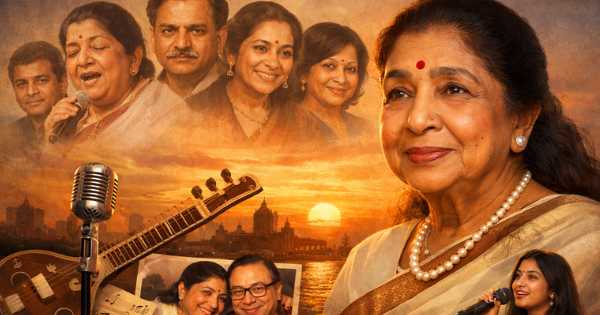

(Asha Bhosle and the Eternal Mangeshkar Dynasty)
By Dipak Kurmi
The passing of the legendary Asha Bhosle on Sunday, April 12, 2026, marks the solemn conclusion of a transformative era in the global musical landscape. Confirmed by both her family and attending physicians at Breach Candy Hospital, the iconic vocalist succumbed to multiple organ failure following a brief but intense battle with a debilitating chest infection and extreme exhaustion. The news follows a period of immense concern that began when she was admitted to the healthcare facility on Saturday, a situation brought to public attention by her granddaughter, Zanai Bhosle, who had requested prayers for her recovery. As the nation grapples with this monumental loss, her son Anand Bhosle has announced that the final rites are scheduled to be held on Monday at 4 pm at the historic Shivaji Park in Mumbai. Before the cremation, well-wishers and devotees of her art will have the opportunity to pay their final respects starting from 11 am at Casa Grande in Lower Parel, the residence that served as the sanctuary for a woman who voiced the dreams of a billion people for over eight decades.
To understand the magnitude of Asha Bhosle’s impact, one must look deep into the roots of the Mangeshkar-Bhosle lineage, a family tree that serves as the very cornerstone of India’s musical identity. This dynasty finds its origin in the life and work of Pandit Deenanath Mangeshkar, a formidable classical singer and a veteran of the Marathi theatre. Deenanath was not merely a performer but a visionary who infused his household with a rigorous devotion to the sur and laya. When he passed away prematurely, the weight of the family’s survival fell upon the slender shoulders of his young children, forcing them to transform their domestic musical training into a professional pursuit. This crucible of necessity forged the most resilient group of artists the subcontinent has ever known, as they transitioned from the classical stages of their father’s world to the burgeoning industry of Indian cinema, eventually becoming the definitive voices of a newly independent nation.
The Mangeshkar siblings represented a collective genius that effectively monopolized the aesthetic of Indian playback singing for more than half a century. While Lata Mangeshkar ascended to a position of unrivaled dominance, often described as the Nightingale of India, Asha Bhosle embarked on a more experimental path, characterized by an audacity and versatility that allowed her to tackle genres ranging from the sensual to the spiritual. However, the brilliance of the family extended beyond these two titans; Meena Khadikar contributed significantly as both a singer and a composer, while Usha Mangeshkar became a household name through her mastery of devotional songs and regional film music. The youngest sibling, Hridaynath Mangeshkar, chose a path of complex composition, blending the intricacies of Indian classical music with the demands of film scores, thereby ensuring that every member of the Deenanath lineage left an indelible mark on the country’s cultural psyche.
Asha Bhosle’s personal narrative was as complex and dramatic as the melodies she rendered, adding a layer of profound human experience to her professional brilliance. Her initial foray into domestic life began with her marriage to Ganpatrao Bhosle, a union that produced three children: Hemant, Anand, and Varsha. Following the dissolution of this marriage, Asha faced the Herculean task of raising her children as a single mother while simultaneously navigating the cutthroat environment of the Mumbai music industry. This period of her life was defined by an iron will, as she balanced the domestic responsibilities of motherhood with the exhausting demands of recording studios. It was this grit that allowed her to eventually find both creative and personal solace in her later marriage to the avant-garde composer R. D. Burman. Their partnership was a celestial alignment of talent, resulting in a series of iconic tracks that revolutionized Bollywood music by introducing elements of jazz, rock, and Latin rhythms to the traditional Indian ear.
The later chapters of Asha’s life were unfortunately punctuated by deep personal tragedies that tested the limits of her legendary resilience. She endured the agonizing loss of two of her children, Varsha Bhosle and Hemant Bhosle, events that cast a long shadow over her twilight years. Yet, even in the face of such immense grief, the artistic spirit of the Mangeshkar-Bhosle family refused to dim. In recent years, the spotlight has begun to shine on the next generation, specifically her granddaughter Zanai Bhosle, who has stepped into the public eye as a symbol of the continuation of this rich heritage. Zanai’s presence serves as a living testament to the fact that while individuals may pass, the Mangeshkar-Bhosle lineage is an enduring river of talent that will continue to nourish the Indian arts for generations to come. This transition from the era of the siblings to the emergence of the grandchildren marks a cycle of renewal that ensures the family’s name remains synonymous with musical excellence.
The story of Asha Bhosle is far more than a chronicle of hit songs or prestigious awards; it is a saga of survival, adaptation, and the relentless pursuit of perfection. From her early days recording in the 1940s to her final performances in the 2020s, she remained relevant by constantly reinventing her vocal texture and style to suit the changing tastes of the audience. She was the voice of the golden age of cinema, the pop revolution of the 1990s, and the digital streaming era of the modern day. Her ability to sing in over twenty languages and her record-breaking output of over twelve thousand songs cemented her place in the Guinness World Records, but it was the emotional depth of her performances that earned her a permanent home in the hearts of millions. As the flames rise at Shivaji Park on Monday afternoon, they will signal the end of a physical presence, but the echoes of her voice will continue to vibrate through every corner of the world where Indian music is cherished.
Asha Bhosle stands as a vital link between the traditional classical past and the modern cinematic future of India. Her life encompassed the entirety of the nation’s post-colonial journey, reflecting its struggles, its joys, and its sophisticated evolution. As tributes flow in from world leaders, fellow musicians, and the common man alike, the consensus is clear: India has lost a part of its soul. The Mangeshkar-Bhosle family tree, rooted in the passion of Deenanath and branched out through the genius of his children, remains the most significant dynasty in the history of Indian entertainment. While the passing of its most versatile member is a cause for profound mourning, the legacy she leaves behind is one of triumph over adversity and the eternal power of the human voice. Asha Bhosle has finished her earthly concert, but the melody she composed throughout her ninety-two years will remain an immortal soundtrack for the ages.
(the writer can be reached at dipakkurmiglpltd@gmail.com)