
By Dipak Kurmi
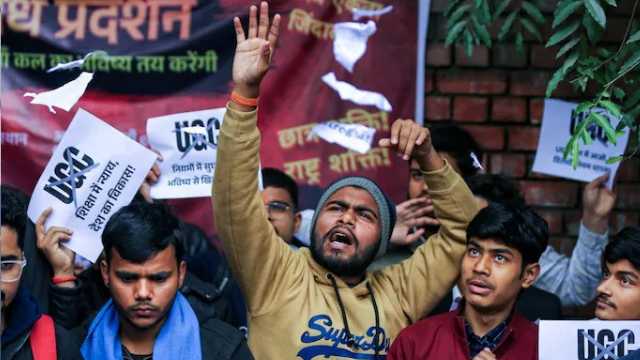
The controversy surrounding the UGC guidelines may, for the moment, have been placed in abeyance following the Supreme Court’s sharp reprimand, but to assume that the crisis has been resolved would be dangerously naïve. The reality is that the issue has merely been postponed and is bound to erupt again in one form or another. The political dilemma is stark and almost insoluble under the present conditions. If the guidelines are diluted, students and groups from non-general categories are likely to erupt, alleging dilution of safeguards against discrimination. If the guidelines are left intact or cosmetically altered, students from the general category will once again feel targeted and mobilise in protest. The substantive legal and constitutional problems embedded in the guidelines have already been examined in detail in opinion columns and need not be repeated here. What deserves far greater scrutiny is how the government walked headlong into this predictable mess, what deeper structural failures it reveals, and how such self-inflicted crises can be avoided in the future. At its core, the problem is not regulatory overreach alone, but a chronic deficit of human capacity within the ruling establishment, particularly in the humanities and social sciences.
Historically, it has been the humanities that have framed, guided, and often constrained the sciences, not the other way around. Ideas precede institutions, narratives shape policy, and ideology often determines the limits of reform. Yet, successive governments, including the present one, have treated the humanities either as an ideological battleground to be rhetorically conquered or as an ornamental add-on to a techno-administrative vision of governance. The current government’s attempt to build intellectual depth has been largely confined to the promotion of Indian Knowledge Systems. While this initiative has undoubtedly produced some valuable scholarship and rediscoveries, a generous assessment would suggest that only a small fraction has added genuine academic value. The remainder has often degenerated into opportunistic appropriation, where individuals adept at gaming the system secure funding, legitimacy, and platforms without contributing intellectual rigour. This pattern is not unique to IKS but is visible across fashionable domains such as quantum technologies, startups, and artificial intelligence, where superficial compliance and buzzword inflation frequently substitute for substance, leaving financial institutions and the public exchequer to absorb the losses.
That the Prime Minister himself is aware of this malaise is evident from his recent admonition to domestic AI developers to stop building toys and focus instead on serious, globally relevant work. This remark was not merely about technology but about a deeper cultural problem of mistaking form for content. The roots of this dysfunction lie in the uneasy and unresolved relationship that large sections of the Sangh parivar have historically had with Western epistemology and methodology. The rejection of Western intellectual traditions has often been instinctive and rhetorical rather than analytical, carried out without the parallel development of a comprehensive alternative epistemology or even a coherent methodological framework. As a result, vast domains of the humanities are dismissed as Western constructs rather than engaged with as academic disciplines that shape how modern states, economies, and societies function.
This rejection creates a profound paradox. While railing against Western and left-dominated academic ecosystems, the BJP simultaneously seeks and craves validation from the very same intellectual and institutional frameworks it claims to reject. This contradiction plays out repeatedly in public life. Why should the attendance of a handful of Europeans at the Mahakumbh be projected as more newsworthy than the participation of millions of Indians? Why were not only media houses but official government handles eager to amplify Euro-American presence and confer upon it an implicit certificate of civilisational legitimacy? Similarly, why does a statement by Ursula von der Leyen acknowledging the historical contribution of Indian mathematicians to Europe’s Enlightenment receive breathless official amplification, as though India’s intellectual worth requires external endorsement? The same government that dismisses assessments of India’s democracy by Bloomberg, Harvard, or the V-Dem Institute as biased and illegitimate has no hesitation in citing figures from Stanford to validate India’s artificial intelligence credentials at Davos.
This behaviour reflects not confidence but an acute and deeply embedded inferiority complex, coupled with a desperate hunger for approval from Western and left-leaning elites. Ironically, it is this very elite, caricatured as first-class-flying, champagne-drinking, cigar-smoking moral arbiters, that the BJP publicly disdains while privately courting. The result is ideological incoherence, where policy and regulation are shaped not by clarity of purpose but by the anxiety of acceptance. Nowhere is this more damaging than in education, which is fundamentally an ideas-driven domain. Despite the Sangh possessing a relatively well-articulated ideological worldview, there has been a conspicuous failure to translate that worldview into sustained intellectual training for the party’s rank and file or even for its policy elites.
This lack of ideological training explains why the BJP has, at times, associated with and promoted individuals who openly advocate caste segregation and other rank casteist positions, despite such views being fundamentally incompatible with Hindutva’s civilisational self-conception. These associations not only validate the left’s most persistent and arguably false tropes about Hindutva but also corrode the party’s own moral and intellectual foundations. While it may be unrealistic to expect every party worker to achieve high levels of philosophical clarity, there is no justification for the absence of a systematic train-the-trainer model. A focused programme that annually identifies, trains, and validates a small cohort of individuals capable of engaging with left-Western institutions on their own epistemological terms could have dramatically altered the intellectual balance. The American right has pursued precisely this strategy with considerable success, creating scholars and institutions that contest dominant narratives from within the same academic frameworks.
In the Indian context, Dr Vikram Sampath stands out as a rare example of someone who has managed to argue on equal footing within established academic systems, backed by comparable credentials, while also investing in institutions and scholarships to build long-term capacity. The absence of dozens more like him is not accidental but symptomatic of institutional neglect. It is against this backdrop that the UGC guideline debacle must be understood. The panels tasked with drafting these regulations were populated either by individuals aligned with left-liberal frameworks, by technocrats with little understanding of the humanities, or by figures so politically insulated that they were oblivious to the social and constitutional consequences of their work. The outcome was predictable: guidelines that resurrected notions such as presumption of guilt and other draconian elements that the Supreme Court itself had previously read down in the context of the SC and ST Act.
While no serious observer accuses the Education Minister, Dharmendra Pradhan, of a crime of commission, the charge of grave errors of omission is difficult to evade. Did he know how the guideline panel was constituted? If he did, the failure is one of judgment; if he did not, it is one of oversight. A minister is not expected to micro-manage expert committees, but that presumes confidence in their competence and balance. This, in turn, raises uncomfortable questions about the minister’s own experience and preparedness to oversee a sector as complex and politically sensitive as national education. By appointing a figure who is electorally and politically marginal to such a critical portfolio, the party has sent an implicit signal that education is not a priority. This is a striking contradiction in a society where parents consistently rank their children’s education as their highest aspiration and where party ideologues have long lamented the corrosion of the education system by ideological indoctrination.
The spectacular failure of consultation and communication during the crisis merely compounded these underlying weaknesses. Ultimately, however, the root cause remains the same: an embarrassing lack of human capacity within the cabinet, the party, and its extended ecosystem, especially in the humanities and social sciences. Until this deficit is acknowledged and addressed through sustained intellectual investment rather than rhetorical posturing, crises like the UGC mess will continue to recur. They are not aberrations but symptoms of a deeper poverty of ideas, one that no amount of political messaging can permanently conceal.
(the writer can be reached at dipakkurmiglpltd@gmail.com)