
By Satyabrat Borah
In American politics, tariffs have always been more than dry instruments of economic policy. They carry emotional weight, tapping into ideas of national strength, fairness and protection. Few leaders understood this better than Donald Trump. For him, tariffs were not just tools to balance trade or revive manufacturing, but symbols of presidential will. They were proof that a
single leader, armed with resolve and authority, could bend global commerce to America’s advantage. It is against this backdrop that the recent posture of the U.S. Supreme Court toward presidential power takes on deep significance. By carefully circumscribing the reach of the presidency, including in areas closely linked to trade and executive authority, the Court has done more than check one man. It has reaffirmed a constitutional balance that protects American democracy from the temptations of overreach.
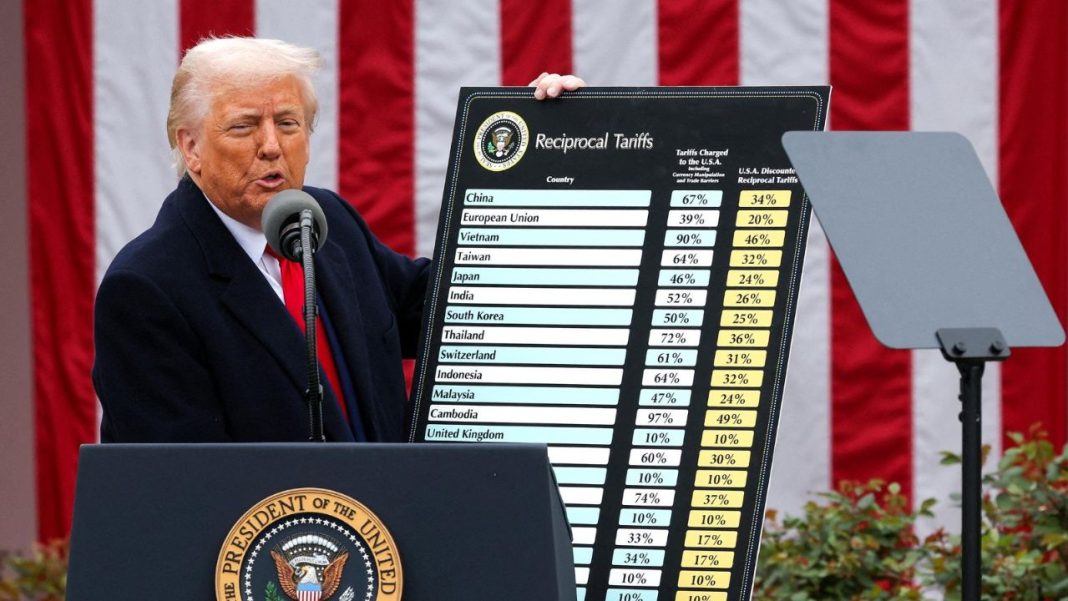
Donald Trump’s approach to tariffs was rooted in a personal style of governance that blurred the line between executive discretion and executive dominance. He believed, and often said openly, that past presidents had been too timid, too bound by rules and institutions. In his view, the presidency was meant to be a powerful office, capable of decisive action without being slowed down by Congress, courts or international bodies. Trade policy became a prime arena for this philosophy. By invoking rarely used statutory provisions and national security justifications, Trump imposed sweeping tariffs on allies and adversaries alike. Steel, aluminium, Chinese goods, European products, all became targets in what he framed as a long overdue correction.
To many of his supporters, this was refreshing. After decades of factory closures and stagnant wages, tariffs felt like action. They felt like someone was finally fighting back. But beneath the political theatre lay a serious constitutional question. How much power should a president have to reshape the economy on his own authority. At what point does flexibility become excessive? And who decides when that line has been crossed.
The U.S. Supreme Court, often portrayed as remote and ideological, has in this context played a stabilising role. Through a series of rulings and legal signals, it has pushed back against the idea of an unchecked executive. It has not targeted Trump personally, nor has it ruled tariffs unconstitutional per se. Instead, it has reinforced principles that limit the concentration of power in the White House. In doing so, it has reminded Americans that the presidency, however powerful, remains a constitutional office, not a personal mandate.
This matters because Trump’s tariff strategy relied heavily on broad interpretations of executive authority. Laws such as the Trade Expansion Act and the International Emergency Economic Powers Act were designed to give presidents flexibility in extraordinary circumstances. They were never meant to serve as blank cheques for reshaping trade relations on a whim. By questioning expansive readings of these statutes, lower courts and the Supreme Court have signalled that emergency powers must remain tethered to genuine emergencies and subject to judicial review.
The human dimension of this legal restraint is often overlooked. Tariffs are not abstract numbers. They affect workers, farmers, consumers and small businesses. When tariffs were imposed suddenly, without legislative debate or clear long term planning, uncertainty spread quickly. Farmers worried about retaliatory measures. Manufacturers struggled with rising input costs. Consumers paid higher prices. The courts, by insisting on limits and procedures, indirectly gave voice to these diffuse but real concerns. They slowed down decisions that could reshape livelihoods overnight.
Donald Trump, of course, saw this differently. For him, judicial scrutiny was obstruction. He framed court interventions as examples of an unelected elite undermining the will of the people. This narrative resonated with a segment of the electorate that felt alienated from institutions. Yet it also revealed a deeper tension. Democracy is not just about elections. It is about restraint, process and accountability. The Supreme Court’s role is not to endorse popular policies but to ensure that power is exercised lawfully.
In circumscribing presidential powers, the Court has also protected future presidents from the temptations that Trump embodied so vividly. The precedents set during his tenure will outlast him. They send a message to any leader, regardless of party, that the tools of executive power have boundaries. This is especially important in an era of polarisation, where the stakes of political victory feel existential and the pressure to act unilaterally is intense.
There is also an international dimension to this story. Trump’s tariffs strained relationships with allies who were used to predictable, rules based American leadership. Sudden tariff hikes justified on national security grounds left partners confused and resentful. By reasserting limits on presidential authority, the Supreme Court has helped restore some measure of credibility to U.S. institutions. It reassures the world that American policy is not solely dependent on the impulses of one individual, but anchored in a system of checks and balances.
Critics argue that judicial restraint on tariffs ties the hands of the president in a competitive global environment. They point to China’s state driven trade practices and argue that speed and decisiveness are essential. This argument has merit, but it also overlooks the long term costs of executive overreach. When one president stretches his authority, he sets a precedent that the next can exploit for entirely different ends. What seems useful today can become dangerous tomorrow.
The Supreme Court’s approach has been notably cautious. It has not sought to micromanage trade policy. Instead, it has focused on constitutional structure. Who has the authority to make major economic decisions. How clear must Congress be when it delegates power. What standards guide executive discretion. These questions may sound technical, but they strike at the heart of democratic governance. By insisting on clarity and accountability, the Court has strengthened the role of Congress, the branch closest to the people.
This rebalancing is particularly significant given Congress’s own reluctance to assert itself. Over the years, lawmakers have often preferred to delegate difficult decisions to the executive, avoiding political risk. Trump exploited this tendency, pushing delegated powers to their limits. The Court’s interventions serve as a corrective, nudging Congress to reclaim its constitutional role. In the long run, this could lead to more robust and transparent trade policy debates.
There is also a cultural aspect to the Court’s stance. Trump’s presidency normalised a style of leadership that prized dominance over deliberation. He mocked constraints as weakness and equated compromise with defeat. By contrast, the judicial process is slow, reasoned and often
frustratingly incremental. In reaffirming limits, the Supreme Court has defended a different vision of leadership, one that values restraint as strength.
For ordinary Americans, this may seem distant from daily concerns. Yet the connection is real. When power is concentrated, mistakes are amplified. When decisions are rushed, the vulnerable pay the price. The Court’s role in tempering executive action helps ensure that policy shifts are debated, justified and reversible. It keeps open the space for dissent and correction.
The phrase “tariffs in trouble” captures more than a policy challenge. It reflects a broader reckoning with how America governs itself in an age of strong personalities and sharp divisions. Trump’s use of tariffs exposed weaknesses in the system, particularly the ease with which old laws could be repurposed for sweeping action. The Supreme Court’s response has been to reinforce guardrails rather than rewrite the road.
Some will see this as judicial activism. Others will see it as common sense. What is clear is that the Court has acted with an awareness of history. The framers of the Constitution feared concentrated power. They designed a system that assumes human fallibility. Trump’s presidency, with its emphasis on personal authority, tested that system. The fact that it held, imperfectly but meaningfully, is a testament to institutional resilience.
As America moves beyond the Trump era, the lessons of this period remain relevant. Tariffs will continue to be debated. Executive power will continue to expand and contract in response to crises. The temptation to bypass slow moving institutions will persist. In this context, the Supreme Court’s willingness to circumscribe presidential authority stands as a quiet but important achievement.
It does not resolve every tension. It does not guarantee wise policy. But it preserves a framework in which wisdom remains possible. By reminding presidents that they govern within limits, not above them, the Court has upheld a principle that matters far beyond trade. It has affirmed that in a democracy, no leader, however popular or forceful, draws the final line alone.
This is not just a story about Donald Trump or tariffs. It is about the enduring struggle to balance power and restraint. The Supreme Court’s interventions signal that while politics may be turbulent, the constitutional order still has teeth. In troubled times, that quiet assurance may be one of the most valuable protections a democracy can offer.