
By Sarbananda Sonowal
Union Minister of Ports, Shipping and Waterways
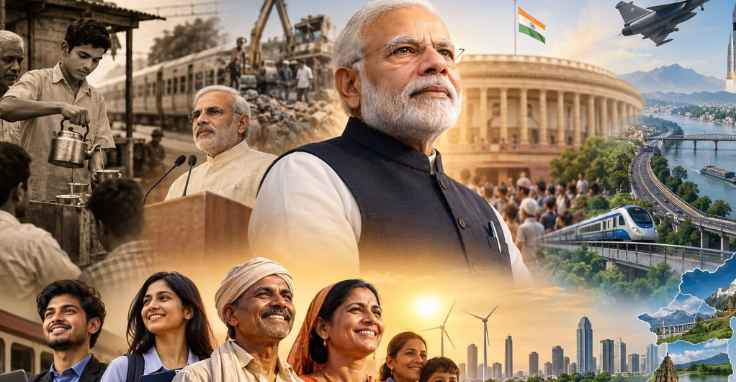
There is a small tea stall in Vadnagar, Gujarat, where Narendra Modi ji ji once helped his father serve tea to passengers waiting for trains that often ran late. What deserves more attention than the stall itself is what came after it — nearly two and a half decades of quiet, unglamorous hard work within the organisational discipline of public life, long before most of the country had heard his name.
On October 7, 2001, Modi ji took oath as Chief Minister of a Gujarat still recovering from a devastating earthquake. It was his first real administrative test. Twelve and a half years later, in May 2014, he became Prime Minister of a nation of 1.4 billion people. This September, he completes 25 continuous years at the head of an elected government — 12 as Prime Minister, and the rest as Chief Minister of Gujarat. It is unusual for a political career anywhere in the democratic world to shine through without interruption for this long, let alone survive. The people trust Modi ji.
What makes it remarkable is that it has been renewed, repeatedly, by the electoral mandates, by the people themselves. In 2014, Modi ji led our party to the first outright parliamentary majority India had seen in three decades. In 2019, that mandate grew larger still. And in 2024, voters brought him back for a third consecutive term, making him only the second Prime Minister in India’s history, after Jawaharlal Nehru, to achieve this. That trust, earned through three national elections, did not come from rhetoric — it came from the hard work that people could see and feel in their own lives.
That intensity in work has rarely slowed. Under Atmanirbhar Bharat, India’s defence production touched a record Rs 1.78 lakh crore in 2025-26 — a figure that would have looked implausible a decade ago, when the country depended far more heavily on imported defence hardware. Digital India, once a policy promise, is now simply how India functions day to day: last year, the UPI payments system processed more than 24,000 crore transactions, and broadband subscriptions crossed 100 crore. These numbers are not abstractions — they describe how differently Indians now pay for a cup of tea, receive a subsidy, or apply for a loan.
That same sense of being seen has reached a region that waited far too long for it. The Northeast, long treated with indifference and apathy by Delhi, has seen a genuine shift in attention to become an “Engine of Growth”. National highway length in the region grew from 10,905 km in 2014 to 16,207 km by last year, while the Brahmaputra is being developed, port by port, into a working transport corridor linking Pandu, Bogibeel, Biswanath Ghat and Neamati. The 100% electrification of Assam’s rail network marks a significant milestone for the region’s development journey. The sustainable peace that people yearned for long has finally dawned in the region after Modi ji’s complete focus to achieve that. The region now is “Ashtalakshmi” of Bharat — a bridge to Southeast Asia, not a frontier to be managed. The scale of new roads, railway lines and river infrastructure suggests this is more than a slogan.
Much of the government’s messaging rests on four categories it calls the Amrit pillars — Yuva, Nari, Kisan, and Garib Kalyan. It is easy to dismiss such terms, until the numbers behind it are examined. Startup India has helped create more than 2.23 lakh recognised startups by March 2026, generating over 23 lakh direct jobs. Under PM-KISAN, more than Rs 4.27 lakh crore has reached farmers directly across 22 instalments. Jan Dhan Yojana accounts now number over 59 crore, nearly 33 crore of them held by women. Individually, these are welfare statistics. Together, they describe the steady construction of a public system built around dignity rather than dependence.
The real test now lies ahead, and it concerns not politics but delivery. India has set itself two long horizons: Viksit Bharat, the goal of a fully developed nation by 2047, the hundredth year of independence; and Net Zero by 2070, a commitment that requires manufacturing, shipping, energy and construction to modernise well ahead of the deadline rather than scramble at it. Neither goal will be met by government alone. Indian industry, in particular, has to start building today for the economy it will be judged by three and four decades from now — one expected to be both prosperous and environmentally responsible.
What connects a tea stall in Vadnagar to a country now working toward 2047 is a fairly simple habit, repeated for 25 years without pause: showing up, consistently, to work that rarely pays off immediately. Whatever else divides opinion about this government, that discipline — dream beyond circumstance, work beyond expectation — remains the thread running through this journey, and it is the same thread India will need as it builds, one mandate and one milestone at a time, towards the future it has set for itself.