
By Satyabrat Borah
In a stunning and unprecedented development that has shaken the foundations of international relations, the United States military launched a large-scale operation against Venezuela on January 3, 2026, resulting in the capture of President Nicolas Maduro and his wife, Cilia Flores. President Donald Trump announced the news in the early hours of the morning via his Truth Social platform, stating that American forces had successfully executed the strike and removed the Venezuelan leader and his spouse from the country. The operation, described by Trump as a coordinated effort between the military and law enforcement, marked a dramatic escalation in longstanding tensions between Washington and Caracas, drawing immediate global condemnation, cautious support from some quarters, and profound uncertainty about the future of Venezuela.
The events unfolded in the predawn darkness over Caracas, Venezuela’s capital. Residents reported hearing multiple loud explosions, accompanied by the roar of low-flying aircraft and sudden power outages across parts of the city. Eyewitness accounts described plumes of smoke rising from key military sites, including Fuerte Tiuna, the country’s largest military complex, and La Carlota airbase. Fires burned visibly in the distance, and streets filled briefly with panicked civilians before an eerie calm settled in. The Venezuelan government quickly accused the United States of a grave act of aggression, declaring a state of emergency and calling on citizens to mobilize in defense of national sovereignty. Vice President Delcy Rodríguez, in an emotional audio message broadcast on state television, demanded immediate proof of life for Maduro and Flores, confirming that their whereabouts were unknown following the chaos.
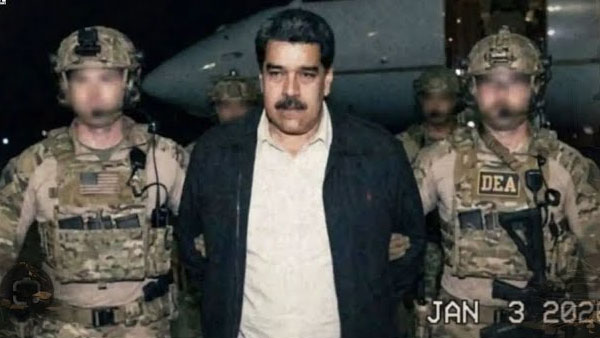
Trump’s announcement came swiftly after the strikes. In his post, he declared that the United States had carried out the operation to hold Maduro accountable for what the administration has long described as his role in running a narco-state. Hours later, at a press conference from his Mar-a-Lago residence in Florida, Trump elaborated on the mission’s success, praising the bravery of American service members and noting that no U.S. personnel were lost. He shared a photograph purportedly showing Maduro aboard the USS Iwo Jima, a U.S. amphibious assault ship, appearing restrained and under guard. Trump emphasized that the action was justified under existing indictments against Maduro, and he revealed plans for the United States to temporarily oversee Venezuela’s affairs until a safe transition to democracy could be arranged. “We’re going to run the country until such time as we can do a safe, proper, and judicious transition,” he stated, hinting at increased American involvement in Venezuela’s vast oil sector.
Details of the operation emerged gradually through official statements and media reports. Sources familiar with the mission indicated that elite U.S. special forces, including the Army’s Delta Force and possibly elements of the FBI’s Hostage Rescue Team, played central roles in the ground component. The raid targeted Maduro’s location, reportedly one of his secure residences or safe houses in or near Caracas, where forces moved with precision to apprehend him and his wife before Venezuelan defenses could fully respond. Supporting airstrikes neutralized key military assets, such as anti-aircraft systems and command facilities, ensuring the extraction team’s safety. Attorney General Pam Bondi confirmed that the couple had been indicted in the Southern District of New York on charges including narco-terrorism conspiracy, cocaine importation, and possession of machine guns and destructive devices. She described the indictment as part of a long-running case accusing Maduro of partnering with Colombian rebel groups to flood the United States with drugs, undermining national health and security. Bondi vowed that the Maduros would face the full force of American justice on U.S. soil.
This bold move did not occur in a vacuum. It capped months of escalating pressure from the Trump administration, which had built a substantial military presence in the Caribbean region. Since August 2025, the U.S. had deployed warships, including the aircraft carrier USS Gerald R. Ford, thousands of troops, and fighter jets, framing the buildup as a counter-narcotics effort under Operation Southern Spear. Strikes on suspected drug-trafficking vessels in the Caribbean and Pacific had become routine, with dozens of boats destroyed and over a hundred individuals killed, according to reports. Oil tankers linked to the Venezuelan regime were seized, and sanctions tightened, crippling the economy further. The administration had doubled the bounty on Maduro’s head to $50 million and designated elements of his government as terrorist organizations. All this stemmed from 2020 indictments accusing Maduro of narco-terrorism, compounded by U.S. rejection of his 2024 reelection as fraudulent and support for opposition leader Edmundo González as the legitimate winner.
Venezuela’s descent into the crisis provided a broader context. Once one of the wealthiest nations in Latin America due to its massive oil reserves, the country has suffered under years of economic mismanagement, corruption, and authoritarian rule. Hyperinflation ravaged the currency, leading to widespread shortages of food, medicine, and basic services. Millions fled as refugees, creating one of the largest migration crises in modern history. Nicolás Maduro assumed power in 2013 following the death of his mentor, Hugo Chávez, whose socialist revolution initially brought popularity through oil-funded social programs. But as global oil prices plummeted and governance faltered, the Bolivarian dream soured. Maduro’s regime cracked down on dissent, rigging elections, imprisoning opponents, and relying on loyal military factions to maintain control. International isolation grew, with the U.S. and many Western nations recognizing the opposition-controlled National Assembly as the legitimate authority.
The capture of a sitting head of state by foreign military forces is extraordinarily rare in modern history, evoking comparisons to the 1989 U.S. invasion of Panama, where dictator Manuel Noriega was seized on similar drug-trafficking charges and later convicted in American courts. That operation, too, occurred on January 3, adding an eerie historical parallel. Legal experts immediately debated the constitutionality and international legality of the Venezuela action. Some U.S. lawmakers, like Senator Mike Lee, initially questioned whether it amounted to an act of war without congressional approval. However, after briefing from Secretary of State Marco Rubio, Lee accepted the framing that the strikes protected personnel executing a valid arrest warrant, falling under presidential authority. Rubio reiterated that Maduro was not the legitimate president and anticipated no further military action now that he was in custody.
Global reactions poured in swiftly, revealing deep divisions. Russia, a key ally of Maduro, condemned the operation as a violation of international law and demanded clarification. Iran echoed similar sentiments, calling it an assault on sovereignty. China expressed concern over instability in the region. In Latin America, responses varied: Mexico and Brazil decried the intervention as crossing unacceptable lines, invoking UN Charter principles against the use of force. Argentina’s President Javier Milei, however, celebrated it as a blow against narco-terrorism. European nations like France and Italy voiced reservations about unilateral military actions while acknowledging concerns over drug trafficking. The United Nations faced calls for an emergency Security Council meeting, though veto powers complicated any unified response.
Within Venezuela, the immediate aftermath remained tense but surprisingly subdued. Pro-Maduro supporters gathered in pockets, waving flags and denouncing imperialism, but widespread unrest did not materialize immediately. The military’s stance proved crucial; Defense Minister Vladimir Padrino López affirmed loyalty to the constitution but avoided direct confrontation. Opposition figures, including María Corina Machado, hailed the development as an opportunity to restore democracy, calling for free elections and the recognition of González as president. Exiled Venezuelans in places like Miami erupted in celebration, seeing the end of an era that had driven them from home.
The longer-term implications are profound and unpredictable. With Maduro removed, power nominally passes to Vice President Rodríguez, but her authority is uncertain amid the power vacuum. Trump indicated U.S. intentions to stabilize the country and tap its oil resources, potentially involving American companies in reconstruction. Critics warn of prolonged occupation risks, insurgency from Chavista loyalists, or spillover effects destabilizing neighbors like Colombia. Economically, Venezuela’s oil infrastructure, long neglected, could see renewed investment, but rebuilding trust and institutions will take years. Humanitarian concerns loom large, with fears that any chaos could exacerbate the refugee crisis or lead to violence.
This event reshapes geopolitics in the Western Hemisphere. It signals a return to assertive U.S. interventionism under Trump, prioritizing national security threats like drug trafficking over traditional non-intervention norms. For proponents, it represents justice against a criminal regime that endangered American lives through narcotics. Detractors view it as neo-imperialism, setting dangerous precedents for powerful nations targeting disliked leaders. As Maduro and Flores head to trial in New York, the world watches Venezuela’s next chapter unfold, hoping for peace amid the ruins of a fallen dictatorship. The operation’s success in tactical terms is undeniable, but its strategic legacy will be debated for decades, influencing how nations balance sovereignty, justice, and power in an interconnected world.