
By Dipak Kurmi
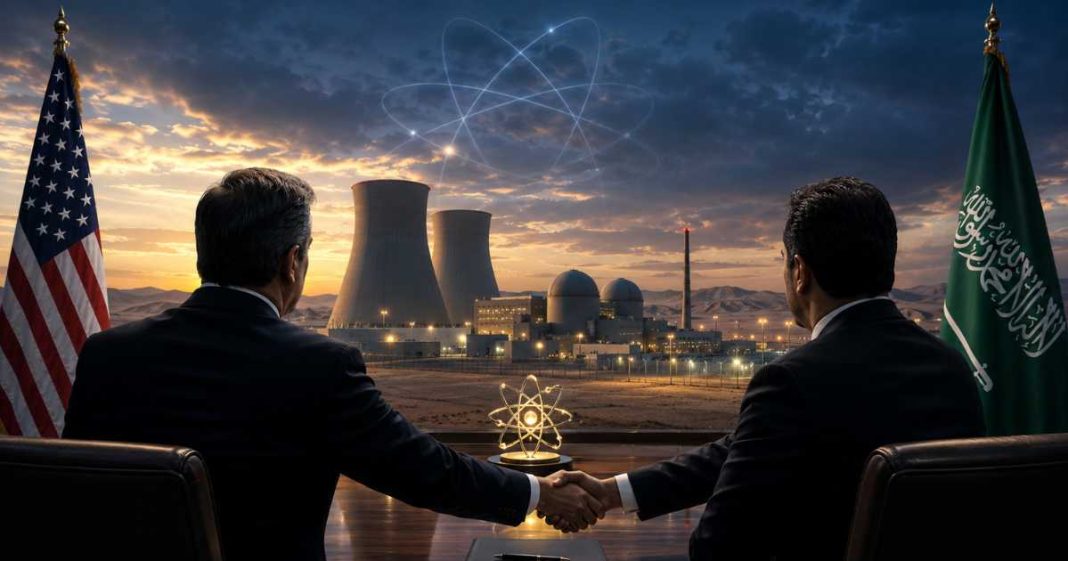
On July 22, United States Energy Secretary Chris Wright and Saudi Energy Minister Prince Abdulaziz bin Salman signed a landmark Section 123 agreement alongside an accompanying bilateral safeguards pact, formalising a thirty-year civilian nuclear framework between Washington and Riyadh. This momentum reflects the strategic understanding reached during Crown Prince Mohammed bin Salman’s high-profile November 2025 visit to the White House. Under the terms of the accord, American enterprises, spearheaded by Westinghouse, will assume the primary operational role in constructing Saudi Arabia’s civilian nuclear infrastructure. Beyond physical construction, the deal mandates a comprehensive two-year joint study to evaluate whether domestic uranium enrichment inside the Kingdom is commercially viable. Should the study endorse domestic fuel production, any resulting enrichment facility would be constructed and operated by American entities under a highly classified black box mechanism. This specialized arrangement is designed to permit uranium processing on Saudi soil while strictly withholding sensitive centrifuge technologies and preventing direct operational control by Saudi personnel. The signed agreement now enters a statutory review period, leaving the United States Congress with a ninety-day window to evaluate, debate, or potentially challenge the bilateral agreement.
For Washington, the overarching rationale driving this ambitious transaction is fundamentally anchored in economic calculation and long-term strategic influence. Securing this foundational thirty-year partnership promises tens of billions of dollars in export revenues for a resurgent American nuclear manufacturing sector, providing a substantial boost to domestic industrial supply chains and high-skilled employment. By locking the Kingdom into American reactor designs, engineering protocols, and nuclear fuel supply chains for decades, the United States preempts aggressive bids from state-backed nuclear entities in China, Russia, and France. Furthermore, this civil nuclear alliance anchors a broader strategic reset in US-Saudi relations, encompassing prospective transfers of advanced F-35 fighter jets and expanded bilateral cooperation in artificial intelligence. This reset fits into President Donald Trump’s broader geopolitical vision to consolidate American security partnerships throughout the Persian Gulf, while offering Crown Prince Mohammed bin Salman a technological backbone for Vision 2030, Riyadh’s economic initiative intended to reduce national reliance on crude oil exports and meet rising domestic power demand.
Despite its lucrative economic promises, the agreement has triggered profound alarm among non-proliferation specialists and international arms control experts who argue that Washington has compromised crucial security guardrails. The core of their concern stems from what the document intentionally omits, particularly when contrasted with the landmark 2009 gold standard agreement negotiated between the United States and the United Arab Emirates. While the UAE pact explicitly contained legally binding prohibitions against domestic uranium enrichment and spent fuel reprocessing, the Saudi accord conspicuously lacks any such formal renunciation. Furthermore, the accord refrains from requiring Saudi Arabia to adopt the International Atomic Energy Agency’s Additional Protocol, a mechanism granting international inspectors broader authority to conduct intrusive inspections at undeclared facilities. Riyadh has steadfastly declined to renounce enrichment, leading prominent analysts at the Arms Control Association and the Carnegie Endowment for International Peace to caution that this relaxed standard establishes a troubling regional precedent. They warn that neighboring states, such as Turkey, Egypt, or even the UAE seeking parity, may now cite this deal to demand similar terms in future negotiations.
The disquiet surrounding the pact is further intensified by historical statements from top Saudi leadership and recent shifts in regional security alignments. Crown Prince Mohammed bin Salman previously declared in public interviews that if Iran were ever to acquire a nuclear weapon, Saudi Arabia would immediately move to match its capability. Adding another layer of geopolitical complexity is Saudi Arabia’s mutual-defence pact signed with nuclear-armed Pakistan, a strategic arrangement widely interpreted by international observers as an informal nuclear deterrent umbrella. Critics inside the American foreign policy establishment find the administration’s compromise particularly striking given that Secretary of State Marco Rubio, during his tenure in the United States Senate, spent years insisting on exactly the guardrails and gold standard restrictions that this deal now lacks. The dramatic shift in Washington’s diplomatic posture underscores how commercial ambitions and high-stakes regional diplomacy have displaced long-standing non-proliferation tenets that once commanded broad bipartisan consensus on Capitol Hill.
The timing of the nuclear signing compounds international anxieties, taking place as United States and Israeli military strikes continued against Iranian nuclear installations to prevent Tehran from weaponising its programme. Democratic Representative Brad Sherman put the policy contradiction bluntly, stating that a government actively fighting a war over proliferation should not facilitate sensitive capabilities elsewhere for commercial gain. Senator Ed Markey voiced similar dismay, warning that granting fuel-cycle access to Saudi Arabia risks igniting a regional arms race rather than restraining one. Analysts emphasize that introducing enrichment capabilities to a region fraught with active conflict creates an environment where miscalculation could carry severe security consequences. The stark contrast between striking one state’s nuclear infrastructure while establishing potential domestic enrichment for another highlights the complex diplomatic balance currently shaping American Middle East policy.
Regionally, the Section 123 agreement represents a structural pivot, effectively uncoupling nuclear technology transfers from diplomatic normalization. For years, American foreign policy strategists held out civil nuclear cooperation as the principal reward for Saudi Arabia to officially normalize diplomatic relations with Israel under the Abraham Accords framework. Delivering this coveted civil nuclear pact to Riyadh without securing diplomatic recognition for Jerusalem has infuriated Israeli officials, who view the deal as eroding Israel’s unique regional nuclear status. Former Israeli Prime Minister Naftali Bennett cautioned that enriching nuclear material on Saudi territory could prompt a regional nuclear race, leading to a breakdown in non-proliferation architecture. With formal Saudi-Israeli normalisation drifting further out of reach, Israeli strategic planners view the unconditioned nuclear transaction as a development that grants Saudi Arabia major technological assets without requiring reciprocal diplomatic commitments.
As the ninety-day congressional review clock continues to tick, the debate over the US-Saudi Section 123 agreement will serve as a battleground for American foreign policy. Lawmakers face a complex choice: weighing the strategic and commercial value of anchoring Saudi Arabia within the American technological orbit against the risks of weakening established global non-proliferation norms. Proponents contend that rejecting the deal will not halt Riyadh’s nuclear ambitions, but will instead push the Kingdom toward non-Western competitors who operate with far fewer non-proliferation requirements. Conversely, opponents maintain that approving an agreement without the Additional Protocol or explicit enrichment bans severely undermines decades of American non-proliferation policy. Ultimately, the verdict reached by Congress over the coming weeks will do far more than authorize a commercial partnership; it will reshape Gulf regional security and test the future credibility of international non-proliferation standards for years to come.
(the writer can be reached at dipakkurmiglpltd@gmail.com)