
China’s Demographic Warning for India
By Dipak Kurmi
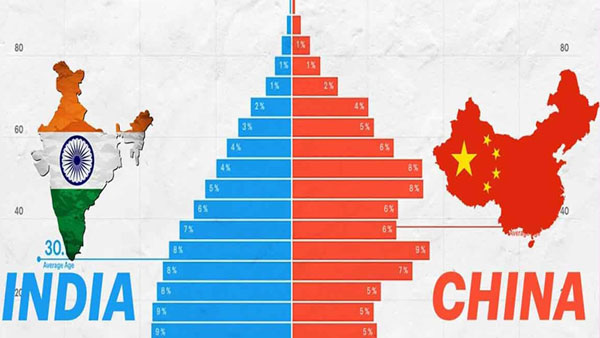
The story of China’s population today is one of striking numerical irony and profound historical consequence. Once the most populous country on earth, China has now ceded that position to India, even as its own population enters a phase of rapid decline. The country that spent decades perfecting an unprecedented experiment in population control has achieved what once seemed impossible: a sustained reduction in population growth through deliberate social engineering. Yet this success has revealed an unexpected and unsettling truth. China is no longer able to maintain the replacement fertility rate of 2.1 required to keep its population stable, and its demographic reversal is unfolding at a speed that few anticipated. In 2025, births in China fell to just 5.63 per 1,000 people, the lowest level since the founding of the People’s Republic in 1949, while deaths climbed to their highest point in more than five decades. These figures are not merely statistical curiosities; they signal a deep structural shift with long-term economic, social, and geopolitical implications.
China’s demographic predicament is rendered even more striking by the dramatic reversal in state policy. For decades, the Chinese government penalised families for having more children, enforcing the one-child policy with a mix of incentives, punishments, and social pressure that reshaped personal lives and collective norms. Today, the same state is offering cash benefits, subsidies, and other incentives to encourage childbirth, yet the response has been largely indifferent. Young Chinese couples, shaped by decades of population control messaging and confronted with harsh economic realities, are reluctant to expand their families. This lack of enthusiasm exposes the limits of state power in reversing social behaviour once it has been deeply internalised. Fertility decisions, it turns out, cannot be switched on and off like a policy lever. Once attitudes towards family size change, and once parenthood is redefined as a burden rather than a default, governments face formidable obstacles in restoring higher birth rates.
The roots of China’s fertility collapse are complex and deeply embedded in its social and economic structure. The one-child policy did far more than limit family size; it transformed life choices, family expectations, and aspirations across generations. At the same time, the cost of raising a child in China has risen to prohibitive levels. Housing prices in urban centres are exorbitant, childcare is scarce and expensive, healthcare costs continue to rise, and the education system is fiercely competitive, demanding heavy financial and emotional investment from parents. In such an environment, parenthood is increasingly viewed as emotionally exhausting and financially risky. Long working hours, job insecurity, limited social support, and the absence of affordable childcare combine to discourage family formation. The choice of a small family is no longer primarily ideological or political; it is rational, shaped by economic pressures and lived experience.
The consequences of this demographic shift are already visible and are likely to intensify in the coming decades. A shrinking workforce threatens productivity, economic growth, and China’s global competitiveness. As the population ages, consumer demand weakens, innovation slows, and the burden on social welfare systems grows heavier. Unlike wealthy countries that aged gradually after achieving high levels of affluence and robust social safety nets, China is growing old before becoming fully rich. This imbalance makes the challenge far more acute. United Nations projections suggesting that China could lose over half its population by 2100 underscore the magnitude of the crisis. Such a decline would reshape not only China’s domestic economy but also global supply chains, geopolitical power balances, and international labour markets.
For India, China’s experience serves as both a cautionary tale and a mirror reflecting its own unresolved demographic debates. India now stands as the world’s most populous nation, still grappling with high population growth rates in several regions while enjoying a relatively young population overall. The question facing Indian policymakers is whether the government should aggressively intervene to control population growth or allow demographic transition to occur organically. At first glance, fewer births appear beneficial. A smaller population could ease pressure on land, water, housing, public services, and the environment, potentially improving living standards and sustainability. Yet China’s experience reveals the long-term price of coercive demographic engineering, especially when it precedes the creation of broad-based prosperity and social security.
India’s demographic situation differs in important ways, but the underlying risks are real. The country currently enjoys what is often described as a demographic dividend, a large working-age population that could drive economic growth for decades. However, this dividend is neither automatic nor permanent. Without sufficient job creation, affordable urban housing, quality healthcare, and sustained investment in education and skills, a youthful population can quickly become a source of social stress rather than economic strength. Moreover, if India were to pursue aggressive birth control measures without addressing these structural issues, it could replicate China’s mistakes in a different form, entering a phase of premature ageing without the cushion of wealth or comprehensive welfare systems.
The central lesson from China’s demographic reversal is that population size alone does not confer power or prosperity. What matters is the quality of human capital: productive, healthy, educated, and confident citizens who can contribute meaningfully to economic and social life. China’s falling birth rate is a warning about the limits of state control over intimate personal choices and the long-term costs of ignoring social wellbeing in pursuit of narrow developmental goals. Fertility decisions are deeply influenced by economic security, gender equality, work-life balance, and social support systems. Policies that fail to address these foundations may succeed temporarily in altering numbers but will ultimately produce unintended and irreversible consequences.
As India charts its demographic future, the challenge lies in resisting simplistic solutions and learning from China’s experience without copying its excesses. Encouraging responsible family planning, investing in women’s workforce participation, expanding childcare and healthcare infrastructure, and creating secure employment opportunities can gradually and sustainably shape population trends. The choice is not between unchecked population growth and coercive control, but between short-term numerical fixes and long-term social investment. China’s demographic reckoning reminds the world that people are not merely units to be counted or controlled. They are the product of social conditions, economic realities, and personal aspirations. Ignoring this truth may deliver quick results on paper, but it carries costs that can echo across generations.
(the writer can be reached at dipakkurmiglpltd@gmail.com)