
By Satyabrat Borah
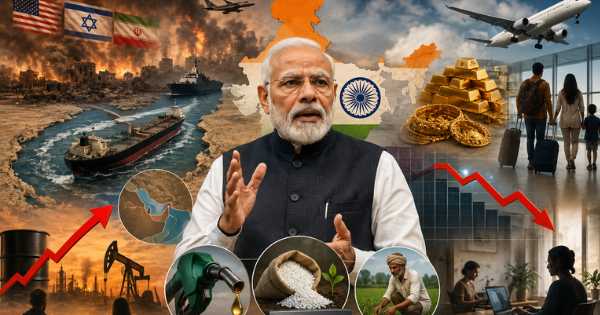
The world feels a bit like it is holding its breath right now. When Prime Minister Narendra Modi stood before a crowd in Hyderabad recently, his message was not just about local policy or standard political updates. It was a direct appeal for a change in how every Indian lives their daily life. The reason is a conflict thousands of miles away,the escalating war involving the United States, Israel and Iran. While the battle lines are drawn in the Middle East, the economic aftershocks are hitting Indian shores with a force that is hard to ignore.
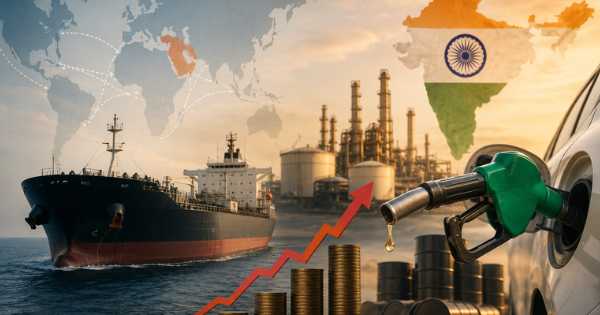
To understand why a world leader is asking citizens to skip foreign holidays and put off buying gold, we have to look at the lifeblood of the global economy: energy. India is a country on the rise, but that growth requires massive amounts of oil and gas. Since the war began in late February 2026, the price of a barrel of Brent crude has jumped from around $73 to well over $105. This is not just a number on a screen; it is a massive bill that the Indian government has to pay in US dollars.
The geography of this war makes matters even more difficult. The Strait of Hormuz is a tiny stretch of water that acts as a throat for the world’s energy supply. With Iran restricting passage and the US implementing naval blockades, the flow of oil and liquefied natural gas has become a trickle. For a country like India, which imports nearly 85 percent of its oil, this is an existential challenge. Every time someone drives a car or a factory turns on its machines, India has to dip into its savings to pay those inflated global prices.
These savings are what economists call foreign exchange reserves. Think of it as a national emergency fund kept in foreign currencies to ensure the country can always buy what it needs from the world. Before this conflict, India’s reserves were at a healthy peak of $728 billion. In just a few months, that number has slid toward $690 billion. It sounds like a lot of money, but when the cost of essentials like fuel and fertilizer is skyrocketing, those billions can vanish surprisingly fast.
This is where the Prime Minister’s specific requests come in. He is looking at the things India buys from other countries and trying to figure out what can be cut. Oil and fertilizer are non-negotiable. Without oil, the country stops moving. Without fertilizer, the farmers cannot grow the food that feeds over a billion people. Since the government cannot stop buying these essentials, it is asking the public to help reduce the demand for everything else.
Gold is a huge part of this equation. For many Indian families, gold is more than jewelry; it is a traditional form of savings and a staple of cultural celebrations. India is the second-largest importer of gold in the world. In the last year alone, the country spent $72 billion bringing gold across its borders. When you buy a gold coin or a necklace, that money eventually leaves the country in the form of foreign currency. By asking Indians to pause these purchases for a year, the government is trying to keep those dollars inside the national “wallet” to pay for oil instead.
Foreign travel follows a similar logic. When an Indian tourist goes to Europe or the Americas, they spend money on flights, hotels, and food in foreign currency. Collectively, this adds up to tens of billions of dollars every year. By encouraging people to holiday within India or postpone international trips, the goal is to prevent that wealth from draining out of the country during this period of high stress.
The suggestion to return to a work-from-home model is perhaps the most practical way to tackle the problem at its source: fuel consumption. We all remember how the streets went quiet during the pandemic. If millions of people stop commuting every day, the national demand for petrol and diesel drops significantly. This isn’t just about saving money for the individual; it is about reducing the total amount of oil India has to import from a volatile global market.
The Prime Minister’s comparison of this moment to the COVID-19 pandemic is a way of signaling that this is a collective struggle. He described “patriotism” not just as a duty for soldiers at the border, but as a daily choice made by citizens. In this view, using public transport, carpooling, or even using less cooking oil becomes a small act of national service. Cooking oil might seem like a minor detail, but India imports a vast amount of it, and the prices have risen alongside energy costs.
There is also the issue of urea and other fertilizers. The Gulf region is a primary source of the world’s fertilizer supply. With the Strait of Hormuz blocked, these supplies are trapped or redirected, making them incredibly expensive. Farmers are being asked to be as efficient as possible, potentially cutting use by half where they can, to ensure the country doesn’t go broke trying to keep the fields green.
The situation is a reminder of how interconnected our world has become. A dispute over maritime blockades and regional power in the Middle East directly affects the price of a flight from Delhi to New York or the cost of a wedding in Hyderabad. The Indian economy is strong, but no nation is immune to the kind of “energy shock” we are seeing now.
Whether people will actually stop buying gold or cancel their summer vacations remains to be seen. These are deeply personal choices tied to family traditions and hard-earned rewards. The government’s hope is that by being transparent about the “foreign exchange” math, they can convince the public that these small sacrifices are necessary to keep the broader economy stable.
Ultimately, the message is one of resilience. The world is in a period of intense uncertainty, and the global energy map is being redrawn by conflict. By asking for these lifestyle changes, the leadership is attempting to build a cushion for the country. It is a strategy of “living responsibly” today to ensure that the national reserves are there for the necessities of tomorrow. In a time of war and rising costs, the focus has shifted from expansion and luxury to conservation and stability.