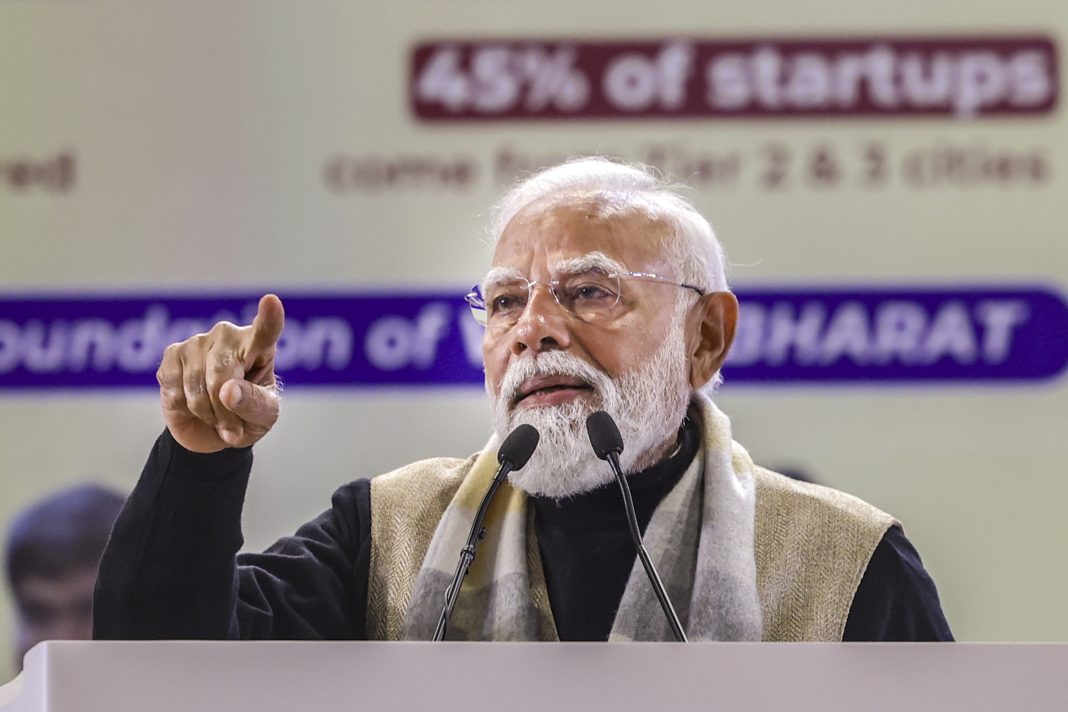

New Delhi, Jan 31: Attacking the government over the rupee hitting a record low against the US dollar, Rajya Sabha member Kapil Sibal on Saturday asked why Prime Minister Narendra Modi is “silent” on the issue and claimed that he is quiet as he knows that he used to criticise the UPA on this issue as part of “a political game”.
On the eve of the presentation of the Union Budget, Sibal said the aim of a budget is to increase pleasure and reduce the pain of the poor but he doubts whether this would happen as this has not been reflected in any of the budgets of the last 11 years.
In an interview with PTI, the former Union minister said India is the fastest growing economy in the world but the real test of an economy is whether it reduces people’s pain with per capita income being one of the indicators.
“First of all people should understand what a budget is. The budget is the allocation of resources based on the revenues that the government earns and the monies that the government has for certain programmes which should target the most underprivileged sections of the society. It is a utilitarian concept, you must give pleasure and you must reduce pain,” Sibal said.
Therefore, through budget, the government must increase the pleasure of people through programmes and facilities and reduce pain.
“If the people are poor, you must uplift them, if certain sates are getting less money, you must make sure that they get more money, that is what the budget is all about. The problem with the Indian budget is that they don’t have enough resources. The reason why they don’t have enough resources is because for the last eleven years, (this government) did nothing to create surpluses,” the Independent Rajya Sabha member claimed.
He pointed out that when Modi came to power, the rate of the rupee was 63 to a dollar and now is it 92.
What this means is that everything which is imported into India now costs more, Sibal said.
“What is imported — 84 per cent of crude oil is imported, price of that import has increased in terms of the loss of the currency from 63 to 92 … what else do we import, we import manufactured goods — they cost more, every medical equipment that is needed, then the telecom sector hardware, in agriculture — fertilizers etc. All cost more.
“We are not an export-oriented economy, we are an import-dependent economy and now everything costs more. Who pays for it — you and I..who suffers the poor because poor people need jobs and there are not enough jobs in the market,” Sibal said.
He said the government does not have surpluses to reduce the pain of the people.
“You increase the pleasure of the rich people, how do you increase their pleasures –they can buy a Lamborghini now as tariff would be low, they will buy imported cars. I If prices increase, it does not matter to them,” Sibal said.
So, the government increases the pleasure of the rich and do not reduce the pain of the poor people, he claimed.
“This budget hopefully will do that (reduce the pain of the poor) but I doubt it because it hasn’t been reflected in the last 11 years, and I don’t thin it will reflect now,” Sibal said.
The real weakness of the economy is that 80 per cent of the people in India live on less than Rs 5,000-10,000 a month, he said.
“Can we be happy with that. It is a shame. What has Modi ji done about it — nothing,” he alleged.
Sibal said before Modi came to power he talked about the falling rupee and why the currency of other countries were not falling.
“So why is Modi ji silent today? Why is he quiet? He was the one who was attacking the strength of the rupee. At that point in time, it was about 58, it became 63 before he came to power. He used to give lectures after lectures to the people of India and now suddenly when the rupee is 92, he is quiet, and rightly so as he knows that it was a political game (back then),” Sibal said.
His remarks come a day after the rupee hit its record low of 92.02 before ending 6 paise higher at 91.93 against the US dollar amid a firm American currency and geopolitical uncertainties.
Asked about India the Economic Survey projecting india to grow by 6.8-7.2 per cent in the fiscal year starting April and reaffirming the country’s status as the world’s fastest-growing major economy, Sibal said India is the fastest-growing economy, but people don’t really understand what that means.
“If I earned Rs 1,000 yesterday and Rs 2,000 today, that’s 100 per cent growth – If you have a low base in the economy and suddenly in one year you increase that it will show that you are growing fast,” he said.
Sibal asserted that the real test of an economy is whether it reduces people’s pain.
One way is to look at the per capita income, even though that is not an absolute test, he added.
“The per capita is how much an individual earns as compared to individuals in other countries. India’s per capita income is about USD 2,800 a year, lower than that of many other economies like Brazil, China and South Africa,” he said.
“That means the average person here has less money in their pocket compared to people elsewhere. So even if you are the fastest growing economy, it does not solve the problems of people because people need money in their pockets,” he said.
If medical care, education, consumer goods, and agricultural inputs such as fertilisers are all becoming more expensive, it means poor people simply don’t have the capacity to meet their daily needs, he argued and added that is a “very serious situation”. (PTI)