
By Dipak Kurmi
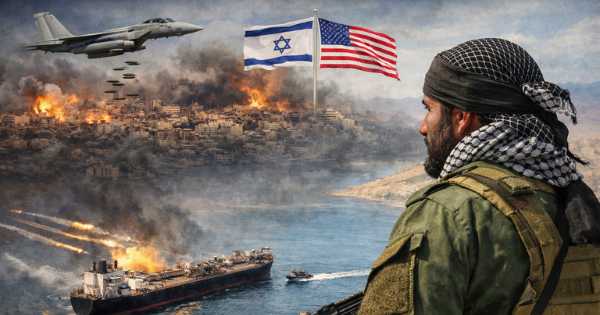
The contemporary landscape of Middle Eastern warfare has been redefined by a paradox that defies conventional military logic. On the surface, the combined might of Israel and the United States has ostensibly knocked the stuffing out of the Islamic Republic of Iran through a campaign of unparalleled aerial supremacy. Iran’s military, nuclear, and missile infrastructures, alongside vital governmental assets, have been systematically shredded by a precision bombing campaign the likes of which the world has never witnessed. American and Israeli forces effectively rule the Iranian skies, striking targets in Tehran, Isfahan, Shiraz, and the critical oil export facilities on Kharg Island with absolute impunity. Yet, despite this decimation, the Iranian state refuses to collapse. Instead, a mysterious and defiant resilience has emerged from the rubble. Iran continues to fire a daily barrage of missiles and rockets at United States assets within the Gulf Cooperation Council (GCC) countries, proving that physical destruction does not equate to strategic neutralization.
The most jarring evidence of this failure to capitulate is Iran’s stranglehold on the Strait of Hormuz. By closing this vital artery of global commerce, Tehran now controls the passage of vessels at its own whim, effectively disrupting twenty percent of the world’s oil and Liquefied Natural Gas (LNG) traffic. To maintain a psychological edge over its neighbors, the regime occasionally loosens off a missile toward residential complexes in Dubai or Bahrain, keeping the entire region in a state of perpetual anxiety. This reality has finally begun to sink in for policymakers in Jerusalem and Washington. The hardline theological regime under the Khameneis remains firmly entrenched, bolstered by a sophisticated diplomatic front. Foreign Minister Abbas Araghchi appears daily on international screens, employing a rhetorically gifted blend of controlled defiance and calculated reasonableness, while President Masoud Pezeshkian brazenly marches in annual Quds Day rallies, flanked by thousands, daring the West to do its worst.
A significant portion of this strategic failure stems from a fundamental misunderstanding of Iranian geography and demography. The architects of this deadly air campaign were beguiled by the belief that a relentless clobbering from above would force a quick capitulation. They overlooked the fact that Iran is a massive entity, half the size of India, characterized by rugged mountainous terrain and a population density roughly one-third that of the United States. While air campaigns can degrade an enemy’s visible assets, history teaches that they rarely vanquish a determined foe; ultimately, boots on the ground are required to finish the job. However, the American memory is haunted by the ghosts of 1980, when a daredevil rescue mission to free fifty-three hostages ended in a tragic collision in the desert, killing eight servicemen and sending the Jimmy Carter presidency into a terminal decline. President Trump now finds himself in a similar bind, as rising petrol prices and a lack of domestic enthusiasm—with only a forty-one percent MAGA base supporting the war—threaten to dim Republican prospects in the upcoming November midterm elections.
The Iranians, it seems, were never caught napping during the pre-war diplomatic posturing. Recognizing that they would eventually lose control of their airspace, the Islamic Revolutionary Guard Corps (IRGC) likely transitioned their most valuable assets into a sophisticated underground network. This “underground” carries a heavy connotation in the region, as Iran was the primary architect of the tunnel technology utilized by Hamas in Gaza. By creating a highly mobile system of launchers and drones hidden deep within the earth, Iran has ensured that its offensive capabilities remain operational despite the “shock and awe” of the initial bombing runs. This mobility explains why, even after three weeks of intense bombardment, they are still able to call the shots and strike GCC infrastructure. The initial assassination of the Ayatollah was a moment of profound vulnerability that nearly triggered a regime-toppling indigenous protest, but the subsequent escalation of the bombing—including the tragic hit on a girls’ school—shifted the narrative from liberation to a David versus Goliath struggle for national survival.
This shift in public sentiment has had the unintended consequence of stabilizing a tottering and previously unpopular regime. Even those Iranians who initially celebrated the death of the supreme leader have withdrawn into a silent, defensive nationalism, unable to bear the sight of their country being torn into pieces. Consequently, the IRGC has successfully pivoted to a classic model of asymmetric warfare. History is replete with examples of how such tactics can exhaust a superior power, most notably in Vietnam, where the United States utilized every tool from precision bombs to Agent Orange, only to be defeated by a barefooted resistance armed with AK-47s. Iran is now applying this lesson with modern lethality. It does not require a formal navy to block the Strait of Hormuz when motivated fighters equipped with assault rifles, rocket launchers, and sophisticated underwater drones can achieve the same result from the coastline.
The concept of a “short, sharp war” has once again eluded American strategic planners, who seem doomed to get bogged down in protracted conflicts. This pattern of entanglement was visible in Vietnam for two decades, in Iraq for eight years, and in Afghanistan for twenty. While recent targeted Special Forces strikes in Venezuela were successful due to their clear and limited objectives, the Iranian campaign has devolved into a quagmire. If the United States pulls out now, a vacuum will be created that Iran will eagerly fill, potentially terrorizing GCC states even further. Conversely, if the war is prolonged, the American economy faces the specter of stagflation and a steady stream of body bags returning home, which would be a death knell for the current administration’s political future. Iran is playing the long game, aware that while its nuclear ambitions are paused, it can use asymmetric pressure to force the GCC countries to eventually fund its reconstruction.
The geopolitical ripples of this conflict have also exposed the fragility of modern international alliances. The BRICS nations, often viewed as the successor to the Non-Aligned Movement, have proven to be little more than a platform for television debates, as every country ultimately looks out for its own interests. India, however, has navigated these treacherous waters with remarkable skill. By disregarding the domestic “white noise” of its political opposition, New Delhi has struck separate deals with Tehran to ensure its energy security through the Strait of Hormuz. This pragmatic approach has led to the unusual situation where India is hailed as a “trusted partner” by all three combatants—America, Israel, and Iran. This success is modeled after India’s own military philosophy, as seen in Operation Sindoor, where objectives were clearly defined, the enemy was punished, and the conflict was ended before it could devolve into a quagmire.
Despite India’s diplomatic maneuvering, the regional outlook remains bleak. As investors grow increasingly wary of the stability of the GCC countries, their economies risk a significant downturn. This could lead to the mass layoff of Indian migrant workers, causing a sharp decline in the remittances that are vital to the Indian economy. We are currently witnessing a lose-lose scenario where the “sweet, resonating bell of victory” is nowhere to be heard. Instead, the world is left with the low moan of the foghorn of loss, as a decimated but defiant Iran continues to disrupt the global order. The lesson of 2026 is a bitter one: precision technology and overwhelming air power are insufficient against a regime that has mastered the art of the underground and the will of a population that, when pushed to the brink of national disintegration, chooses the devil it knows over a foreign-imposed collapse.
(the writer can be reached at dipakkurmiglpltd@gmail.com)