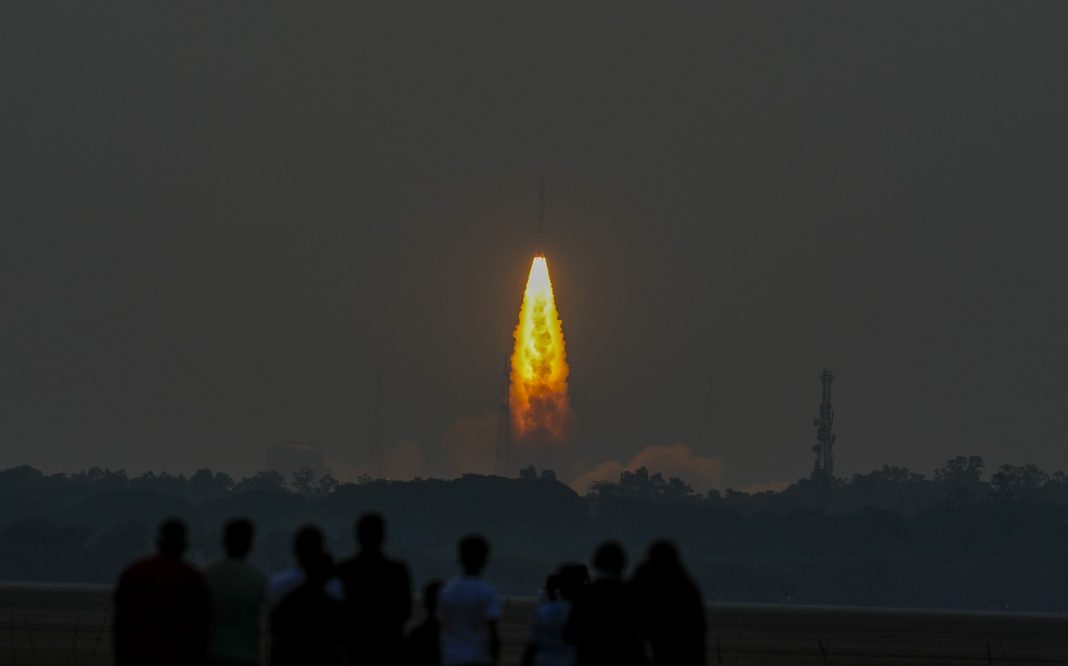


Sriharikota (Andhra Pradesh), May 18: ISRO’s 101st mission from here, an earth observation satellite onboard the agency’s trusted PSLV rocket, could not be accomplished on Sunday following a pressure issue in the third stage of the launch vehicle, the space agency said.

Although the Polar Satellite Launch Vehicle (PSLV) made a textbook lift-off at the prefixed time of 5.59 am, the mission objectives, however could not be achieved.
“Today we targeted the 101st launch from Sriharikota, the PSLV-C61 EOS-09 mission. The PSLV is a four-stage vehicle and up to the second stage, the performance was normal. The third stage motor started perfectly but during the functioning of the third stage we are seeing an observation and the mission could not be accomplished,” Narayanan said.
The third stage is a solid motor system.
“…and the motor pressure–there was a fall in the chamber pressure of the motor case and the mission could not be accomplished. We are studying the entire performance, we shall come back at the earliest,” Narayanan said post the unsuccessful launch.

EOS-09 is a repeat satellite similar to EOS-04 launched in 2022 that has been designed with the mission objective to ensure remote sensing data for the user community engaged in operational applications and to improve the frequency of observation.
The mission’s payload, a Synthetic Aperture Radar (SAR) which is inside the satellite is capable of providing images for various earth observation applications under all-weather conditions, day and night.
This all-weather, round-the-clock imaging is vital for applications ranging from agriculture and forestry monitoring to disaster management, urban planning and national security.

The mission was aimed to be a debris-free one.
According to scientists, a sufficient amount of the fuel had been reserved for de-orbiting the satellite after its effective mission life by lowering it to an orbit that ensures its decay within two years, towards ensuring a debris-free mission. (PTI)