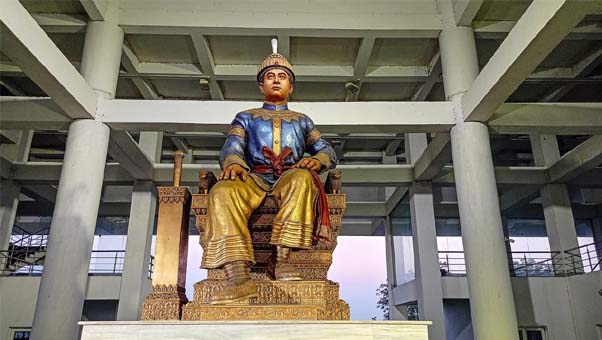

By Satyabrat Borah
Chaolung Sukapha, revered in Assamese history as the founder of the Ahom kingdom, was a prince of the Shan tribe who left the verdant hills of present-day northern Myanmar in the early thirteenth century and, after years of wandering and warfare, established a state that would endure for six centuries in the Brahmaputra valley. Born around 1189 at Mong Mao, a powerful Tai-Shan principality on the upper reaches of the Irrawaddy, Sukapha belonged to the royal line of the great Tai chieftain Khunlung and Khunlai, the legendary ancestors who, according to Shan and Ahom chronicles, had descended from heaven. His childhood name was Chao Chao Pha Phu Chao Ti Ying, but upon ascending to leadership he took the title Swargadeo, meaning “Lord of the Heavens,” a name that later generations rendered as Sukapha.
The decision to leave Mong Mao was not born of mere adventure. By the beginning of the thirteenth century, the once-mighty kingdom had begun to fracture under internal strife and external pressure. Succession disputes, the growing power of neighboring kingdoms, and perhaps the memory of ancestral migrations westward all combined to convince Sukapha that the future of his people lay beyond the Patkai mountains. In the year 1219, according to some traditional Ahom Buranji chronicles, or more commonly accepted as 1228, Sukapha set forth with a modest but determined retinue. The party consisted of about nine thousand followers, including two hundred horses, three hundred priests and nobles, ordinary soldiers, artisans, and most crucially, members of the royal family and the priestly clans of Deodhai and Bailung who carried with them the sacred ancestral tablets and the copper-plated royal genealogies.
Accompanying him were his chief queen, his two sons Khenung and Khunlai, several lesser wives, and elephants laden with grain, tools, and the ritual objects necessary for establishing a new kingdom. Among the most important possessions were the pair of golden umbrellas that symbolized sovereignty and the sacred Somdeo, a representation of the supreme deity. The march across the rugged Patkai range was arduous. Dense forests, swollen rivers, and hostile Naga tribes slowed their progress. Many perished from disease, exhaustion, and skirmishes. Yet Sukapha pressed on, guided by the belief that the land beyond the mountains had been promised to his ancestors by the god Lengdon.
After thirteen years of wandering, battling local tribes and searching for a suitable place to settle, Sukapha finally reached the fertile plains of the Brahmaputra valley in 1240. The region was then inhabited by Morans, Borahis, and other tribal groups who practiced shifting cultivation and lived in small chiefdoms. Sukapha first established a temporary capital at Chemun, near the present-day town of Jorhat, but soon moved to the banks of the Dihing river. The site he chose for his permanent capital was at the foot of the hills where the Dihing and Dikhow rivers met, a place he named Chetang Borgohain, later known simply as Charaideo, meaning “the shining city on the hill.” Here, in 1253, he built a palace of bamboo and thatch and laid the foundations of what would become one of the longest-lasting kingdoms in Indian history.
Sukapha’s greatest contribution was not merely military conquest but the creation of a durable political and social system that allowed a small band of immigrants to establish dominion over a much larger indigenous population without destroying local cultures. He adopted a policy of conciliation and assimilation rather than annihilation. The Morans and Borahis were not driven out; instead, many were absorbed into the Ahom fold. Sukapha married local princesses, the most famous being the Moran girl Nang Borg Konwari and the Borahi princess Nang Simung Mung Ri. Their descendants formed powerful clans within the Ahom nobility. This practice of intermarriage continued for generations, gradually transforming the Ahom elite into a mixed Tai-Aboriginal aristocracy.
He reorganized the administration along Tai lines while adapting to local conditions. The kingdom was divided into territorial units called khels or phoids, each under an officer responsible for supplying a fixed number of paiks, the able-bodied male population who owed labor and military service to the state. Every adult male between sixteen and fifty was registered as a paik and served the king for part of the year in agriculture, construction, or war. In return, he was allotted land for personal cultivation. This paik system, refined over centuries, became the economic backbone of the Ahom state, enabling it to mobilize massive labor forces for wet-rice cultivation, embankment building, and prolonged military campaigns.
Sukapha introduced wet-rice cultivation on a large scale, transforming the marshy floodplains into productive agricultural land. The construction of embankments and tanks, the digging of canals, and the systematic settlement of villages laid the groundwork for the prosperous agrarian economy that sustained the kingdom. He brought with him the sophisticated Tai knowledge of bronze casting, silk weaving, and manuscript writing on bark, skills that enriched the material culture of Assam.
Religiously, Sukapha maintained the ancestral Tai worship of Pha Tu Ying, the supreme god, and the Chumphi deities, but he showed remarkable tolerance toward the beliefs of the indigenous people. He allowed the tribal priests to continue their rituals and even incorporated some local deities into the Ahom pantheon. The sacred hill of Charaideo became the burial ground of Ahom kings, where maidens known as the Kunworis were interred alive with the deceased monarch, a custom borrowed from the local tribes but later abandoned.
Militarily, Sukapha laid down principles that would serve the Ahoms well for centuries. He emphasized guerrilla tactics suited to the terrain of rivers, jungles, and hills. The use of war boats on the Brahmaputra, the construction of stockades, and the employment of war elephants became hallmarks of Ahom warfare. Even in his lifetime, Sukapha faced challenges from the Nagas in the hills and the Chutiyas and Kacharis to the north and south, but he avoided large-scale confrontations, preferring diplomacy when possible and swift punitive expeditions when necessary.
By the time of his death in 1268, at the age of seventy-nine, Sukapha had created a stable kingdom stretching from the Patkai in the east to the Dikhow river in the west. He had appointed his younger son Khunlai as his successor, bypassing the elder Khenung who had shown less interest in administration. On his deathbed, Sukapha is said to have advised his nobles: “Do not oppress the people. Rule with justice and compassion. The kingdom is not mine alone but belongs to all who live in it.” He was buried with great ceremony at Charaideo, and the mound raised over his grave became the first of the famous maidams, the royal burial vaults that still stand as silent witnesses to Ahom glory.
The kingdom Sukapha founded grew steadily under his successors. Within a century, the Ahoms had absorbed the Chutiya kingdom and extended their sway to the borders of Kamrup. By the sixteenth century, they were strong enough to repel repeated invasions by the Delhi Sultanate and later the Mughals, inflicting on the latter some of the most humiliating defeats in Mughal history, including the battle of Saraighat in 1671. The Ahom state lasted until 1826, when it finally succumbed to Burmese invasion and British annexation, making it the longest unbroken reign of any dynasty in the Indian subcontinent after the imperial Guptas.
Sukapha’s legacy lies not only in territorial conquest but in the creation of a composite culture. The Assamese language that emerged in the medieval period owes much to the interaction between the Tai-Ahom tongue and the indigenous Austroasiatic and Tibeto-Burman languages. The Bihu festival, the distinctive Assamese gamusa towel, the manuscript tradition on sanchi bark, and the sattras of Vaishnavism that later flourished under royal patronage all bear traces of the cultural synthesis initiated by Sukapha. Even the name “Assam” itself is believed to derive from the Ahom word “Asama,” meaning “unequalled” or “peerless,” which the Ahoms applied to their kingdom.
Every year on the first day of the Assamese month of Kati, the people of Assam observe Sukapha Divas, paying homage to the man who crossed mountains with a handful of followers and gave them a homeland. Statues of Sukapha on horseback stand in Guwahati and Charaideo, and the great maidam at Charaideo has been declared a World Heritage site. Historians debate the exact dates and details of his journey, but none dispute his central role in shaping the destiny of the Brahmaputra valley.
Sukapha was neither a world conqueror like Alexander nor a lawgiver like Hammurabi, yet in the quiet persistence with which he built a kingdom that lasted six hundred years, in the wisdom with which he blended conquest with conciliation, and in the enduring institutions he created, he stands as one of the most remarkable state-builders in Asian history. From a wandering prince with nine thousand followers to the founder of a kingdom that defied empires, Sukapha’s life embodies the truth that great nations are often born not in the thunder of decisive battles but in the patient labor of those who plant rice, build dikes, marry across tribes, and teach their children to remember where they came from and why they must stay together. In the long chronicle of Assam, no name shines brighter than that of Chaolung Sukapha, the heaven-sent tiger who made the wilderness bloom.