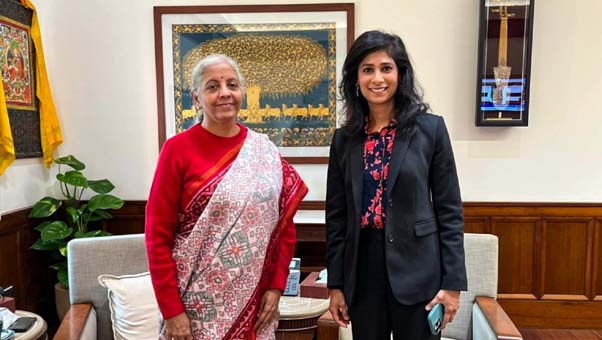

New Delhi, Dec 17 : The Indian economy is expected to record around 7 per cent growth in the current fiscal, slightly higher than 6.6 per cent projected by the IMF in October, said Gita Gopinath, former chief economist of the Washington-based International Monetary Fund.
Speaking at Times Network’s India Economic Conclave 2025, Gopinath said that the IMF made its projection for India’s growth before the National Statistical Office (NSO) came out with its July-September quarter growth rate of 8.2 per cent.
“I would say that the IMF number (India’s growth projection) was 6.6 per cent that came out in October. But their forecast for the second quarter of the current fiscal, in terms of what the growth would be, was much lower than what it turned out to be at over 8 per cent.
“Just doing math, I would expect that India’s GDP growth would go up close to 7 per cent,” she said.
Earlier this month, the Reserve Bank of India raised the GDP growth projection to 7.3 per cent for the current fiscal from its earlier estimate of 6.8 per cent, following robust economic performance in the July-September quarter.
The Gross Domestic Product (GDP) registered a six-quarter high growth of 8.2 per cent in Q2 of 2025-26, underpinned by resilient domestic demand amidst global trade and policy uncertainties.
The International Monetary Fund (IMF), in October, revised upwards India’s GDP growth forecast for the current fiscal to 6.6 per cent compared to its earlier estimate of 6.4 per cent on the back of strong growth, offsetting the impact of US tariffs on Indian shipments.
Gopinath, currently a Gregory and Ania Coffey Professor of Economics at Harvard University, said if India can maintain growth rates of close to 8 per cent for 20 years, then the country will reach much closer to the 2047 goals.
“But it is not easy to maintain even 8 per cent growth for a 20-year period on a sustained basis.
“That is going to require sustained reforms,” she said.
Gopinath said India is actually doing better than what was predicted before the India-US trade crisis.
Responding to a question on global trade, Gopinath said tariff rates have gone up substantially, but still are not at extremely high levels.
“I do think that at least from the US perspective, we are past peak tariffs in the US.
“2026 is a year of mid-term elections in the US. I do not think there is anybody who wants to have a lot of uncertainty in the run-up to the elections, tariffs have raised prices in the US,” she said.
According to her, tariffs have pushed up inflation, so the increase in the cost of living is a problem for affordability. So, that also dampens the incentive to raise tariffs further.
Responding to a question on India-US trade talks, Gopinath said the US is a very important partner for India.
“Therefore, I think it is very important that both countries, both India and the US, work together to come up with a mutually agreeable solution,” she said.
The relations between New Delhi and Washington witnessed a major downturn after US President Donald Trump doubled tariffs on Indian goods to a whopping 50 per cent in August, including a 25 per cent additional duty for India’s purchase of Russian crude oil.
The strain in the relations has been exacerbated by constant criticism of New Delhi by officials in Trump’s administration.
Asked why the IMF is not doing enough to hold Pakistan accountable for the reforms and the economic prudence, Gopinath said that the IMF has a responsibility to help countries that are in an economic crisis.
“And countries that are in economic crisis are in crisis for multiple reasons.
“It is not just because of macroeconomic policies that go wrong, but there is social conflict, conflicts at their borders,” she said.
The eminent economist said that is the candidate country which comes to the IMF for financial support.
“…therefore, it is always an important and careful decision that has to be made about, can you help the country? Can you truly improve its macroeconomic situation?” she said.
She pointed out that despite everything else that is going on, there is a set of policies extremely well argued through, and by the way, these policies are signed off, not by IMF management, but by the members, by 195 member countries.
“So there is a defined set of policies that are accepted, and you have to implement it based on that,” she said. (PTI)