
By Dipak Kurmi
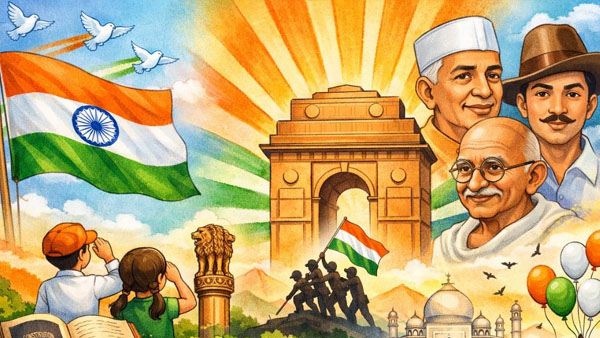
On January 26, 2026, India will mark its 77th Republic Day, a moment that transcends ceremonial celebration to reaffirm the nation’s constitutional soul. While Independence Day commemorates liberation from colonial rule, Republic Day signifies something deeper and more enduring: the moment India consciously chose to govern itself through laws framed by its own people. It is the day the Constitution of India came into force in 1950, transforming a newly independent nation into a sovereign, democratic republic. Republic Day thus celebrates not merely freedom, but the disciplined exercise of freedom through constitutional governance, democratic accountability, and collective responsibility.
The choice of January 26 as Republic Day was not accidental, nor was it a matter of administrative convenience. It was a date already etched into India’s freedom struggle long before independence became a reality. In December 1929, at the historic Lahore session of the Indian National Congress, the demand for Purna Swaraj, or complete independence, was formally adopted. Rejecting the British proposal of Dominion Status, leaders such as Jawaharlal Nehru and Subhas Chandra Bose articulated a more uncompromising vision of freedom. The Congress declared January 26, 1930, as Independence Day, urging Indians across the country to take a pledge for full sovereignty. For the next seventeen years, this date symbolised resistance, aspiration, and moral resolve. When the Constitution was ready to be implemented, the framers chose January 26, 1950, to honour that historic pledge and link the republic to the deepest roots of the freedom movement.
India’s journey from independence to republichood was neither automatic nor symbolic alone. On August 15, 1947, India became free from British rule, but it remained a Dominion within the Commonwealth. King George VI was still the ceremonial Head of State, and the country functioned under the Government of India Act of 1935. True sovereignty required more than political transfer; it demanded a constitutional framework rooted in the will of the people. The Constituent Assembly, under the chairmanship of Dr. Rajendra Prasad and with Dr. B.R. Ambedkar as the chief architect of the Constitution, worked for nearly three years to draft a document that could hold together a vast, diverse, and deeply unequal society. When the Constitution came into force on January 26, 1950, India ceased to be a Dominion and became a republic, with the President replacing the Governor-General and the Constitution emerging as the supreme law of the land.
The Indian Constitution is not merely a legal document outlining the structure of government; it is a transformative charter aimed at reshaping society itself. Guided by the ideals of justice, liberty, equality, and fraternity, it sought to heal the wounds of colonial exploitation while confronting entrenched social hierarchies. Under Ambedkar’s leadership, the Constitution addressed not only political democracy but also social and economic democracy. Fundamental Rights guaranteed civil liberties and equality before the law, while Directive Principles of State Policy laid down the moral obligations of the state to promote welfare, reduce inequality, and ensure social justice. Fundamental Duties, later added, reminded citizens that rights are inseparable from responsibilities. This balance between freedom and obligation remains central to the republican ethos India celebrates each January 26.
Republic Day celebrations reflect these constitutional ideals in a language of symbols and public participation. The grand parade along Kartavya Path in New Delhi is the most visible expression of this spirit, combining military discipline with cultural diversity. The armed forces march not merely to display strength, but to affirm the state’s commitment to safeguarding sovereignty and constitutional order. Alongside them, tableaux from states and Union Territories present India’s pluralism, showcasing regional cultures, histories, and developmental aspirations. Schoolchildren, folk artists, and performers participate in large numbers, reinforcing the idea that democracy is not the domain of institutions alone but a shared national endeavour involving citizens across generations.
Republic Day 2026 carries an additional layer of cultural significance through its theme, “150 Years of Vande Mataram.” Composed by Bankim Chandra Chattopadhyay, the national song became a rallying cry during the freedom struggle, inspiring generations to imagine the nation as a sacred collective. The theme highlights how cultural expression and political aspiration intertwined in India’s journey to freedom. Through performances, tableaux, and public commemorations, the celebrations seek to remind citizens that the republic is sustained not only by laws and institutions, but also by shared symbols, songs, and sentiments that bind people together across linguistic and regional boundaries.
Yet Republic Day is not solely a spectacle of pride; it is also an occasion for introspection. The Constitution lays down lofty ideals, but the lived reality of democracy often reveals tensions between promise and practice. Despite constitutional guarantees, challenges such as economic inequality, caste discrimination, gender injustice, communal polarisation, and uneven access to opportunities persist. Democratic institutions are frequently tested by political pressures, questions of accountability, and concerns over transparency. Republic Day thus compels citizens and leaders alike to confront uncomfortable questions about how faithfully constitutional values are being upheld in everyday governance.
In this context, the role of institutions such as the judiciary, the legislature, the executive, the media, and civil society becomes crucial. The judiciary acts as the guardian of the Constitution, interpreting its provisions and protecting fundamental rights. However, constitutional morality cannot be enforced by courts alone. An engaged citizenry, an independent media, and a vigilant civil society are essential to ensure that democratic norms do not erode under the weight of expediency or majoritarian impulses. Republic Day reminds citizens that democracy is sustained not by passive celebration, but by active participation through voting, debate, dissent, and community engagement.
Education occupies a particularly important place in preserving the republican spirit. While Republic Day is widely celebrated in schools through flag hoisting and cultural programmes, constitutional awareness must extend beyond symbolic rituals. Young citizens need to understand how the Constitution shapes their daily lives, protects their freedoms, and imposes responsibilities upon them. Constitutional literacy can empower people to question authority, demand accountability, and participate meaningfully in democratic processes. In a diverse society like India, such awareness is vital for nurturing mutual respect and social cohesion.
At the same time, the Constitution’s enduring strength lies in its adaptability. The framers deliberately designed it as a living document, capable of evolving with changing social and economic realities. Amendments over the decades have expanded voting rights, strengthened social justice provisions, and responded to emerging challenges. While debates over constitutional amendments are often contentious, they underscore a fundamental truth: the republic is not static. Its vitality depends on the ability to balance continuity with reform, ensuring that change does not dilute core values of justice, liberty, equality, and fraternity.
As India celebrates its 77th Republic Day, the significance of January 26 remains undiminished. It is a day that connects past sacrifices with present responsibilities and future aspirations. The unfurling of the tricolour and the echo of the national anthem serve as reminders that freedom was hard-won and must be consciously preserved. Republic Day calls upon Indians to rise above divisions, embrace diversity as strength, and recommit themselves to the constitutional vision of an inclusive and just society.
Republic Day is a celebration of India’s moral and democratic imagination. It affirms the idea that democracy is not merely a system of governance but a way of life rooted in constitutional values. As the nation moves forward amid global uncertainties and internal challenges, the Constitution continues to serve as a guiding light. January 26 stands as a living promise that the Indian Republic, shaped by law, sustained by institutions, and animated by its people, will continue striving towards a more just, equal, and humane future.
(the writer can be reached at dipakkurmiglpltd@gmail.com)