
By Dipak Kurmi
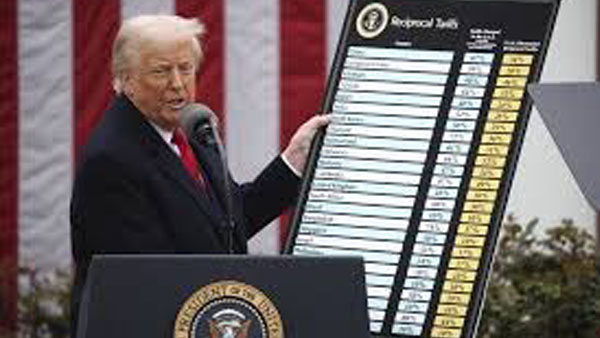
Donald Trump remains one of the most confounding figures of contemporary global politics, a man who blurs the line between statesman and spectacle with unsettling ease. His physical stamina, theatrical presence, and relentless self-assurance are not merely personal traits but political instruments. After nearly nine exhausting hours in the air, including a forced U-turn due to technical failure and a subsequent replacement flight, Trump walked directly onto the Davos stage and spoke for close to two hours without pausing even for water. What he said there is almost secondary to how he said it: upright, defiant, energised, embodying a peculiar vitality that appears incongruous in a 79-year-old leader. Yet this vitality is not benign. It fuels a political project that has increasingly reshaped global norms for the worse, redefining power as performance and governance as transaction, while captivating audiences who confuse endurance with legitimacy and bravado with vision.
This performative power has now found institutional expression in what Trump calls the Board of Peace, an initiative that claims to offer a new architecture for global stability while demanding a one-billion-dollar entry fee for permanent membership. Its durability remains uncertain, but its logic is unmistakable: peace as privilege, influence as purchasable commodity. What is striking is not only the audacity of the proposal but the speed with which wealthy, largely Muslim-majority states have reportedly embraced it. Saudi Arabia, Turkey, Egypt, Jordan, Qatar, Pakistan, Indonesia, and the United Arab Emirates are prepared to join, with reports suggesting that 25 to 30 countries have already expressed willingness. This alignment reveals less about a shared vision of peace than about a shared acceptance of transactional geopolitics, where security and recognition are secured not through justice or international law but through capital and proximity to power.
What is rarely asked in mainstream discourse about Trump is not how outrageous his rhetoric is, but how profitable his politics have been. During the first year of his second term, his personal wealth is estimated to have increased by around three billion dollars, much of it linked to the expansion and legitimisation of the crypto economy. This financial trajectory offers a revealing lens through which to view his policy decisions, including the controversial pardon of Changpeng Zhao, the China-born founder of Binance. Trump has never hidden his ambition to be, in his own words, “rich like hell,” and his presidency demonstrates how the boundaries between public office and private accumulation can dissolve entirely. In this sense, Trump is not an aberration but an extreme symptom, exposing the fault lines of liberal democracy by exploiting them openly. Ironically, by stripping away the façade of moral universality and procedural virtue, he may be contributing more to the West by revealing what it has long been unwilling to confront about itself.
Yet respect for the West need not vanish entirely, because within it remain a handful of scholars and thinkers willing to engage in uncomfortable self-critique. One such reckoning concerns the historical dismantling of democracy in the Arab world, a process often obscured by narratives that portray authoritarianism there as culturally inherent. Elizabeth Thompson, in her meticulously researched book How the West Stole Democracy from the Arabs, documents how early twentieth-century Arab political movements articulated democratic principles with remarkable clarity. She quotes Arab constitutional writings asserting that no ruler, however exalted, stood above the will of the nation and that the people were the source of all authority. These ideas were not borrowed from European revolutions or postwar liberal philosophy; they were articulated and enacted in Syria between 1919 and 1920 by Arab parliamentarians, Islamic reformers, and constitutionalists who believed democracy to be a universal right. The elected Syrian Arab Congress drafted a democratic constitution grounded in popular sovereignty, only to be dissolved by French colonial forces. The echoes of that historical erasure resurface today in new forms, including initiatives like the Board of Peace, where external power again reshapes regional futures under the guise of order and stability.
Trump, perhaps more clearly than many of his critics, understands the hollowness at the core of Western liberal ideology. Its language of human rights and rules-based order often masks a history of selective morality and strategic violence. Western powers bomb Arab societies after renaming West Asia as the Middle East, then position themselves as protectors of Muslims in Myanmar and elsewhere. They speak of contributing to African livelihoods while the continent still bears the scars of generations uprooted, enslaved, and sold. This is not hypocrisy born of ignorance but a system of sophisticated doublespeak, refined over centuries, that legitimises domination while claiming benevolence. Trump’s blunt transactionalism does not invent this tradition; it merely discards the polite euphemisms that once concealed it.
To understand why this moment feels so disorienting, the thought of Antonio Gramsci offers a powerful framework. Writing from prison under Mussolini’s fascist regime, Gramsci developed a theory of power that extended beyond coercion to encompass culture, civil society, and common sense itself. In his Prison Notebooks, he famously observed that a crisis occurs when the old world is dying and the new cannot yet be born, producing an interregnum filled with morbid phenomena. This was not metaphorical flourish but structural diagnosis, describing periods when foundational certainties collapse without yielding viable alternatives. Today’s overlapping crises environmental breakdown, erosion of institutional trust, fragmentation of political consensus, and the rise of algorithmic governance that replaces judgement with calculation mirror Gramsci’s interregnum with unsettling precision. Slavoj Žižek has similarly warned that the crisis is not temporary and that faith in history’s automatic progress is a dangerous illusion.
Within this context, Trump’s Board of Peace becomes emblematic of the age. It claims to address global violence yet operates entirely through transactional logic, prioritising wealth over justice and offering reconstruction without accountability or genuine inclusion. Gramsci’s insights reveal this not as innovation but as re-enactment: elite domination repackaged through new mechanisms. Power, Gramsci argued, is sustained not merely by force but by consent, by intellectual and moral leadership that transforms ruling-class interests into common sense. Institutions such as family, education, and media normalise existing hierarchies, making them appear inevitable. The Board of Peace functions precisely in this way, cloaked in the language of peace-building while leaving intact the structures of inequality and global imbalance. Its model turns peace into a commodity to be purchased rather than a collective achievement grounded in justice, echoing what Gramsci called trasformismo, the absorption of dissent into frameworks that neutralise radical challenge while preserving the status quo.
Escaping this impasse requires recognising that the current quagmire is not reducible to one flawed leader or theatrical politics alone. It reflects the deeper collapse of hegemonic frameworks that once lent coherence to societies. The old liberal order, with its faith in institutions and incremental reform, no longer commands loyalty, while the new order struggles to articulate a unifying vision capable of linking ecological, economic, racial, and cultural struggles into a coherent emancipatory project. To confront the Trump phenomenon as a portal, a threshold through which history may descend into annihilation or re-emerge in radically different form, is to embrace Gramsci’s insistence that politics is fundamentally a struggle for meaning and direction. A genuinely Gramscian response would move beyond denunciation toward the construction of counter-hegemony: alternative institutions, narratives, and practices that cultivate new forms of popular consent. It would link ecological justice with economic democracy, affirm the agency of ordinary people, and reject the commodification of peace. Gramsci’s enduring maxim, pessimism of the intellect and optimism of the will, captures the task ahead with stark clarity. Without a new organised political subject capable of turning analysis into sustained transformative force, the interregnum will persist, and the world will remain suspended between the decay of the old and the stillborn promise of the new.
(the writer can be reached at dipakkurmiglpltd@gmail.com)