
By Dipak Kurmi
Agriculture, with its intrinsic connection to human survival, culture, and collective memory, has remained the beating heart of civilizations since time immemorial. Across the world, agricultural cycles have influenced not only economies but also belief systems, social bonds, and ritual calendars. In India, mid-January festivals such as Magh Bihu in Assam, Lohri in Punjab, and Pongal in Tamil Nadu celebrate the harvest, expressing gratitude for nature’s bounty. These festivals, although diverse in form, share a common essence: they honour the intimate relationship between humans, land, and the seasons. However, in the northeastern region of India, particularly in Assam and parts of Arunachal Pradesh, the festival of Ali Aye Ligang stands apart. Unlike post-harvest celebrations, Ali Aye Ligang marks the beginning of the agricultural cycle. It is a celebration not of abundance but of hope, preparation, and faith in the future, symbolizing the belief that a good beginning will ensure prosperity throughout the year.
Ali Aye Ligang holds great significance for the Mising community, one of Assam’s largest indigenous groups. This community is an integral part of the greater Tani cultural family, which spans across Northeast India and parts of Tibet. The Misings, with a deep connection to agriculture, particularly wet rice cultivation, have long structured their social and ritual lives around the agricultural calendar. Ali Aye Ligang is celebrated annually during the second week of February, falling on the first Wednesday of the month of Ginmur Polo, which corresponds to February or March. This festival, celebrated at the arrival of spring, is a reflection of the deep agricultural philosophy of the community. The earth, at this time, is considered fertile and receptive to the sowing of seeds, making it a sacred period for the Misings.
The very name of the festival carries the essence of this agricultural philosophy. “Ali” refers to the root or seed, “Aye” signifies fruit, and “Ligang” denotes the act of sowing or beginning. The term Ali Aye Ligang, therefore, encapsulates the sacred moment when seeds meet the soil—when human labour is in harmony with the forces of nature, and when the community seeks divine blessings for growth, fertility, and abundance. Traditionally, the festival lasts for five days, with each day marked by rituals, taboos, and communal activities that foster a sense of unity and reverence towards nature.
At its core, Ali Aye Ligang is more than just a cultural celebration; it is a reaffirmation of the Mising worldview, which is deeply rooted in animism and, for many, Donyi-Poloism. The faith venerates the Sun, Donyi, and the Moon, Polo, as supreme deities who maintain the moral and natural order of the universe. Alongside these celestial forces, ancestral spirits and nature deities also play an essential role in the everyday life of the Misings. Agriculture, therefore, is not viewed as a mere economic activity but as a moral and spiritual undertaking. The observance of strict taboos during the festival, such as prohibiting the cutting of trees, excessive ploughing, or disturbing the soil, reflects an ecological ethic that the Misings adhere to—recognizing the vulnerability of nature during the early stages of crop growth. A belief prevalent within the community holds that any violation of these taboos could lead to poor crop yields or natural calamities, reinforcing the communal responsibility of respecting the environment.
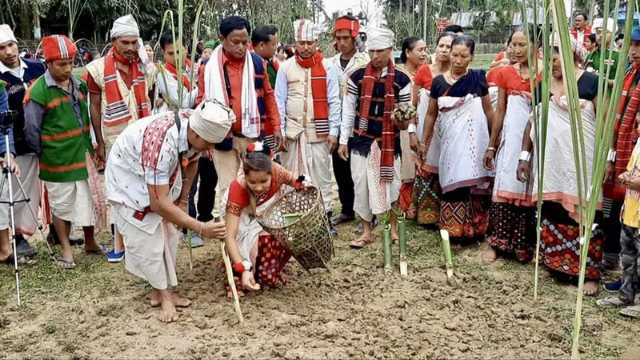
The festival begins with the performance of Gumrag Puja, a ritual offering to seek blessings from deities and ancestors for a successful agricultural season. This puja is usually led by the head of the family or a respected elder, sometimes under the guidance of a traditional priest. In a symbolic act of faith, a small quantity of paddy seeds is ceremonially sown on a patch of land, marking the official start of the sowing season. This act, though simple, carries profound meaning. It represents the community’s trust in nature and divine forces, symbolizing not only human effort but also a deep sense of interdependence with the natural world. In some villages, the ritual of ploughing is also initiated at this time, reinforcing the sacred threshold between dormancy and growth. Prayers are offered not only to the gods but also to the ancestors, whose blessings are believed to ensure the fertility of the land and the well-being of the people. These rituals underscore the shared belief that agriculture is a collective endeavor, requiring the cooperation of the living, the departed, and the natural world.
Feasting plays a central role in Ali Aye Ligang, turning solemn rituals into moments of collective joy. The food prepared during the festival is deeply symbolic, reflecting the agrarian identity of the community. A key dish is purang apin, boiled sticky rice wrapped in torapat leaves, a delicacy made exclusively during festivals and special occasions. This dish, often shared among relatives and neighbours, symbolizes unity and the spirit of community. Alongside this, poro apong, a traditional rice beer, is served as a ceremonial drink that strengthens social bonds and reinforces hospitality. Dried fish and pork, which are integral to the Mising diet, feature prominently in the festive meal, highlighting the community’s traditional subsistence economy, which combines agriculture with fishing and animal husbandry. The communal feast is not just about food consumption but about reaffirming collective identity. Here, social hierarchies dissolve, and everyone partakes in the same food, a gesture that speaks to the egalitarian nature of Mising society.
Music and dance are vital components of Ali Aye Ligang, imbuing the festival with emotional depth and cultural resonance. The festival’s musical tradition is rich, featuring instruments such as the dhul, taal, sifung (flute), cymbals, and gong. The songs performed during the festival cover a wide range of human experiences, from love and longing to the struggles of daily life, joy and sorrow, and the deep connection between humans and nature. These songs, passed down through generations, are more than entertainment; they serve as a living archive of the community’s collective memory, preserving moral lessons and cultural values.
The Gumrag dance is another hallmark of the festival. Performed primarily by young men and women, it is characterized by rhythmic footwork, expressive hand movements, and synchronised action with traditional instruments. The dance traditionally starts from the easternmost house of the village, symbolizing the rising sun and the beginning of life, before gradually moving through courtyards and fields. This movement through the village landscape serves as a reminder of the collective participation in agricultural life, with the village itself becoming a stage for the celebration.
Traditional attire adds visual splendour to the festival. Mising women wear ege-gasor, intricately woven garments that feature vibrant colours and motifs symbolizing nature and fertility. The act of weaving, passed down through generations, carries cultural significance and embodies skill, patience, and creativity. Mising men don Gonro Ugon (a type of dhoti) and Mibu Galuk (a shirt), completing the look with a Dumer, a traditional scarf. These garments not only distinguish the festival visually but also reaffirm the community’s cultural identity in an increasingly homogenized world.
Ali Aye Ligang also holds deeper meaning within the broader social context of the Mising community. As the second-largest tribal group in Assam, the Misings continue to live in stilt houses known as Chang Ghar, constructed from bamboo and wood to withstand the frequent floods in the region. Agriculture, particularly rice cultivation, remains the backbone of their economy. Ali Aye Ligang, therefore, serves as not just a festival but also a reaffirmation of social values, kinship bonds, and collective responsibility.
The Mising community also celebrates Porag, another major harvest festival, though it differs from Ali Aye Ligang. While Ali Aye Ligang focuses on the hope and beginnings of the agricultural cycle, Porag is a post-harvest festival that celebrates the completion of the harvest and expresses gratitude for the abundance. Together, these festivals reflect a cyclical understanding of time in which sowing and harvesting are interconnected phases of life.
Ali Aye Ligang faces challenges as it adapts to the changing realities of modern life. With urban migration and environmental changes, many Mising families now live in cities, making it difficult to celebrate the festival in its traditional form. However, the spirit of Ali Aye Ligang remains resilient. Urban Mising communities continue to organize celebrations in community halls, open fields, and auditoriums, adapting rituals to new environments while preserving their core meanings. Technology, social media, and cultural organizations have also helped keep the festival alive, ensuring that younger generations stay connected to their roots.
Despite the challenges of modernization, Ali Aye Ligang endures as a symbol of cultural continuity and resilience. It serves as a reminder of the deep connection between the Mising people and the land, celebrating agricultural life, ecological wisdom, and collective identity. As the rhythms of drums, the aroma of festive meals, and the dance of the people fill the air each spring, Ali Aye Ligang reaffirms the timeless truth that human life is inseparable from the land it depends on. Like the fertile soil of Assam, the traditions of Ali Aye Ligang continue to nurture the community, passing from one generation to the next, ensuring that the seeds of culture, once sown, will bear fruit for years to come.
(the writer can be reached at dipakkurmiglpltd@gmail.com)