
By Satyabrat Borah
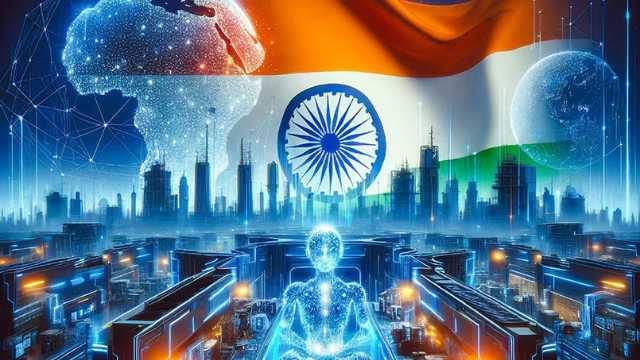
When Prime Minister Narendra Modi speaks about artificial intelligence on global stages, he is not merely talking about technology. He is talking about power, sovereignty, trust, and the future shape of the world. In recent years, as AI has moved from laboratories into daily life, it has become clear that control over AI systems will shape economies and geopolitics much like oil did in the twentieth century. Against this backdrop, Modi’s articulation of an alternative AI vision places India in a unique role, not as a rival superpower in the traditional sense, but as a bridge between competing global interests.
The United States today dominates much of the AI stack. From advanced semiconductor design to cloud infrastructure, foundational models, operating platforms, and developer ecosystems, American companies sit at the core. Washington is actively encouraging allies and partners to build their AI capabilities on top of this American stack. The logic is strategic as much as it is technological. Shared platforms mean shared standards, shared values, and shared dependencies. For many countries, aligning with the US AI ecosystem offers speed, reliability, and access to cutting edge tools that would otherwise take decades to build independently.
India is approaching this moment differently. Rather than rejecting American technology or blindly embracing it, New Delhi is trying to carve out a third path. Modi’s message is subtle but firm. India wants partnership, not dependence. It wants openness, not dominance. And it wants AI to serve development, inclusion, and public good, not just corporate profit or strategic leverage.
This vision is rooted in India’s own experience. Over the last decade, India has built some of the world’s largest digital public infrastructures. Aadhaar created a unique digital identity system at scale. UPI transformed payments by making them instant, interoperable, and nearly free. CoWIN managed vaccination for hundreds of millions. These systems were not built as proprietary corporate platforms. They were designed as public rails on which private innovation could flourish. Modi often presents this as proof that technology can be both powerful and democratic.
When applied to AI, this philosophy leads India to emphasize resilience and self reliance without isolation. The push to develop a domestic AI ecosystem is not limited to software. It stretches from chip making and semiconductor fabrication to data centers, cloud services, foundational models, and sector specific applications. India knows it cannot replace the US or China overnight. But it also knows that total reliance on external AI stacks would leave it vulnerable, economically and politically.
The semiconductor challenge illustrates this clearly. Chips are the physical foundation of AI, and advanced manufacturing is currently dominated by a handful of players in the US, Taiwan, South Korea, and a few other regions. India has launched incentive schemes to attract chip manufacturing and assembly. Progress is slow and complex, but the intent is strategic. Even partial domestic capacity can reduce exposure to supply shocks and geopolitical pressure.
At the same time, India is investing heavily in AI talent. Its universities, startups, and research institutions are producing engineers and data scientists at scale. Indian professionals already play key roles in global tech companies. The government wants more of that expertise to be anchored at home, working on problems relevant to India’s population, languages, and development needs. AI models trained only on Western data often fail in Indian contexts. Building domestic models is not a luxury, but a necessity.
Modi’s alternative AI vision also reflects India’s position in the global order. India is not part of a formal military or technological bloc. It maintains strategic autonomy while engaging with multiple power centers. In AI, this translates into dialogue with the US, cooperation with Europe, engagement with the Global South, and cautious management of competition with China. India presents itself as a country that understands both the concerns of advanced economies and the aspirations of developing nations.
Many countries in Africa, Asia and Latin America worry that AI will deepen global inequality. They fear becoming mere data suppliers or markets for technologies developed elsewhere. Modi speaks directly to this anxiety. He frames India as a voice for inclusive AI, one that shares best practices, open platforms, and capacity building rather than locking countries into opaque systems. This is where the idea of India as a bridge becomes most visible.
The US approach to AI governance often emphasizes innovation first, with regulation following later. Europe prioritizes regulation, ethics, and rights. China focuses on state control and strategic deployment. India positions itself somewhere in between. It talks about ethical AI, but also about affordability and access. It talks about innovation, but also about public interest. This balancing act resonates with many nations that feel caught between powerful models that do not fully reflect their realities.
The AI push is tied to economic ambition. India wants to move up the value chain. For decades, it was seen primarily as an IT services hub. AI offers a chance to become a creator of core technologies rather than just an implementer. Startups working on healthcare diagnostics, agricultural forecasting, language translation, education tools, and governance solutions are central to this narrative. The government’s role is to create enabling conditions, data access, compute infrastructure, and regulatory clarity.
There are challenges and contradictions. Building a resilient AI ecosystem requires massive investment. Advanced chips remain expensive and scarce. Training large models demands enormous energy and computing power. India must also address concerns about data privacy, surveillance, and algorithmic bias. Its regulatory framework is still evolving, and public trust cannot be taken for granted.
Critics also argue that India’s ambition may be overstated. Catching up with the US in foundational AI is a monumental task. American companies have decades of head start, deep capital, and global influence. Even China, with its scale and state backing, struggles under export controls. India’s path will likely be uneven, with successes in some areas and dependencies in others. But supporters counter that the goal is not dominance, but choice. Even partial independence changes the balance.
What makes Modi’s positioning noteworthy is its tone. It avoids confrontation. India does not frame its AI vision as anti American. Instead, it emphasizes complementarity. India is willing to work with US companies, host their investments, and integrate their tools, but on terms that preserve domestic capacity and long term autonomy. This nuanced stance allows India to benefit from global innovation while preparing for a future where AI power is more distributed.
On global platforms, Modi often links AI to human values. He speaks about using AI to address climate change, healthcare gaps, education access, and disaster response. This moral framing is strategic. It contrasts with narratives that focus solely on competition and dominance. By presenting AI as a shared human challenge, India seeks moral leadership even if it lacks technological supremacy.
This approach also aligns with India’s broader diplomatic strategy. Whether in climate negotiations, vaccine diplomacy, or digital public goods, India often positions itself as a problem solver rather than a rule breaker. In AI, this means advocating for global norms that are flexible enough to accommodate different stages of development. It also means resisting a world divided into rigid tech blocs.
For the United States, India’s stance is both an opportunity and a complication. India is a valuable partner in counterbalancing China and shaping global standards. At the same time, India’s insistence on autonomy limits how tightly it can be integrated into a US led AI ecosystem. Washington must accept that partnership with India will not mean control. For New Delhi, this trade off is acceptable, even necessary.
As AI continues to reshape economies and societies, the question of who builds it, who controls it, and who benefits from it will only grow more urgent. Modi’s alternative AI vision does not promise quick dominance or dramatic breakthroughs. Instead, it offers a slower, more deliberate path focused on resilience, inclusion, and choice. It reflects India’s historical instincts and contemporary ambitions.
Whether this vision succeeds will depend on execution. Policies must translate into infrastructure. Rhetoric must be matched by results. Private sector innovation must align with public goals. And ethical commitments must withstand political and commercial pressure. If India can navigate these challenges, it may indeed emerge as a bridge, not just between the US and other countries, but between competing ideas of what AI should be.
In a world increasingly defined by technological power, India’s message is quietly radical. It suggests that leadership does not always come from dominance. Sometimes it comes from offering an alternative that others find credible and humane. As AI races ahead, that alternative may prove to be one of India’s most significant contributions to the global future.