
Garo Hills belongs to all lawful residents: Sofior Rahman
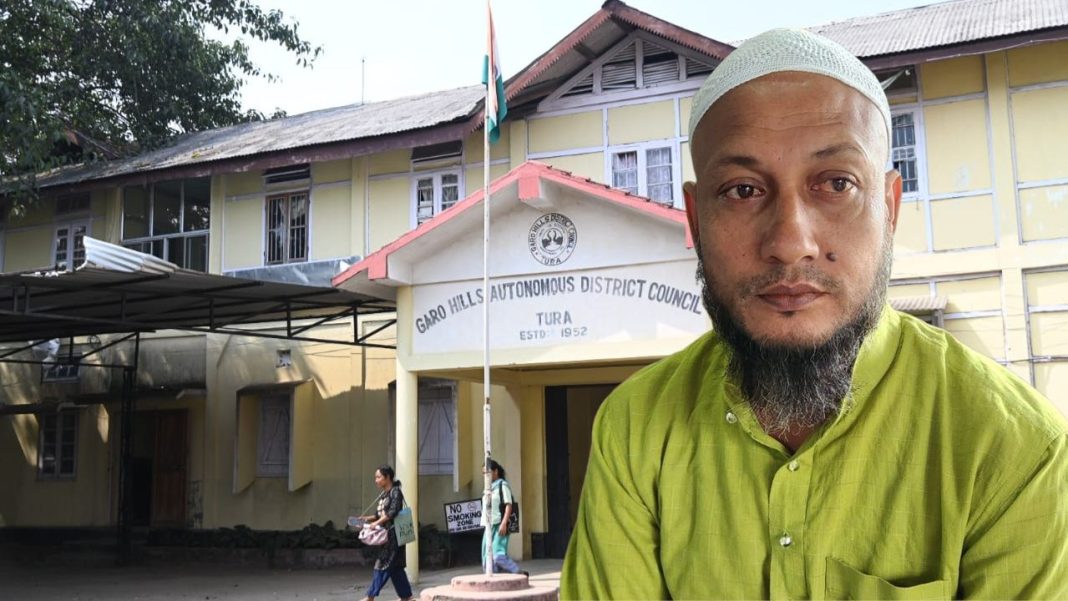
Tura, Mar 2: In another development in the controversy over GHADC’s order mandating ST certificates for contesting the upcoming Council elections, former MDC Sofior Rahman has asserted that no single group can claim exclusive moral ownership over the democratic space of Garo Hills.
In a strong statement, he said the region belongs to all its lawful inhabitants who have lived there for decades.
He was reacting to recent remarks by MDC Rinaldo K Sangma regarding the requirement of a Scheduled Tribe (ST) certificate to contest elections to the Garo Hills Autonomous District Council (GHADC).
In a press release issued on Monday, Rahman said it was necessary to place “certain constitutional facts on record” concerning the powers and limits of the GHADC under the Sixth Schedule of the Constitution of India.
Clarifying the constitutional position, he said that while the Sixth Schedule grants autonomy to Autonomous District Councils to safeguard tribal customs, land and traditions, it does not place them above the Constitution.
“The Council functions within the constitutional framework and must respect the democratic rights of all lawful citizens residing in the region,” Rahman stated.
Referring to Paragraphs 2 and 3 of the Sixth Schedule, he noted that District Councils are empowered to legislate on matters relating to land, customs and traditional governance. However, he stressed that any restriction on political participation must have a firm legal basis.
“Any restriction on political participation must be backed by valid constitutional authority, proper legislation, and notification by the Hon’ble Governor — not merely by political interpretation or sentiment,” he said.
Rahman also underlined that fundamental rights guaranteed under the Constitution cannot be ignored. He cited Article 14 (equality before law), Article 15 (prohibition of discrimination), Article 19 (freedom of speech and expression) and Article 326 (universal adult franchise) as key safeguards.
Placing the issue in historical context, Rahman said that since the creation of the GHADC in 1952 and after Meghalaya attained statehood in 1972, Garo Hills has been home to diverse communities.
“Non-tribal residents and even non-Garo communities have lived in this region for generations and have contributed to its social and economic development,” he said.
He reiterated that the GHADC was established to preserve tribal identity within India’s constitutional framework, not to promote exclusion.
“The GHADC was not created to promote exclusion, but to preserve tribal identity while ensuring democratic governance within India’s constitutional framework. Protection of tribal traditions must go hand in hand with respect for constitutional values and democratic principles,” Rahman stated.
Stressing on coexistence and democratic balance, he added: “No single group can claim exclusive moral ownership over the region’s democratic space. Garo Hills belongs to all its lawful inhabitants who have lived here for decades with dignity and mutual coexistence.”
He concluded by calling for a balanced approach that upholds both the spirit of the Sixth Schedule and the supremacy of the Constitution of India, ensuring justice, equality and mutual respect for all communities.