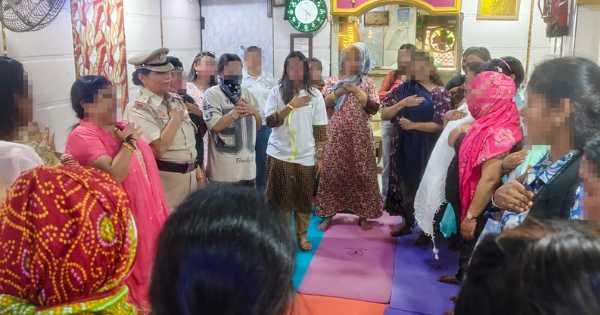

New Delhi, Mar 29 : In a small hall at a multi-storey brothel in Delhi’s red-light area, Garstin Bastion Road, popularly known as GB Road, about 40 sex workers paused their daily routines and gathered for a session on mental health. During the two-hour session, the hall echoed with affirmations such as “Main khud ke liye garv mehsoos karti hoon” (I feel proud of myself).
Handling between 15 and 20 customers a day and often under the influence of intoxicants, these moments provide them with a scarce respite and an opportunity to laugh.
In the hall, which has five small enclosures, each measuring 3 feet by 5 feet, used by the women to sleep and carry out their work, the sex workers — aged between 20 and 50 — were asked to write their names on sheets marked with different emojis to symbolise their moods.
“These women struggle to write their names. Most of them have little understanding of what constitutes a crime against them. Their internalised trauma has made them numb to physical pain,” said an NGO worker who counsels them regularly.
The programme was led by Sub-Inspector Kiran, popularly known as ‘Lady Singham’, who heads the All-Women Police Post (Mahila Police Chowki) at GB Road, in collaboration with an NGO.
The Mahila Police Chowki has, since its inception in February 2024 as one of the first two all-women police posts in the city, emerged as a quiet yet powerful space for empowerment in an area that houses hundreds of multi-storey brothels and over 1,000 sex workers.
The police post has been running regular skill development and awareness programmes aimed at helping women from economically weaker sections move towards self-reliance.
Coaching classes, makeup artist training, sewing courses, cooking sessions, aerobics, and counselling are among the initiatives conducted on the first floor of the police post. Other activities include embroidery, bag-making, pot-making, and creative exposure through film-related initiatives.
Self-defence and awareness sessions are also held regularly. On March 22, around 50 women participated in a police-led programme where they were sensitised about their rights. Educational activities are conducted for children in the area as well, benefiting over 50 girls with basic education and introductory computer knowledge.
Health and hygiene form a key component of the initiative. Regular health camps have been organised since 2023, benefiting both sex workers and residents. Nearly 500 individuals have been provided with spectacles, while dental check-ups are conducted with support from Maulana Azad Dental Hospital. Awareness on hygiene, including the distribution of sanitary napkins and guidance on safe practices, is also carried out.
Mental health counselling is offered for nearly 20 days a month at a dedicated counselling room within the police chowki. De-addiction awareness campaigns and psychological assessments are also part of the outreach.
But while the aforementioned facts provide data, witnessing real-life impact tells a story of hope and courage. In one case, a woman rescued from a brothel, along with her two children, including a son with multiple disabilities, was provided medical care and shelter, with both children now pursuing education.
Another woman trained in handicrafts and cake baking is currently employed at a restaurant in Rajouri Garden. Others have been trained in makeup artistry, paper craft, and similar skills to support self-employment. One woman was also provided with an e-rickshaw, which she now drives to earn a livelihood.
Speaking to PTI, Pooja (name changed), aged around 35 years, who has been attending regular coaching classes for six months, said, “I have never felt more confident than this. I had no idea how to even spell my name. Today, I can write it and also understand the basics. Whenever we feel something wrong is happening with us, we can go to the chowki and freely tell madam (Sub-Inspector Kiran).”
Police officials said over 50 people, including minors, have been rescued from brothel houses so far since the post came into existence, with several rehabilitated through shelter homes, skill training, and employment opportunities.
The initiative has also enabled cultural expression. In February 2025, in a first-of-its-kind effort, 17 sex workers performed a play titled “Pardah” at the National School of Drama. Nukkad nataks have also been organised multiple times since 2024.
While these initiatives could suffice for someone nearing retirement, Kiran goes the extra mile to ensure participation.
One such instance was witnessed when a sex worker approached her office to file a complaint against her husband for assault and theft of her jewellery.
Kiran patiently wrote a four-page complaint, narrating each word aloud as she wrote. She told the complainant that everything had been recorded as stated and asked her to verify it, mindful of her illiteracy.
“I trust you fully, madam,” the complainant said.
Kiran then urged her to attend the classes run at the police post.
Forcing the woman’s hand to her head, she said, “Kasam kha meri ki tu aayegi, nahi to meri maut tere sar hogi” (Promise me you will come, or my death will be on you).
These women, often shunned by society and viewed through a different lens, now find comfort in having a women’s police post nearby. Many of them also become informers, alerting police about the movement of criminals in brothels. From surviving in confined spaces, they are now beginning to laugh, learn, and dream of a life beyond them. (PTI)