
By Satyabrat Borah
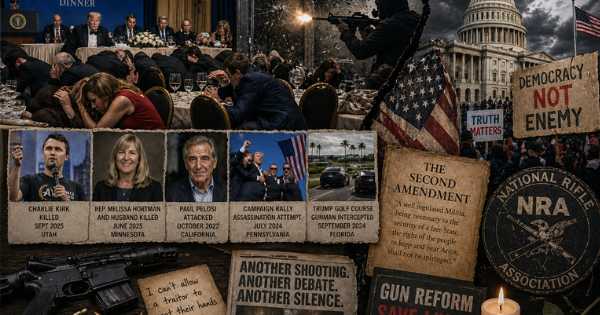
The air in Washington DC usually carries a certain performative tension during the annual White House Correspondents’ Association dinner. It is a night designed for the intersection of power and the press, a rare moment where the friction of the briefing room is supposed to give way to self-deprecating jokes and a shared, if fragile, respect for the First Amendment. But on a recent Saturday evening, that fragile peace was shattered by the sharp, unmistakable cracks of gunfire. The gala, attended by President Donald Trump and his senior administration officials, became the latest backdrop for a terrifying display of political violence that has increasingly come to define the American experience.
A gunman managed to breach security protocols, firing shots that sent the nation’s most powerful figures and members of the global press diving for cover under linen-clothed tables. While the President and his staff escaped physically unharmed, the psychological toll of the event rippled instantly across the country. The suspected shooter was quickly apprehended and identified as Cole Tomas Allen, a thirty-one-year-old man from Torrance, California. Initial investigations suggest a premeditated strike driven by deep-seated political animosity. White House officials noted that Allen clearly stated his intention to target members of the administration. A chilling note recovered by law enforcement revealed a man who felt pushed to the brink, claiming he could no longer allow a person he viewed as a traitor to coat his hands with crimes.
This was not an isolated flash of anger but rather the third major incident apparently targeting Mr. Trump. It follows a harrowing campaign rally where an assassin’s bullet grazed the President’s ear and another tense encounter where a gunman was intercepted near a golf course he frequently visits. Each of these events serves as a grim milestone in a timeline of escalating hostility that shows no signs of slowing. The shooting at the Hilton ballroom is a symptom of a much larger, more systemic rot in the way Americans engage with one another when their visions for the country diverge.
When we look back at the last couple of years, the landscape of American politics is littered with the casualties of this culture of violence. In September 2025, the country was rocked by the killing of conservative activist Charlie Kirk in Utah, an event that sent shockwaves through the Republican base. Only a few months before that, Minnesota felt the sting of tragedy when Democratic State Representative Melissa Hortman and her husband were murdered.
These acts of violence are not confined to one side of the aisle; they represent a total breakdown of the democratic compact. We also cannot forget the 2022 attack on Paul Pelosi, which demonstrated that even the families of political leaders are now considered fair game in this scorched-earth environment.
The current atmosphere is thick with a level of polarization that feels almost impossible to navigate. Mr. Trump is now more than a year into his second term, and the policy battles over immigration, trade, and social issues have reached a fever pitch. Combined with the lingering controversies surrounding his past associations, including his ties to the late Jeffrey Epstein, the national mood has curdled into something dangerously volatile. There is a sense that the common ground has not just shrunk but has been completely excavated.
While bitter partisanship is a historical staple of the American story, the specific danger of the modern era is found in the sheer number of guns available to those who feel they have no other way to be heard. The proliferation of firearms has given a deadly edge to what should be verbal or electoral disagreements. There is a tragic irony in the fact that the current administration has been one of the most vocal defenders of the Second Amendment. By aligning so closely with the National Rifle Association and working to roll back even modest restrictions on ownership, the administration has championed a philosophy that views the widespread presence of guns as a fundamental necessity of liberty.
Mr. Trump’s own journey on this issue reflects the shifting tides of the political landscape. Back in 2000, he expressed support for a ban on assault weapons, a position that seems almost unrecognizable compared to his current stance. By the time he entered the 2016 race, his views had shifted to match the priorities of the millions of dollars in NRA support that flowed into his campaign. This policy shift has occurred even as the United States is periodically wracked by the trauma of mass shootings. With three such incidents already recorded this year and hundreds over the last several decades, the frequency of these tragedies has created a sense of national numbness.
The lobbying power of the NRA and the deep pockets of gun rights groups on Capitol Hill often make the prospect of reform feel like a distant dream. There is a cycle that occurs after every high-profile shooting: a brief period of national mourning, a heated debate over gun control, and then a return to a status quo that ensures the next incident is only a matter of time. It is a cycle that requires a fundamental reassessment of what we value as a society. It behoves the nation to take a step back from this unrelenting epidemic and consider the human cost of current policies.
Common-sense reforms, such as more rigorous background checks and limitations on high-capacity magazines, are often framed as radical attacks on freedom. In reality, they are attempts to restore a level of safety to the public square. Until Congress can find the political will to enact such measures into law, the threat remains constant. The incident in Washington is a reminder that no one is truly safe in a society where the first instinct in a disagreement is to reach for a weapon.
The cultural shift required to change this trajectory is immense. We are living in a time where moderate voices are often drowned out by those who believe that the only way to save the country is to destroy their opponents. This belief system, when paired with easy access to lethal force, creates a powder keg that can be ignited by a single social media post or a piece of breaking news. The suspect in the Washington shooting, with his talk of traitors and crimes, appears to have been a person who convinced himself that violence was a moral necessity.
The impact of these events goes far beyond the immediate targets. Every time a gun is fired in a political context, it chips away at the foundation of the democratic process. It sends a message that power is not something to be debated or won at the ballot box, but something to be seized or silenced through fear. This climate of intimidation makes it harder for good people to enter public service and makes it nearly impossible for citizens to engage in the kind of honest, difficult conversations that are required for a healthy society.
The events at the press dinner should be a wake-up call, but history suggests it might just be another data point in a long and bloody trend. We have seen time and again that the shock of a single event is rarely enough to overcome the entrenched interests that benefit from the current system. The rhetoric from both sides of the political spectrum often serves to fan the flames rather than douse them, creating an environment where the next Cole Tomas Allen is already being radicalized in some corner of the internet.
Addressing the culture of violence requires more than just new laws, though those are essential. It requires a collective decision to reject the idea that our neighbors are our enemies. It requires a media environment that prioritizes facts over outrage and a political leadership that values the stability of the republic over the temporary gains of a news cycle. Without these changes, the proliferation of guns will continue to provide a shortcut to tragedy for anyone with a grievance and a trigger finger.
The events of 2025 and early 2026 have shown us what the alternative looks like. It is a world where activists are picked off at university events, where local representatives are hunted in their own homes, and where a night intended for humor and celebration turns into a scene of chaotic survival. This is not the vision of a functional democracy; it is the portrait of a society in the midst of a slow-motion collapse.
It is reasonable to believe that until there is a move toward a more moderate position on gun laws and a genuine effort to lower the temperature of our national discourse, the violence will continue unabated. The shooting in Washington was a close call that could have altered the course of history in a single second. We may not be so lucky next time. The urgency of this moment cannot be overstated, yet the path to a solution remains blocked by the same partisanship that fueled the fire in the first place.
The story of Cole Tomas Allen is a story about the failure of our social and political systems to provide a constructive outlet for anger and a safe environment for everyone. It is a story about how easily the language of war can be adopted by those who feel forgotten or betrayed. Most of all, it is a story about the cost of inaction. Every day that passes without meaningful change is a day that we accept the current culture of violence as the new normal.
We must look at the names of those lost like Charlie Kirk, Melissa Hortman and the countless anonymous victims of gun violence and ask if this is truly the best we can do. The edge of our disagreements has become too sharp, and the tools we use to settle them have become too lethal. The time for common-sense reform was years ago, but the second-best time is right now. If we continue to wait, we are simply waiting for the next tragedy to arrive.