
By Satyabrat Borah
The sun over the Indian subcontinent has always been a formidable presence, but lately, it feels less like a familiar seasonal guest and more like an unwelcome intruder that has broken in far too early. We are seeing a shift in the very rhythm of the year. While the calendar says it is only April, the thermometer is already screaming that it is June. This premature arrival of extreme heat is not just a matter of discomfort or a reason to stay indoors; it is a fundamental challenge to the way life functions in one of the most populated regions on Earth. Across the vast stretches of Vidarbha, through the coastal humidity of Kerala, and into the industrial heartlands of Gujarat, the mercury is hitting marks that used to be reserved for the peak of summer. When the air hits forty degrees Celsius before the first monsoon clouds are even a distant hope, we have to acknowledge that the ground beneath our feet is changing.
This year, the weather seems to have lost its traditional balance. Usually, we rely on western disturbances or the occasional afternoon thunderstorm to provide a temporary reprieve, a cool breath that breaks the tension of a sweltering afternoon. But those natural cooling mechanisms have gone silent. Without the convective activity that usually stirs the air, the heat simply sits there, heavy and stagnant. We are also feeling the lingering ghost of the previous El Nino, which has left the atmosphere primed for these spikes. In cities, the situation is even more claustrophobic. The urban heat island effect means that concrete and asphalt soak up the sun all day and radiate it back out all night. This creates a cycle where the body never gets a chance to truly rest. When the nights stay warm, our hearts and lungs have to keep working at high speed just to keep our internal temperatures stable. This physiological exhaustion is a quiet crisis, one that fills hospital wards with people suffering from heatstroke and cardiovascular stress long before the official heatwave season is supposed to begin.
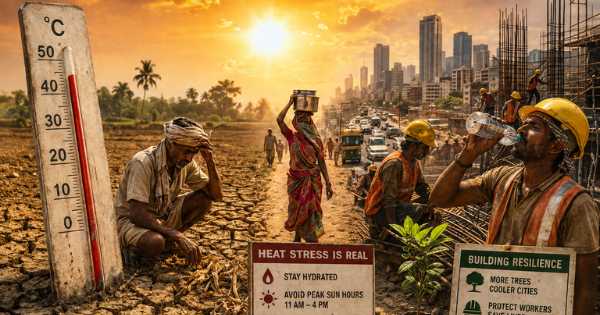
The impact of this warming reaches far into the fields and onto the scaffolding of our rising cities. Most of the people building modern India or growing its food do so with nothing but the sky above them. For a construction worker in a city or a farmer tending to the rabi harvest, a heatwave is not an inconvenience; it is a direct threat to their ability to earn a living. We saw staggering numbers recently suggesting that billions of work hours are being swallowed up by the heat. When it becomes physically impossible to stand in the sun, the economy slows down, but the needs of the family do not. Farmers face a double blow because the heat forces crops to mature too quickly, which shrivels the harvest and drives up the price of food for everyone else. This creates a ripple effect of inflation and hunger that starts in a parched field and ends at every dinner table in the country.
Our current way of handling this is largely reactive. We have heat action plans, which are good in theory, but they often function like a bandage on a deep wound. They focus on telling people to drink water or stay inside during the peak hours of the noon sun. While that advice is necessary, it does nothing to change the fact that a daily wage laborer cannot afford to miss a day of work, or that many urban homes are little more than tin-roofed ovens. We need to move toward structural changes. This means re-greening our cities so that trees can provide natural shade and cooling. It means passing laws that protect workers in the informal sector, ensuring they have mandatory breaks and access to cooling stations without losing their pay. Without dedicated funding and a shift toward long-term cooling infrastructure, we are just waiting for the next emergency rather than preventing it.
Even our democratic processes are being tested by the rising temperature. During recent elections, millions of people had to stand in line under a punishing sun to cast their votes. While extending polling hours is a kind gesture, it is a temporary fix for a permanent problem. If the current trend of warming continues, some parts of the country might reach a point where being outdoors for extended periods becomes a risk to human survival itself. This is a sobering thought. It suggests that our very way of life, from how we work to how we govern ourselves, is being squeezed by the climate.
There is a path forward, though it requires a level of international cooperation and local boldness that we haven’t fully embraced. Other nations are forming coalitions to move away from the fossil fuels that drive this warming, and there is a strong argument for India to be at the center of those conversations. Joining these global efforts isn’t just about environmental idealism; it is about getting access to the money and technology needed for climate adaptation. Locally, we could be doing so much more. Mobile health units could be sent directly into the hottest neighborhoods. Essential services could be delivered to the doorsteps of the elderly and the vulnerable during the worst weeks of the year. We have to address the underlying vulnerability of our people. The heat is coming earlier and staying longer, and our response must be just as persistent and much more visionary. We are living through a transformation of our climate, and our survival depends on how quickly we can transform our society to match it.