
By Dipak Kurmi
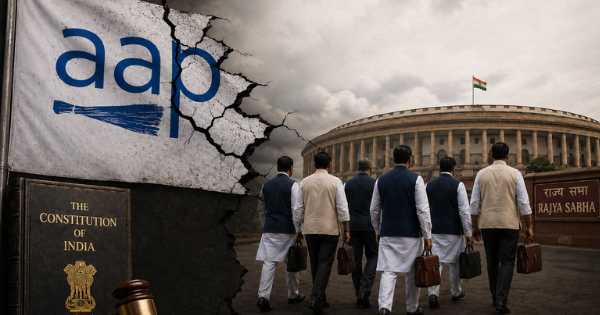
The Aam Aadmi Party, a political entity that once boasted a meteoric rise unparalleled in the annals of modern Indian history, is currently grappling with its most profound existential crisis to date. What was originally envisioned as a bastion of inclusivity and a monument to ideological cohesion is now visibly splitting down the middle, threatening the very foundations of its survival. The genesis of this catastrophic unraveling can be traced back to the high-profile rebellion of its Rajya Sabha member Raghav Chadha, whose eventual crossing of the floor to join the Bharatiya Janata Party acted as the first domino in a rapidly collapsing structure. This individual act of defiance has since snowballed into an en masse defection within the Upper House of Parliament, systematically eroding the party’s prestige and significantly hollowing out its legislative presence at the national level.
The subsequent defection of seven Rajya Sabha Members of Parliament from the Aam Aadmi Party to the Bharatiya Janata Party has triggered far more than a mere moment of political embarrassment; it has ruthlessly exposed the structural vulnerabilities of a party that once claimed to be immune to the vices of traditional politics. For a movement born out of the heat of anti-corruption protests and strategically positioned as a moral alternative to an entrenched political culture, AAP is now facing the grim reality that its own rank and file are profoundly disillusioned. The party leadership is increasingly being accused of adopting an autocratic style of functioning, characterized by a lack of transparency and a refusal to engage with internal dissent. These defections are not isolated incidents but are symptomatic of a deep-seated rot where the idealistic fervor that once unified the party has been replaced by a stifling centralization of power.
This mass exodus of parliamentarians has precipitated a complex constitutional situation, bringing the intricacies of Indian law into sharp focus. The central question currently being debated across the legal and political spectrum is whether the Anti-Defection Law, as outlined in the Tenth Schedule of the Constitution, applies to these seven individuals and whether they should face immediate disqualification. The immediate theater of this battle has shifted to the office of the Rajya Sabha Chairperson, C. P. Radhakrishnan, where the AAP leadership intends to aggressively pursue the disqualification of the defecting members. The party’s legal argument rests heavily on the sanctity of constitutional provisions, asserting that any act of defection, regardless of the numerical strength involved, is inherently unconstitutional and a betrayal of the electoral mandate.
However, the defectors appear to have calculated their moves with clinical precision, utilizing the very loopholes that the Anti-Defection Law inadvertently provides. Under the current legal framework, if two-thirds of the legislative members of a party defect, it is categorized not as a defection but as a legitimate “merger” with another political entity. Since the seven defecting MPs constitute more than two-thirds of AAP’s total strength of ten members in the Rajya Sabha, the party may find itself legally impotent in its attempt to disqualify them. This is not merely a legal contest; it is a harsh political reality check that demonstrates how a sophisticated understanding of constitutional technicalities can be used to legitimize what the parent party views as a moral transgression.
The leadership of the Aam Aadmi Party, including prominent figures such as Sanjay Singh and Punjab Chief Minister Bhagwant Mann, has sought to control the narrative by framing these defections as the result of external coercion and unethical political maneuvering. They characterize the loss of their colleagues as a targeted hit by the ruling establishment to fracture the opposition. Yet, the voices emerging from within the breakaway faction tell a significantly different and more nuanced story of internal neglect. These members speak of a pervasive sense of alienation, the total inaccessibility of the top leadership, and a mounting dissatisfaction with the quality of governance, particularly regarding the administrative challenges facing the state of Punjab. Allegations of the marginalization of key leaders and the concentration of all decision-making power in a few hands suggest that the organizational fissures have been widening for years.
This crisis was not a sudden explosion but rather a slow-burning fire that has finally reached the surface. AAP’s rapid expansion from its stronghold in Delhi to its victory in Punjab created a sprawling organizational structure that remained fundamentally fragile and lacked the deep-rooted institutional stability of older parties. The rapid growth outpaced the development of internal mechanisms for conflict resolution, leaving the party vulnerable to the kind of internal combustion currently on display. The dissatisfaction in Punjab, often cited as a primary driver for the rebellion, highlights the difficulty of transitioning from a protest movement into a governing body capable of satisfying diverse regional aspirations and managing complex state bureaucracies.
What lies immediately ahead for the Aam Aadmi Party is a grueling test of its political maturity and its capacity for self-reflection. The leadership stands at a crossroads where it can choose to dismiss this turmoil as nothing more than external sabotage orchestrated by rivals, or it can choose to confront the uncomfortable internal truths that allowed such a rebellion to germinate. Rebuilding trust within its depleted ranks, decentralizing its leadership hierarchy, and genuinely addressing the governance concerns that have alienated its own representatives will be crucial if the party hopes to survive. The alternative is a slow but inevitable erosion of its credibility, where it risks becoming just another cautionary tale in the history of Indian political movements.
The larger lessons of this crisis extend far beyond the fate of a single political party and touch upon the health of the Indian democratic framework itself. India’s anti-defection framework was originally conceived to ensure parliamentary stability and prevent the “Aaya Ram, Gaya Ram” culture of the past, yet it has paradoxically ended up legitimizing large-scale, organized defections while punishing the lone, principled dissenter. This legal contradiction rewards those who can organize a mass rebellion while leaving the individual representative without the right to disagree with party dictates. Until this fundamental contradiction in the Tenth Schedule is addressed by the legislature, such wholesale political migrations will remain a recurring and destabilizing feature of the Indian landscape.
Furthermore, this episode serves as a telling reflection of the declining standards of contemporary Indian democracy. The increasing reports of money and coercion being deployed by ruling parties to fracture the opposition represent a significant departure from the high standards and moral limits that once defined the nation’s political discourse. It forces a serious rethink on the ethical boundaries of power and the resilience of the institutions meant to protect the mandate of the people. When the mechanics of power overshadow the principles of representation, the democratic process itself becomes a casualty of strategic attrition. For AAP, the path to redemption requires more than just a legal victory; it requires a return to the transparency and grassroots connectivity that first captured the imagination of the Indian electorate.
(the writer can be reached at dipakkurmiglpltd@gmail.com)