
By Satyabrat Borah
The results of the 2026 Assembly elections have delivered a verdict that is both a resounding endorsement of the incumbent administration and a devastating indictment of the traditional opposition structure. By securing a convincing and overwhelming majority, the Bharatiya Janata Party has not only retained power but has also effectively redefined the parameters of electoral dominance in Northeast India. The scale of this victory suggests a deep-rooted alignment between the aspirations of the electorate and the governance model offered by the ruling party. At the heart of this tectonic shift lies a narrative of two starkly different trajectories: the continued ascent of a well-oiled political machine and the sudden, precipitous decline of a political dynasty that once seemed unassailable.
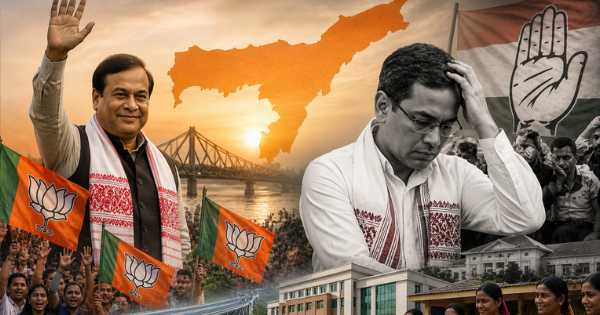
The most visible symbol of this shift is the defeat of Gaurav Gogoi, an event that has sent shockwaves through the national political circuit. As the leader of the opposition and the son of a former three-term Chief Minister, his career was widely seen as the primary hope for a Congress revival in the region. His loss in a seat that was considered a personal and familial stronghold represents more than just a localized failure; it signals the possible conclusion of an era. When a figure of such central importance loses their own contest, it creates a vacuum of leadership that is difficult to fill and suggests that the voters have moved past the politics of legacy.
The voters chose to prioritize a vision of progress and stability over historical associations, a choice that has left the Congress party in a state of unprecedented crisis. This defeat serves as a definitive marker of the changing times, where name recognition and lineage no longer provide a guaranteed path to power in the face of a disciplined and ideologically driven opponent.
The BJP’s success can be attributed to a meticulous strategy that combined aggressive infrastructure development with a highly efficient social welfare delivery system.
Over the past several years, the state has witnessed a visible overhaul of its physical landscape, with new bridges, highways, and medical colleges becoming the tangible symbols of a government in action. This focus on “big-ticket” projects was complemented by a grassroots approach to governance that reached the remotest corners of the Brahmaputra and Barak valleys. By ensuring that government benefits reached the intended recipients without the interference of middlemen, the administration built a direct and powerful rapport with the common citizen. This bond proved to be resilient against the challenges posed by the opposition, as voters felt a personal stake in the continuation of the current regime.
The sense of security and the promise of a predictable future outweighed any grievances that might have been expected after multiple terms in office.
In contrast, the Congress party struggled to articulate a coherent or compelling alternative vision. The reliance on a coalition of disparate interests lacked the ideological glue necessary to withstand the BJP’s narrative of unity and growth. While the opposition attempted to raise concerns about identity and constitutional values, these arguments seemed distant to an electorate focused on economic mobility and social stability.
The internal fractures within the Congress organization became increasingly apparent as the campaign progressed, with local leaders often working at cross-purposes. This lack of cohesion was brutally exposed on counting day. The disappearance of the Congress from its traditional bastions indicates a failure to adapt to the new realities of Indian politics, where a constant presence and a clear message are required to remain relevant.
The party now faces the daunting task of reinventing itself from the ground up, a process that appears nearly impossible given the current state of its leadership.
The role of the Chief Minister in this victory cannot be overstated. His ability to communicate directly with the masses and his reputation as a tireless worker have made him the central pillar of the party’s success. He has managed to bridge the gap between traditional cultural concerns and modern developmental needs, creating a synthesis that appeals to a broad cross-section of society.
His tactical brilliance in navigating the complexities of Assam’s demographic makeup allowed the BJP to expand its reach into areas that were previously considered hostile territory. By framing the election as a choice between a future of rapid modernization and a return to the perceived stagnation of the past, he successfully localized the national momentum of his party. The conviction with which the people have voted suggests that they view his leadership as essential for the state’s journey toward becoming a major economic hub.
The defeat of Gaurav Gogoi is particularly poignant because it comes at a time when he was being projected as a future national leader. His inability to hold his own ground raises serious questions about the viability of the Congress party’s strategy of relying on prominent individuals rather than building a robust organizational foundation. The loss suggests that the voters of Assam are no longer moved by the rhetoric of the past and are demanding a level of engagement that the Congress was unable to provide. It is a moment of reckoning for the party, as it realizes that its influence has diminished to a point where even its most celebrated faces are vulnerable. The vacuum created by this defeat will likely lead to a period of intense internal soul-searching, but the path to recovery remains obscured by the sheer scale of the BJP’s triumph.
The results indicate a significant consolidation of the tribal and ethnic votes in favor of the NDA. The strategic alliances formed with regional parties were not merely electoral pacts but were perceived as genuine partnerships aimed at preserving the unique cultural identities of various communities while integrating them into the broader developmental agenda. This inclusivity helped the BJP neutralize the opposition’s attempts to paint it as a monolithic force. Instead, the party emerged as a diverse platform that could accommodate different voices under a single banner of progress. The success in the autonomous districts and the tea garden belts further solidified this position, leaving the opposition with very few pockets of influence. The map of Assam is now almost entirely painted in the colors of the ruling alliance, reflecting a level of political homogeneity that the state hasn’t seen in decades.
The electoral process itself highlighted the high level of engagement among the people of Assam, with voter turnout reaching impressive levels across all phases. This high participation is a testament to the vibrancy of the democratic spirit in the region, but it also reflects a clear desire for a decisive mandate. The people did not want a fractured or uncertain government; they wanted a clear direction, and they found it in the promises of the BJP. The overwhelming nature of the win provides the government with a powerful mandate to pursue its legislative and developmental goals without the constant need for political compromise. This stability is expected to attract more investment and focus to the state, further fueling the cycle of growth that has been the hallmark of the recent administration.
As the new government prepares to take office, the challenges ahead are significant but are met with a sense of optimism by the supporters of the ruling party. The focus will likely remain on completing the ongoing infrastructure projects and expanding the digital footprint of the state’s economy. The integration of Assam with the rest of Southeast Asia through the Act East policy remains a priority, and this victory provides the necessary political capital to push that agenda forward. The administration will also need to address the long-term issues of flood management and employment generation, which remain critical for the sustained prosperity of the region. However, with the opposition in disarray, the government faces little resistance in implementing its vision.
The decline of the Congress in Assam is a microcosm of its struggles in several other parts of the country. The loss of a state where it once held a monopoly on power is a harsh reminder of how quickly political fortunes can change in a dynamic democracy. For a party that once defined the political identity of the Northeast, being reduced to a marginal player is a humbling experience. The absence of a strong opposition is not necessarily a positive development for a healthy democracy, as it removes the checks and balances required for accountability. However, the responsibility for this situation lies with the opposition itself, which failed to offer a credible or energetic challenge to the dominant narrative.
The BJP’s victory in 2026 will be remembered as the moment when the party transitioned from being a formidable contender to becoming the natural party of governance in Assam. Its ability to win convincingly across different geographies and demographics proves that its message has a universal appeal within the state. The focus on “Sabka Saath, Sabka Vikas” was not just a slogan but was seen as a lived reality by many who had felt neglected by previous administrations. The sense of belonging and the pride in the state’s progress have become powerful motivators for the electorate. The BJP has successfully tapped into the collective psyche of the people, presenting itself as the guardian of Assam’s interests and the architect of its future.
The aftermath of this election will see a major realignment of political forces. Small regional players may find it increasingly difficult to survive as independent entities and might seek closer ties with the ruling party to remain relevant. The Congress, on the other hand, might see further defections as leaders look for more viable political futures. The total collapse of the Gaurav Gogoi-led campaign signifies that the old ways of doing politics are no longer effective. The new era of Assam politics is defined by high-tech campaigning, data-driven governance, and a relentless focus on delivery. The BJP has mastered these elements, while its rivals are still struggling to find their footing in this new environment.
The narrative of this election is one of a mandate for continuity and a rejection of the status quo of the past. The people of Assam have spoken with a clarity that leaves no room for ambiguity. They have chosen a path of growth, security, and assertive leadership. The convincing win for the BJP ensures that the state will continue on its current trajectory for the foreseeable future. The opposition’s failure to hold even its most prestigious seats suggests a disconnect that will take more than just one election cycle to repair. As the celebrations continue in the BJP camps, the reality of the task at hand remains. The government now has the responsibility to live up to the immense trust placed in it by millions of citizens.
The victory also has implications for the national political scene. Assam serves as a gateway to the Northeast, and the BJP’s dominance here strengthens its position across the entire region. The model of governance developed in Assam is often cited as an example for other states to follow. The ability to manage complex social dynamics while maintaining a focus on economic development is a rare feat in Indian politics. This success provides the national leadership of the BJP with a success story that they can showcase on a larger stage. It also proves that the party’s ideological reach is expanding, finding resonance in areas that were once thought to be culturally and politically distinct.
In the final assessment, the 2026 Assam elections have established a new political order. The BJP has emerged as the sole dominant force, while the Congress has been pushed to the fringes of relevance. The defeat of Gaurav Gogoi is the definitive image of this election, symbolizing the fall of a political house and the rise of a new era. The convincing victory is a testament to the power of a clear vision and the importance of delivering on promises. As the state moves forward, the impact of this mandate will be felt in every aspect of its public life.
The journey of Assam toward a more prosperous and stable future continues, now with a government that has the full and unwavering support of its people. The political map has been redrawn, and for now, it is a map that belongs entirely to the BJP. The era of uncertainty is over, replaced by a period of settled leadership and a singular focus on the progress of the state. The lessons from this election will be pondered by all who seek to understand the pulse of modern India, for in the story of Assam’s 2026 verdict, one finds the broader story of a nation in transition. The triumph of the ruling party is a clear indication that the voters value results above all else, and in this election, the results were delivered with a conviction that was impossible to ignore.