
By Satyabrat Borah
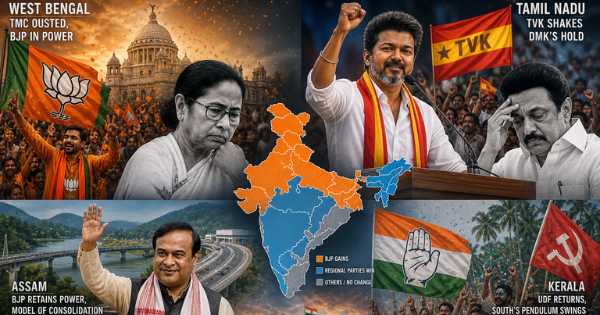
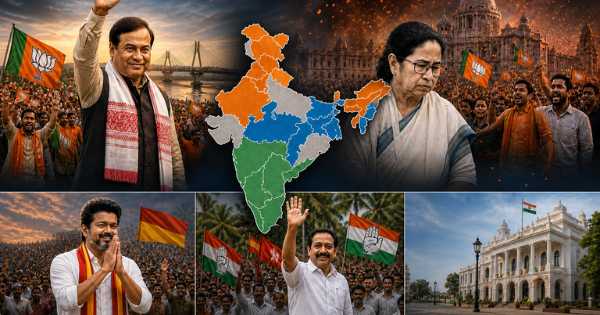
The 2026 Assembly elections have left India at a crossroads that feels both familiar and deeply unsettling. As the dust settles across Assam, West Bengal, Tamil Nadu, Kerala, and Puducherry, the political map of the country looks like a patchwork quilt of conflicting ideologies and shifting loyalties. We are looking at a moment where the National Democratic Alliance finds itself celebrating massive territorial gains in the north and east while facing a stubborn, almost impenetrable wall in the south. This election cycle was never just about who gets to sit in the Chief Minister’s chair for the next five years. It was a high-stakes battle for the soul of our federal structure and the definition of what it means to be a secular republic in a rapidly changing world. When we look at the numbers and the narratives that emerged from these five regions, we see a story of incredible consolidation on one side and a desperate, sometimes failing, struggle for relevance on the other.
In Assam, the story is one of absolute dominance that has effectively rewritten the rules of the game. For the first time in the history of the state, the Bharatiya Janata Party has managed to cross the halfway mark of sixty four seats entirely on its own strength. This is a massive psychological and political victory for Himanta Biswa Sarma, who has spent the last few years crafting a persona that blends aggressive communal rhetoric with a very calculated system of welfare redistribution.
By winning one hundred and one seats along with its partners in the one hundred and twenty six member Assembly, the NDA has essentially decimated the opposition. The Congress party is staring at a wreckage that is hard to describe. This is their worst performance ever, falling even below the dismal numbers they saw in 1985 after the Assam Agitation. It is a stinging blow to the grand old party, especially with Gaurav Gogoi losing his own seat. It feels like the old guard of Assamese politics has been pushed out by a new, more muscular form of nationalism that does not feel the need to hide its polarising edges. The regional parties that tried to find a middle ground or align with the Congress, like the Raijor Dal and Assam Jatiya Parishad, were completely routed. Even the allies within the NDA, such as the Asom Gana Parishad and the Bodoland People’s Front, find themselves in a precarious position. They won a few seats, but they have almost no leverage left because the BJP does not actually need them to stay in power. The state has moved from a complex multi-polar contest to a virtual one-party system.
While the victory in Assam was a validation of a sitting government, the earthquake in West Bengal is what will define the history books of this decade. The BJP has achieved what many thought was impossible just a few years ago. They have managed to dismantle the Trinamool Congress’s fortress through a combination of relentless, long-term planning and a deep understanding of Bengal’s unique political history. Bengal has always been a paradox. It was the cradle of India’s national movement and a bastion of secularism for decades under the Left, but it was also the birthplace of many Hindutva ideas long before they became mainstream in the cow belt.
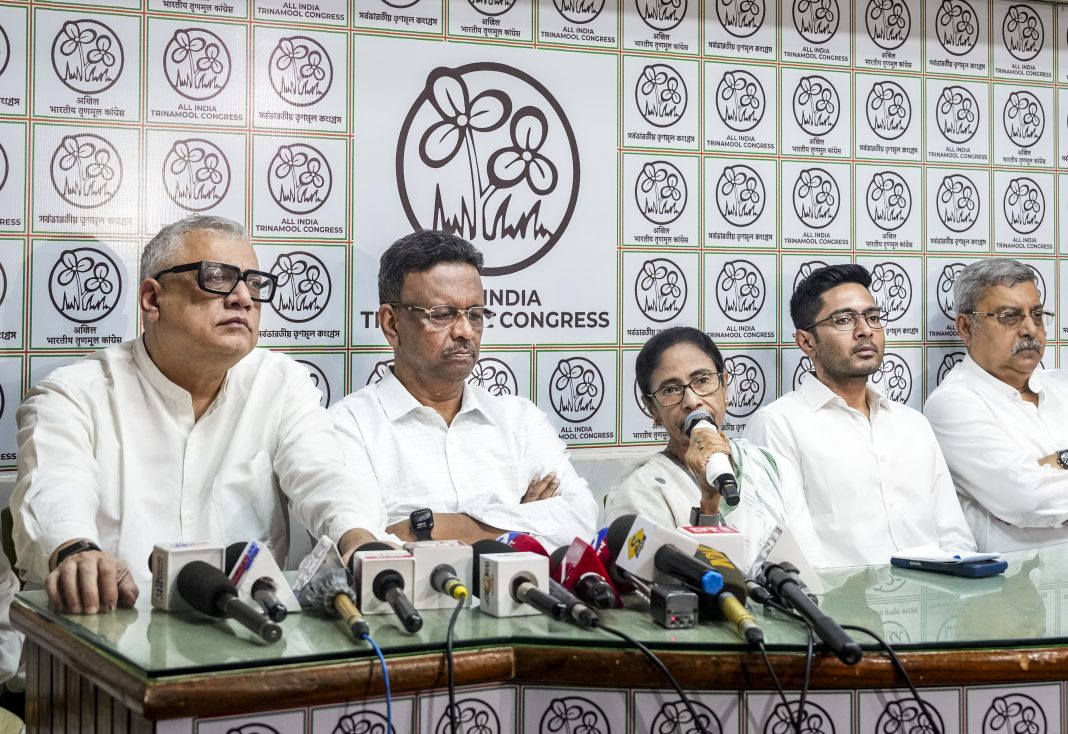
The BJP tapped into this older, dormant identity and fused it with a totalising nationalist narrative that eventually overwhelmed the regional pride Mamata Banerjee had successfully weaponised for so long. The Trinamool Congress now finds itself in a state of existential crisis. Mamata Banerjee is seventy one years old, and without a clear line of succession that carries her same fire and connection to the grassroots, the party looks vulnerable. Its cadres and voters are now exposed to the immense pressure of a triumphant BJP that has shown it knows how to subsume regional politics, much like it did in Maharashtra and Odisha.
But we cannot talk about the Bengal results without addressing the dark clouds that hung over the entire process. This was perhaps the most tainted election in our recent memory. The fact that nearly twenty seven lakh people were arbitrarily removed from the electoral rolls is a staggering blow to the integrity of our democracy. When the Supreme Court of India took what many see as an unhelpful view of this massive disenfranchisement, it sent a shiver down the spine of anyone who cares about fair play. If a victory is built on the foundation of excluding a significant portion of the electorate from the very act of voting, then the mandate carries a heavy burden of doubt. It is a sign of a decaying democratic culture where the process matters less than the result. This trend is a cause for serious concern because it suggests that the fundamentals of our republic are being tinkered with in ways that might be irreversible.
The narrative shifts completely when we cross the Vindhyas and look at the southern states. In Tamil Nadu and Kerala, the NDA’s juggernaut hit a solid wall of regional identity and alternative governance models. In these two states, the incumbents were swept away, but not in the direction the BJP hoped for. The people chose to change their leaders, but they did not choose the saffron path. Tamil Nadu remains a territory where the Dravidian identity is the primary filter through which all politics must pass. The rejection of the NDA here is a reminder that a singular, centralised nationalist narrative often fails to resonate in places that take deep pride in their linguistic and cultural distinctiveness.
Kerala also followed its tradition of rotating power, but it did so by keeping the contest within the frameworks of its own unique social coalitions. These states act as a vital check on the idea that India is moving toward a monolithic political future. They represent the federal spirit of our republic, proving that different parts of the country can and will march to different beats.
The success of the BJP in the east and its failure in the south creates a strange imbalance in the national discourse. We are seeing a country that is becoming more politically polarised not just between parties, but between entire regions. The north and east seem to be gravitating toward a strong, centralised authority that uses a mix of religion and direct benefit transfers to maintain its grip.
Meanwhile, the south continues to protect its autonomy and its own specific brand of social justice politics. This divergence makes the task of national integration much harder. It places a lot of stress on our federal institutions, which are supposed to mediate between these different visions of India. When one side feels that the very rules of the election are being manipulated, as we saw in Bengal, the trust that holds a diverse country together begins to fray.
Puducherry followed the trend of the NDA retaining power, similar to Assam, which provides a small foothold for the alliance in the south, but it is too small a sample to suggest a broader shift in the region. The real story remains the massive consolidation of power in the hands of a few leaders who have mastered the art of the permanent campaign. The way Himanta Biswa Sarma has reinforced his position in Assam is a masterclass in modern Indian politics. He has managed to make himself indispensable by being both a development-oriented administrator and a fierce ideological warrior. This dual identity allows him to appeal to a broad base of voters while keeping his core supporters energised.
On the other hand, the loss for the Congress and its regional allies in the state shows a complete lack of a counter-narrative. You cannot defeat a powerful ideological machine with half-hearted alliances and a leadership that seems disconnected from the ground.
The situation for the opposition in Bengal is even more dire. The Trinamool Congress’s politics had clearly run its course, exhausted by years of incumbency and allegations of corruption that the BJP was able to exploit. But more than that, the BJP succeeded because it was willing to play the long game. They did not just show up for the election; they spent years building an organisation that could match the TMC’s muscle on the streets. This meticulous preparation is what allowed them to convert a threshold population to their side. Now that they have won, the question is how they will govern a state as complex and volatile as Bengal. Will they try to heal the wounds of a fractured society, or will they continue the same polarising tactics that brought them to power? Given the history of the last few years, many fear it will be the latter.
When we think about the future of India as a secular, democratic, federal republic, these election results offer a mixed bag of hope and despair. The persistence of regional identities in the south is a sign of health for our federalism. It shows that the Indian voter is not a monolith and can distinguish between national trends and local needs. But the erosion of democratic norms in the election process in Bengal is a warning that we cannot ignore.
A democracy is only as strong as its weakest link, and if our electoral rolls and our courts fail to protect the right of every citizen to vote, then the very foundation of our republic is at risk. We are living through a time of great flux where old certainties are disappearing and new, often harsher realities are taking their place. The 2026 elections have shown us that while some parts of India are ready to embrace a new order, others are digging their heels in to protect a different vision of the country. This tension is what will define our politics in the years to come. It is not just about who wins or loses; it is about what kind of India survives the victory.