
By Dipak Kurmi
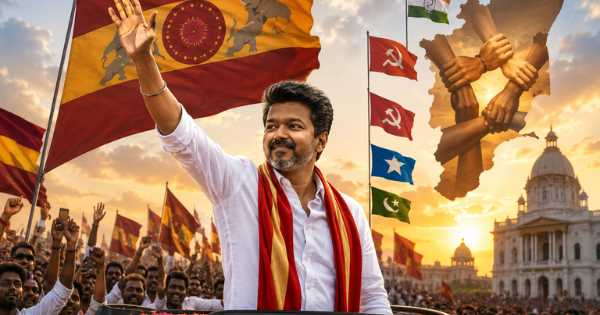
The political landscape of Tamil Nadu, long defined by the rhythmic oscillations between the DMK and the AIADMK, has officially entered an unprecedented era of multi-polar governance. In a development that has sent shockwaves through the Dravidian heartland, the Tamizhaga Vettri Kazhagam (TVK) has successfully navigated the complexities of a hung assembly to secure the majority required to form the next state government. According to reports from the Times of India, the actor-turned-politician Vijay has demonstrated a surprising level of diplomatic finesse, transforming his party’s status as the single largest entity into a governing coalition. This breakthrough does not merely represent a change in administration but signals a fundamental collapse of the decades-old bipolar dominance that has dictated the state’s destiny since the late 1960s. By stitching together a diverse tapestry of ideological allies, TVK has positioned itself as the fulcrum of a new political consensus, marking a historic departure from traditional power dynamics.
The path to this majority was paved with intense mathematical scrutiny and high-stakes negotiations following a verdict that initially left the state in a state of legislative paralysis. TVK had emerged from the polls with 108 seats, a figure that was subsequently adjusted to 107 after the party leader vacated one of the two constituencies he had contested. While this established the party as the dominant force in the 234-member house, it left them short of the 118-seat magic figure needed for a simple majority. The ensuing days were characterized by frantic political maneuvering as the single largest party sought to bridge the eleven-seat deficit. The breakthrough began when the Congress party, holding five crucial seats, became the first to extend its formal support. This initial infusion of strength brought the TVK tally to 112, yet the assembly remained tantalizingly out of reach, necessitating further alliances with regional and ideological players who have traditionally occupied the fringes of the DMK-led bloc.
The final consolidation of power was achieved through a series of tactical internal meetings and formal overtures to the Left and Dalit-focused parties. In a significant realignment, the Viduthalai Chiruthaigal Katchi (VCK) and the Indian Union Muslim League (IUML) joined forces with the Communist Party of India (CPI) and the Communist Party of India (Marxist) to provide the necessary legislative floor support. CPM state leader P. Shanmugam confirmed that the decision followed a formal written request from Vijay, who invoked constitutional conventions regarding the priority of the single largest party in a hung house. With two seats each from VCK, CPI, CPM, and IUML, the TVK-led alliance reached a final strength of 120 seats. This mathematical victory is being hailed as Vijay’s first major triumph in the theatre of realpolitik, proving that his screen presence could indeed be translated into the gritty, backroom diplomacy required to lead a state as complex as Tamil Nadu.
This development is particularly striking because it reflects a massive migration of support from parties that were once considered the bedrock of the Dravidian Progressive Federation. By bringing together the Congress and the Left under a single banner, TVK has effectively dismantled the traditional alliance structures that the DMK relied upon for stability. Analysts suggest that this shift indicates a growing appetite for a third alternative that moves beyond the legacy of the Karunanidhi and Jayalalithaa eras. The ability of a nascent party to attract established entities like the IUML and VCK suggests a persuasive narrative of inclusivity and administrative reform that resonated during the negotiation phase. It remains to be seen whether this coalition will operate as a formal cabinet-sharing arrangement or if the allies will provide support from the outside to maintain their distinct ideological identities while ensuring the government’s survival.
As the dust settles on the legislative numbers, the focus now shifts toward the Raj Bhavan, where TVK is expected to formally stake its claim before the Governor. The transition from a charismatic cinema icon to a Chief Minister responsible for the welfare of nearly eighty million people represents a significant challenge. However, the speed with which the alliance was forged has silenced many skeptics who questioned Vijay’s ability to manage the fractious nature of Tamil Nadu’s coalition politics. The state now stands at a crossroads, where the populist appeal of TVK will be tested against the practicalities of governance, infrastructure development, and fiscal management. Supporters across the state have erupted in celebration, viewing this moment as the “dawn of a new era” where the heavy-handed influence of the two major Dravidian parties is finally checked by a new, energetic political force.
The emergence of TVK as a governing entity also raises critical questions about the future of the DMK and AIADMK. For the first time in over half a century, both these titans find themselves sidelined by a newcomer who has managed to occupy the center-stage of the legislative assembly. The political realignment suggests that the electorate is increasingly looking for leadership that transcends the binary disputes of the past. By securing the backing of parties representing diverse demographic interests—ranging from the Dalit empowerment focus of the VCK to the secular and labor-oriented mandates of the Congress and the Left—TVK has managed to create a broad-based platform. This coalition, while seemingly disparate in ideology, is united by the common goal of providing a viable alternative to the status quo, effectively ending the era of bipolarity and ushering in a more pluralistic form of governance in Chennai.
Looking ahead, the TVK administration will likely prioritize the fulfillment of its campaign promises while navigating the expectations of its varied allies. Forming a government with outside support requires a delicate balancing act to ensure that the legislative agenda remains stable. The constitutional convention cited by the CPM leadership provides the legal framework for this transition, but the political longevity of the government will depend on its ability to maintain the trust of its five supporting parties. As the news of the 120-seat tally solidifies, the atmosphere in Tamil Nadu is one of guarded optimism and high anticipation. This historic shift marks not just a change in the occupant of Fort St. George, but a complete re-engineering of the state’s political DNA, proving that in the vibrant democracy of Tamil Nadu, the script is never truly finished until the final vote is counted and the last alliance is signed.
(the writer can be reached at dipakkurmiglpltd@gmail.com)