
By Dipak Kurmi
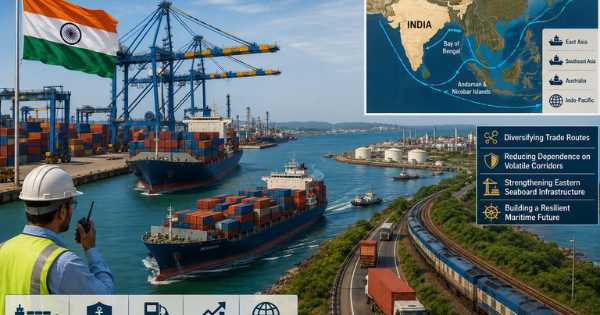
The shifting tectonic plates of global geopolitics have fundamentally altered the calculus of maritime trade, forcing nations to re-evaluate the sanctity of their supply chains. For India, a nation where nearly 95 percent of trade by volume and approximately 70 percent by value is inextricably linked to the sea, maritime resilience is no longer a peripheral concern but a core pillar of national security. As volatility continues to plague West Asian corridors, specifically the vital arteries of the Strait of Hormuz and the Red Sea, the Indian subcontinent finds its traditional trade routes under unprecedented strain. This geopolitical friction has catalyzed a strategic pivot toward the Bay of Bengal, transforming the eastern seaboard from a regional coastline into a critical frontier for global commerce and energy security. The strengthening of this maritime flank is a multifaceted endeavor that transcends mere infrastructure; it is an exercise in diversifying risk and ensuring that the pulse of Indian industry remains steady despite the tremors of international conflict.
At the heart of this maritime transformation lies Andhra Pradesh, a state endowed with a coastline of nearly 974 kilometers—the second longest in the country. Its geographical positioning is nothing short of providential, sitting squarely along the primary shipping lanes that bridge the Indian Ocean with the burgeoning economies of Southeast Asia, East Asia, and the wider Indo-Pacific. Historically, India’s maritime weight was heavily tilted toward its western coast, anchored by the massive container hubs of Gujarat and Maharashtra. However, the current exigencies of global trade demand a more balanced maritime architecture. Andhra Pradesh provides the natural solution to this imbalance, offering a deep-water gateway that reduces the national economy’s over-reliance on a single geographic direction. By expanding the capacity of the eastern coast, India effectively creates a “dual-engine” maritime strategy that ensures the flow of goods continues even if one corridor faces logistical or political bottlenecks.
The existing port ecosystem in Andhra Pradesh—comprising Visakhapatnam, Gangavaram, Krishnapatnam, and Kakinada—already serves as a vital conduit for the nation’s industrial health. These ports are the lifelines for critical sectors such as steel manufacturing, cement production, fertilizer distribution, and seafood exports. They handle a staggering array of bulk cargo, petroleum products, and essential industrial raw materials that feed the hinterlands of eastern and southern India. Beyond simple transit, these hubs have fostered the growth of massive industrial clusters, creating a feedback loop where port efficiency drives manufacturing investment, which in turn necessitates further port expansion. This synergy is central to the Sagarmala Programme, India’s ambitious national framework for port-led development. With over 800 projects identified and an investment exceeding 5 lakh crore, Sagarmala is the legislative and financial wind beneath the wings of Andhra Pradesh’s maritime aspirations.
The next phase of this evolution is marked by the development of three transformative deep-sea ports: Mulapeta, Machilipatnam, and Ramayapatnam. In North Andhra, Mulapeta Port is designed to unlock the mineral-rich potential of the northern Bay of Bengal, providing a sophisticated outlet for bulk trade that has historically been underserved. Centrally, the Machilipatnam Port is being reimagined as a modern gateway for containerized and bulk cargo, supported by a robust network of road and rail connectivity that penetrates deep into the Indian heartland. Further south, the Ramayapatnam Port is being engineered with deep-draught capabilities, allowing it to accommodate the “mega-ships” that dominate modern international shipping but often bypass smaller regional ports. These three projects are not isolated infrastructure works; they are the anchors of a resilient maritime network that enhances India’s ability to participate in high-volume global trade while insulating the domestic market from external shocks.
The strategic dimension of this expansion is underscored by the fragility of West Asian routes, particularly in light of the ongoing tensions involving Iran, Israel, and the United States. The Strait of Hormuz remains a precarious chokepoint through which a vast majority of India’s crude oil imports and a significant portion of its exports to Europe must pass. When these waters become contested, the impact is felt far beyond the shipping lanes; it manifests in the daily lives of Indian citizens. For instance, a substantial share of India’s cooking gas (LPG) travels through the Gulf. When ships are forced to reroute or pay exorbitant insurance premiums due to regional conflict, supply chains tighten and price volatility spikes. By strengthening the eastern seaboard, India is essentially building a strategic hedge. The Bay of Bengal offers a safer, more predictable alternative for trade with the East, ensuring that the country’s energy and food security are not hostage to a single, volatile geography.
Furthermore, the integration of the eastern mainland with the Andaman and Nicobar Islands creates a formidable maritime shield and economic springboard. Located near the Malacca Strait, one of the world’s busiest and most vital maritime chokepoints, these islands serve as India’s “unsinkable aircraft carrier” and a premier logistics hub. A modernized eastern seaboard allows the mainland to better synchronize with the strategic depth provided by the islands, facilitating smoother trade flows into the Pacific. This connectivity is essential for India’s “Act East” policy, as it deepens engagement with the ASEAN bloc—a region of rapid economic growth. As global manufacturers look for alternatives to traditional hubs, the combination of Andhra Pradesh’s ports and the strategic positioning of the Bay of Bengal makes India an increasingly attractive destination for “China plus one” supply chain strategies.
The economic logic of this maritime shift is grounded in the cold reality of numbers. If India is to realize its ambition of becoming a 1 trillion dollar merchandise export economy, it must drastically reduce its logistics costs, which currently remain higher than those of its global competitors. Efficient ports reduce vessel turnaround times, lower freight costs, and streamline the movement of goods from the factory floor to the international market. Andhra Pradesh’s model of linking ports with dedicated industrial corridors and logistics hubs is the blueprint for this national transition. By diversifying its trade gateways and investing in deep-water infrastructure, India is not just building docks and berths; it is constructing the foundations of a resilient, world-class economy. As the uncertainty of global trade becomes the new normal, the eastern seaboard stands ready to serve as the reliable anchor of India’s future prosperity.
(the writer can be reached at dipakkurmiglpltd@gmail.com)