
By Dipak Kurmi
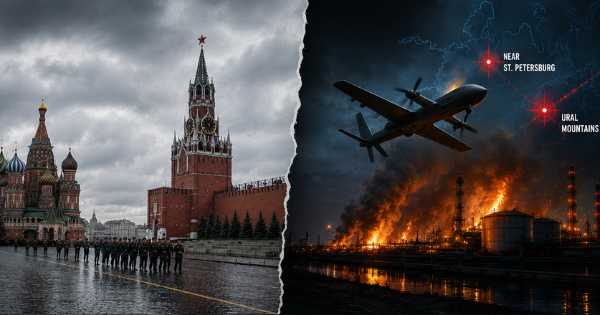
The annual Victory Day parade in Red Square has long served as the liturgical center of the Russian state, a meticulously choreographed display of martial prowess intended to bridge the glory of the Soviet past with the perceived invincibility of the Putin era. However, the 2025 celebrations on May 9 revealed a starkly different reality, one defined by uncharacteristic restraint and visible anxiety. For the first time in two decades, the heavy military hardware that typically rumbles across the cobblestones was entirely absent, replaced by a vacuum that spoke louder than any engine roar. The thinning ranks of both Russian and foreign dignitaries further underscored a growing sense of isolation. This dramatic scaling back is not merely a logistical adjustment but a profound symbolic concession, signaling that the long-range strike capabilities of Ukraine have successfully punctured the domestic sanctuary Vladimir Putin has spent decades cultivating.
The atmosphere in Moscow leading up to the holiday was more reminiscent of a city under siege than a nation in celebration. In an unprecedented move, the government shuttered major airports and temporarily suspended mobile internet access, measures the Kremlin defended as necessary to thwart Ukrainian “terrorism.” To project a semblance of moral high ground, Moscow declared a unilateral truce for May 8 and 9, accompanied by a draconian warning that any Ukrainian provocation would trigger a massive retaliatory strike on Kyiv. President Volodymyr Zelensky correctly identified this as a “theatrical performance,” a desperate attempt to frame the aggressor as a victim while the Russian state struggled to secure its own capital against the persistent threat of unmanned aerial vehicles.
Under Putin’s leadership, the commemoration of the 1945 defeat of Nazi Germany has been co-opted and fused with the contemporary invasion of Ukraine, leveraging historical trauma to legitimize a modern war of conquest. The Kremlin’s propaganda machine has tirelessly worked to equate the fictitious “Nazis” in Kyiv with the actual Third Reich, making the Victory Day parade a core ritual for domestic stability. Just a year ago, the event was a stage for geopolitical defiance, featuring leaders like Xi Jinping, Lula da Silva, and Abdel Fattah el-Sisi to demonstrate that Western sanctions had failed to isolate Moscow. The presence of the S-400 anti-aircraft missile system in the 2025 parade served as a grim reminder of the shift from offensive display to defensive posture, reflecting a year in which the front lines have effectively moved into the Russian heartland.
Ukraine’s strategic momentum is increasingly defined by its ability to bypass traditional battlefield bottlenecks through deep-strike operations. Targets that were once considered untouchable, such as oil terminals in the Baltic Sea near St. Petersburg and industrial hubs in the Ural Mountains, are now within reach of Ukrainian ingenuity. The psychological impact of these strikes is immense; the mere threat of drones has paralyzed Moscow’s civil aviation, causing hundreds of flight delays and frequent airport closures. Simultaneously, Ukraine has mastered the art of domestic defense, reportedly intercepting a record-breaking 33,000 Russian drones in March alone. This defensive proficiency, combined with an aggressive long-range campaign, suggests that the technical equilibrium of the war is shifting in favor of the defender turned counter-attacker.
A pivotal element of this shift is the rapid maturation of Ukraine’s defense industrial base. Kyiv has reported a staggering 50-fold increase in its domestic production capacity since the beginning of the full-scale invasion, now accounting for approximately 70% of its total weapons procurement. The development of advanced systems like the Flamingo missile, which recently struck a defense plant 1,500 kilometers away from the border, demonstrates a leap in technological autonomy. This burgeoning industry has not only sustained the war effort but has also turned Ukraine into a credible security partner. The recent 10-year defense export agreement signed with Saudi Arabia, the United Arab Emirates, and Qatar—nations well-acquainted with the threat of Iranian-made drones—validates the global relevance of Ukrainian military tech.
While manpower remains a significant constraint for Kyiv, technological force multipliers are helping to offset Russian numerical advantages. On the front lines, the narrative of a stagnant stalemate is being challenged by incremental but significant Ukrainian gains. Analysts noted that in February, Ukrainian forces actually recaptured more territory than they surrendered, marking a significant psychological turning point since the 2023 counter-offensive. Meanwhile, the human cost for Russia continues to escalate at an unsustainable rate. NATO Secretary General Mark Rutte and President Zelensky have both pointed to staggering Russian casualty figures, with estimates suggesting that between 30,000 and 35,000 Russian troops are being killed or wounded every single month. Such losses are difficult to mask, even within a controlled information environment.
Within the walls of the Kremlin, the facade of confidence is beginning to show structural cracks. President Putin has reportedly descended into a state of heightened paranoia, drastically limiting his public appearances and retreating into fortified bunkers surrounded by layers of elite security. This personal isolation mirrors the growing domestic strains within the Russian Federation. The rate of military recruitment is now failing to keep pace with battlefield attrition, and the quality of new recruits has plummeted. Reports suggest that authorities are increasingly resorting to pressuring marginalized individuals or those with substance abuse issues into service. This decline in human capital makes the prospect of another politically explosive general mobilization look increasingly inevitable, threatening the social contract Putin has maintained by keeping the war distant from the urban elite.
The Russian economy is also showing signs of fatigue under the dual pressure of sanctions and a total war footing. Chronic labor shortages, stagnant growth, and spiraling inflation have created a volatile economic climate that even loyalists are beginning to fear. Gennady Zyuganov, the long-time leader of the Communist Party, has warned that the current trajectory could stoke a 1917-style revolutionary sentiment among the populace. Perhaps most shocking was the public outburst of Ilya Remeslo, a former pro-Kremlin propagandist who branded Putin a “war criminal.” Though he was arrested, his release after only 30 days and his subsequent vow to continue his dissent suggests a breakdown in the state’s monolithic control over internal discourse and a potential lack of consensus among the security apparatus on how to handle high-level defectors.
The digital front has become another theater of internal conflict. The tightening of controls on platforms like WhatsApp and Telegram, intended to stifle criticism and organize resistance, has instead fueled popular resentment. As the elite begin to grumble and the public feels the squeeze of a slowing economy and restricted freedoms, the narrative of “impregnability” fostered by the Kremlin is dissolving. An anonymous former senior official, writing for The Economist, suggested that the grumbling among the Russian elite is a clear indicator that Putin’s grip on the levers of power is no longer absolute. While these internal pressures may not lead to an immediate collapse, they significantly complicate the Kremlin’s ability to project strength and maintain long-term social cohesion.
Despite external political rhetoric, such as Donald Trump’s unfounded claims of a Ukrainian military defeat, the reality on the ground suggests a resilient and evolving defense. The European Union’s recent finalization of a 90 billion euro loan underscores a long-term commitment to Kyiv that transcends short-term political cycles in Washington. Strategic analyst Lawrence Freedman argues that Ukraine is successfully employing a “Micawber strategy”—maintaining its position and surviving the onslaught in the expectation that internal Russian contradictions or external shifts will eventually turn the tide. By simply “not losing,” Ukraine is forcing Russia into a war of attrition that Moscow is no longer guaranteed to win.
As the smoke clears from a diminished Victory Day, the geopolitical landscape looks vastly different for Vladimir Putin. The transition from a grand display of power to a fearful, locked-down capital reveals a leader whose “maximalist” goals are increasingly at odds with his country’s diminishing resources and internal stability. Ukraine’s ability to hit deep, defend its skies, and innovate its way out of ammunition shortages has fundamentally altered the calculus of the conflict. The war is no longer a distant event for the Russian people; it is a presence felt in closed airports, silent internet feeds, and the glaring absence of tanks on Red Square. If these trends persist, the Kremlin may soon find that the “theatrical performances” it once used to legitimize its rule are no longer enough to mask the reality of a failing campaign.
(the writer can be reached at dipakkurmiglpltd@gmail.com)