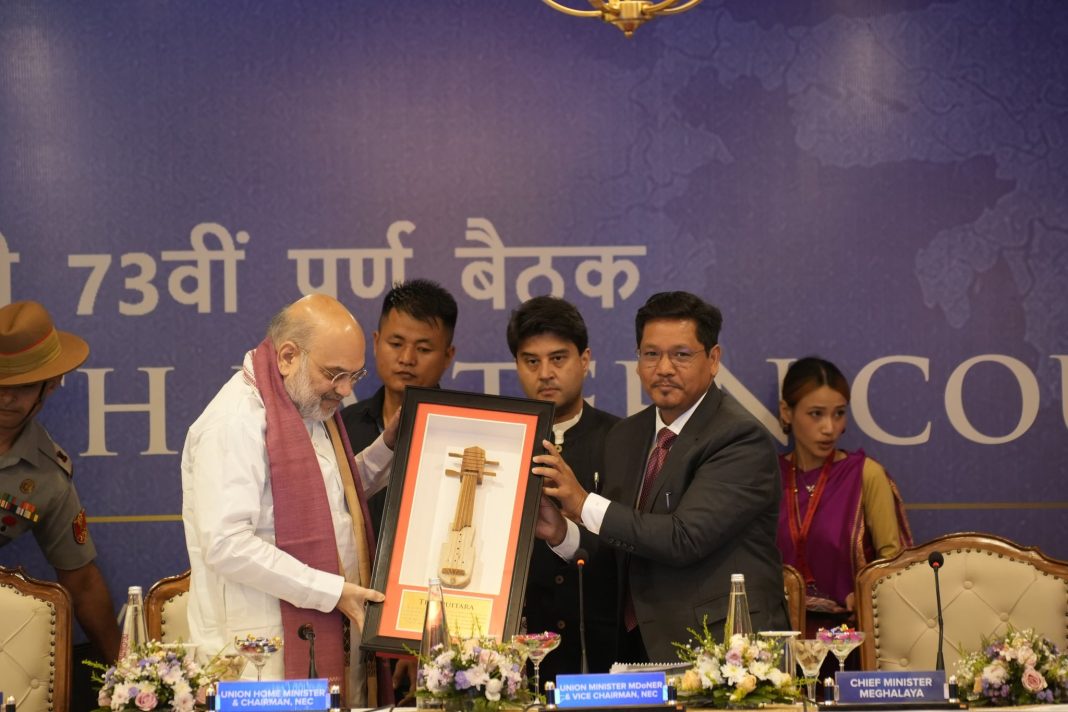

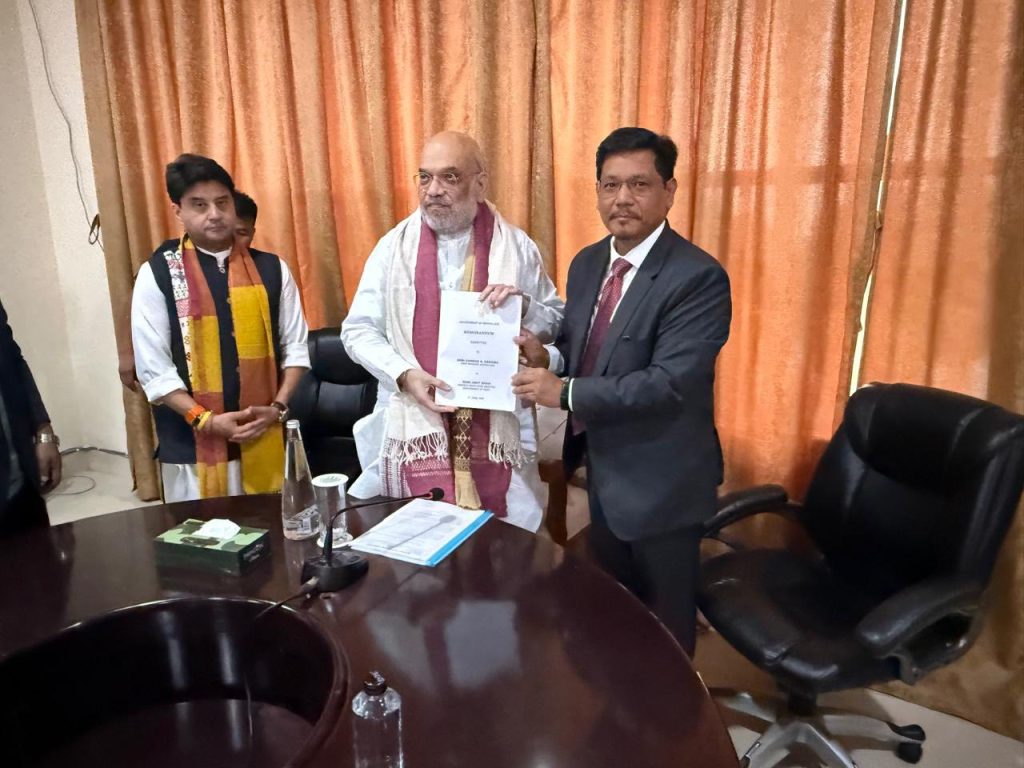
Shillong, June 4: Chief Minister Conrad K Sangma has reiterated the state government’s three long-pending demands – Inner Line Permit (ILP), Presidential assent to amended Residents Safety Bill, and inclusion of Khasi and Garo in the Eighth Schedule – in a memorandum submitted to Union Home Minister Amit Shah here on Thursday.
Backing the demand for ILP, the Chief Minister cited security concerns and public sentiment, saying the state requires “stronger mechanisms to check illegal immigration” to protect its indigenous population.
He reflected on the strong public demand for ILP, saying, “The need to strengthen mechanisms to check illegal immigration into the State of Meghalaya has been strongly felt by the Government of Meghalaya to strengthen the security of the state and to fulfill longstanding demands of the people,” the memorandum stated.
The Chief Minsiter reminded the Centre that the Meghalaya Legislative Assembly unanimously adopted a resolution on December 19, 2019, seeking ILP under the Bengal Eastern Frontier Regulation, 1873.
The resolution was passed a week after the Citizenship (Amendment) Act, 2019 took effect.
“The need for implementation of Inner Line Permit is necessitated in the State of Meghalaya due to the coming into force of the Citizenship (Amendment) Act, 2019 on 12th December 2019,” he said.
The resolution argued that while the CAA exempts Sixth Schedule areas, “this provision will not be adequate to protect and safeguard the interests of the tribal population of the state.”
It called for ILP “to further protect the rights of the indigenous/tribal population as has been granted to the State of Manipur.”
The memorandum also sought a fresh review of the Meghalaya Residents Safety and Security (Amendment) Bill (MRSSAB), 2020. The Bill requires non-residents staying in the state for more than 48 hours to register details via a digital app, with exemptions for permanent residents, MPs, MLAs, and government officials.
“The purpose of the Act is to ensure enhanced security vetting of tenants and to ensure the safety and security of the citizens of the State by preventing anti-social elements from gaining shelter in the State which might be detrimental to peace,” Sangma noted.
Passed by the Assembly in 2020 and sent for Presidential assent, the Bill drew objections from the MHA, which termed it “constitutionally invalid” and “beyond the legislative competence of the State Legislature in view of Article 19 (1)(d) of the Constitution of India.”
Sangma countered that the Bill “is squarely within the legislative competence of the State and also does not violate any of the Fundamental Rights,” urging the Centre to reconsider.
On the demand for Eighth Schedule status, the Chief Minister reiterated that Khasi and Garo remain excluded despite being the state’s most widely spoken languages. A resolution seeking their inclusion was passed by the Assembly on November 27, 2018, and sent to the MHA that December.
“There is a strong demand for inclusion of the above two languages in the Eighth Schedule because of the advantages the language gets once it is included,” the memorandum said, citing benefits such as Sahitya Akademi awards, central funding, job opportunities, and inclusion as a UPSC subject.
Sangma said both languages “have fulfilled the requisite criteria” for inclusion and pointed out that they were notified as official languages through the Meghalaya Official Languages Ordinance, 2026.
“The Government of India is requested to consider the inclusion of Khasi and Garo languages in the Eighth Schedule of the Constitution of India,” he said.