
How Infrastructure Deficits and Extreme Weather Fuel Assam’s Latest Flood Crisis
By Dipak Kurmi
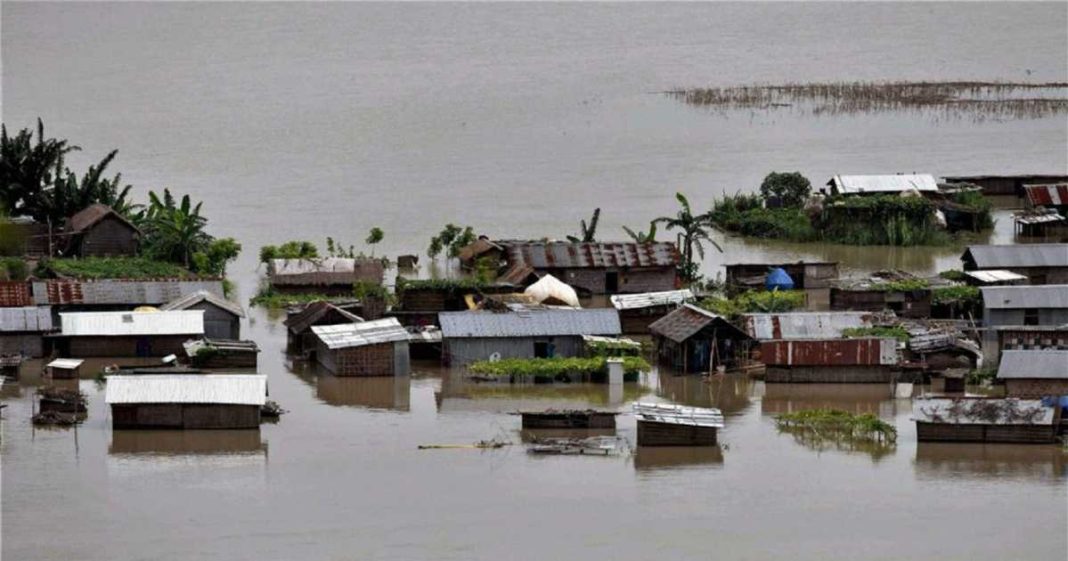
The monsoon framework in Northeast India has once again manifested its devastating potential, precipitating a severe hydrological crisis across the state of Assam. Following a weekend of continuous, high-intensity precipitation, the flood situation has deteriorated sharply, resulting in the loss of life, widespread displacement, and severe disruption to both rural and urban ecosystems. The sudden escalation of water levels has forced the provincial administration to adopt an aggressive emergency footing, mobilizing state resources and requesting the federal armed forces to remain on standby to avert a larger humanitarian catastrophe. As several major river systems breach their structural and natural boundaries, the intersection of extreme meteorological phenomena and systemic municipal vulnerabilities has left multiple districts highly compromised.
According to the official data released by the Assam State Disaster Management Authority, the current wave of floods has claimed at least one life in the Sivasagar district, elevating the cumulative mortality toll for this year’s monsoon-induced deluges to five individuals. The geographical scope of the crisis is expansive, with more than 57,100 people reported as actively affected across seven distinct districts, specifically Charaideo, Dhemaji, Dibrugarh, Jorhat, Sivasagar, Tinsukia, and Udalguri. The trajectory of the inundation underscores an alarming velocity; just twenty-four hours prior, the number of individuals suffering from the deluge stood at approximately 24,000 across four districts, indicating that the impact of the floodwaters has more than doubled within a single diurnal cycle. A localized analysis reveals that Charaideo has emerged as the most severely impacted region, with nearly 24,000 residents reeling under the surge, followed closely by Dhemaji with over 22,000 affected citizens, and Dibrugarh, where more than 4,000 individuals are experiencing the direct consequences of the rising waters.
In response to the rapid acceleration of the floodwaters, Assam Chief Minister Himanta Biswa Sarma has initiated high-level emergency protocols to coordinate rescue operations and expedite the delivery of essential supplies. Utilizing digital communication channels to brief the public, the Chief Minister confirmed that the state government has officially requested the Indian Army and the Indian Air Force to remain on standby for immediate deployment. This precautionary mobilization is targeted primarily at the worst-affected sub-regions of Sivasagar, Charaideo, and Jorhat, where conventional rescue infrastructure could soon become overwhelmed if the current rate of inundation persists. To ensure direct administrative oversight and prevent bureaucratic bottlenecks on the ground, the Chief Minister has deployed four senior cabinet colleagues—Ajanta Neog, Bimal Borah, Keshab Mahanta, and Susanta Borgohain—to the Upper Assam region with strict directives to manage relief logistics and guarantee that every displaced family receives timely and adequate assistance.
The logistics of the state-led relief operations are currently managed by local administrative bodies in tandem with regional disaster response teams. The disaster management authority reported the functional operation of fourteen relief camps and distribution centers across four districts, which are currently providing shelter and basic amenities to 440 displaced citizens. Simultaneously, tactical operations executed by the State Disaster Response Force have successfully extracted ten individuals from highly vulnerable positions within the Charaideo district. To sustain the affected populations, authorities have disbursed considerable quantities of essential food supplies over a twenty-four-hour period, including 58.17 quintals of rice, 10.89 quintals of dal, 3.26 quintals of salt, and 326.88 liters of mustard oil. Despite these interventions, the physical scale of the disaster remains immense, with 298 villages completely submerged and approximately 3,874.84 hectares of agricultural crop land suffering extensive damage, threatening the long-term economic stability of the agrarian communities involved.
The destructive capacity of the deluge has not been confined to agricultural sectors; it has severely compromised critical civic infrastructure and the regional livestock economy. Embankments designed to regulate river channels, along with vital transportation networks including roads and bridges, have sustained varying degrees of structural failure across multiple districts. A key focal point of hydrological concern is the Burhidihing River, which is currently flowing well above the designated danger mark at Chenimari in the Khowang region of the Dibrugarh district. Furthermore, the ecological and economic toll is compounded by the impact on domestic animals, with statistics showing that over 37,558 domestic animals and poultry have been adversely affected or displaced by the intrusion of floodwaters into grazing lands and shelters.
Urban centers in Upper Assam have faced severe flash flooding, exposing deep-seated structural issues within local municipal governance and drainage infrastructure. Intense, early-morning downpours caused immediate waterlogging across Sonari, Sivasagar, and portions of Jorhat. In Sonari, located within the Charaideo district, crucial arterial pathways such as the Dhodar Ali Road, alongside numerous secondary residential streets, were transformed into torrents of knee-deep water that persisted for hours. The floodwater quickly breached residential perimeters, causing extensive damage to household assets, furniture, and irreplaceable legal documentation. Long-term residents of Ward 6 expressed profound dismay, noting that the severity of the internal street flooding was unprecedented over the past three and a half decades. Public sentiment in these urban pockets heavily criticizes the municipal authorities, attributing the crisis to neglected drainage maintenance and an inability of existing channels to handle heavy precipitation events.
The socio-political landscape in Sonari has further complicated the administrative response to this environmental crisis. The current civic gridlock coincides with an acute institutional deadlock within the Sonari Municipal Board, precipitated by ten councilors moving a formal no-confidence motion against the sitting chairperson, Tilak Chandra Neog. Local business owners and residents argue that this political impasse has directly stalled vital public works and structural mitigation projects that could have alleviated the severity of the drainage failure. Meanwhile, in Sivasagar town, the situation mirrored these urban challenges, with all fourteen municipal wards reporting extensive waterlogging. Critical commercial and residential sectors, including Dolmukh Chariali, Muktinath Chariali, Melachakar, Phukan Nagar, Amolapatty, BG Road, HCB Road, ONGC Colony, Babupatty, and Boarding Road, were heavily inundated. While municipal leaders claim that field teams are actively working to clear blockages and prioritize the worst-hit wards, the immediate reality for citizens remains one of severe disruption. Similarly, in Jorhat, municipal authorities have had to resort to emergency water pumps to clear localities where major drainage channels completely overflowed.
The short-term outlook for the state remains highly concerning, given the unsettling atmospheric forecasts issued by meteorologists. The India Meteorological Department has issued warnings predicting moderate to heavy rainfall accompanied by isolated thunderstorms and lightning across Guwahati and numerous other districts over the next three to four days. This sustained wet spell is driven by prevailing monsoon dynamics and specific regional meteorological systems, with anticipated precipitation volumes ranging between six to twelve centimeters within a twenty-four-hour window. The disaster management authority has explicitly warned that these impending weather conditions are highly likely to aggravate existing waterlogging, induce further flash floods, disrupt vehicular traffic, and significantly elevate the risk of localized landslides in geologically vulnerable, low-lying, and hillside pockets. Consequently, emergency response frameworks have been placed on maximum alert, and the state has issued strong advisories urging daily commuters, long-distance travelers, and residents in high-risk zones to practice extreme vigilance, curtail unnecessary travel during peak downpours, and proactively prepare for potential evacuations.
(the writer can be reached at dipakkurmiglpltd@gmail.com)