
By Prarthana Hazarika
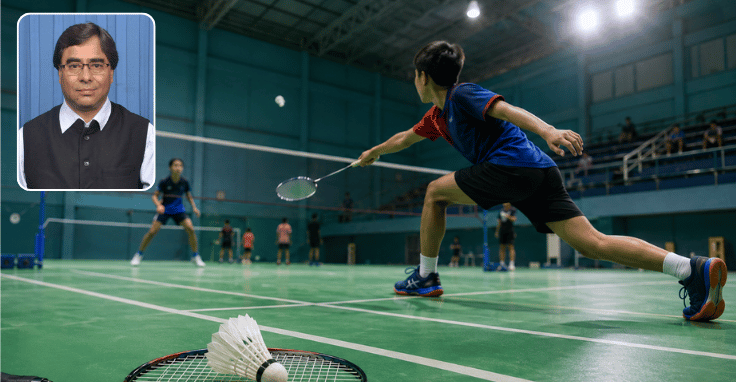
Shillong, Aug 6: As Meghalaya accelerates preparations to host the 2027 National Games, badminton has emerged as one of the disciplines receiving focused government attention. While financial backing for coaching, infrastructure and player development has finally begun to gather pace, the state’s badminton leadership believes that sustained exposure at the national level—not merely infrastructure—will determine whether Meghalaya can challenge the country’s established powerhouses.
In an exclusive interaction with Meghalaya Express, Meghalaya State Badminton Association (MSBA) General Secretary Rajesh Kamal outlined both the optimism and the realities confronting the sport in the state.
According to Kamal, the Meghalaya Government has initiated a comprehensive preparation programme for the National Games, with badminton identified among the priority disciplines. Funds have already been sanctioned for recruiting experienced coaches, strengthening human resources, procuring equipment and preparing a pool of probable athletes.
“The Government has taken every step towards preparing Team Meghalaya for the National Games. For badminton, support has already been extended for hiring top coaches, human resources, equipment and the training of probable players,” Kamal said.
The investment represents one of the most structured interventions in the sport’s recent history. Yet, despite the welcome support, Kamal is under no illusion about the challenge that lies ahead.
He believes the single biggest obstacle preventing Meghalaya’s shuttlers from making a consistent impact on the national circuit is the prohibitive cost of competing in ranking tournaments.
“For any player to improve, regular participation in national ranking tournaments is essential. But each tournament can cost between ₹40,000 and ₹50,000, which is beyond the reach of many talented youngsters,” he said.
The association, which relies largely on government grants and assistance from the Sports Authority of India, has limited independent financial resources. As a result, several promising players struggle to gain the competitive exposure necessary to climb the national rankings.
“Many players have the talent but not the financial support. Without exposure, talent alone is not enough in today’s competitive badminton landscape,” Kamal observed.
Recognising this gap, the state government has now allocated funds specifically for exposure tours as part of the National Games preparation programme—a move the association believes could significantly enhance Meghalaya’s competitiveness by 2027.
Beyond elite preparation, the association has quietly strengthened the sport’s grassroots network over the past two decades.
When Kamal assumed office as General Secretary in 2006, the state had only two affiliated district associations. Today, all 12 districts are affiliated to the Meghalaya State Badminton Association, with district bodies conducting school and district championships before players graduate to the State Championships.
District administrations and District Sports Officers have also begun extending financial assistance through sports promotion schemes, enabling tournaments to be organised more regularly and talent to be identified from across Meghalaya.
The next challenge, however, is transforming that expanding talent base into athletes capable of competing beyond the domestic circuit.
Kamal acknowledged that Meghalaya is still some distance away from consistently producing international-level players. Nevertheless, he believes the recent appointment of one head coach and two assistant coaches exclusively for the National Games programme marks an important beginning.
“We have just started. If government support for coaching, human resources and player development continues, we are hopeful of achieving that milestone in the future,” he said.
The association’s long-term vision extends beyond hosting a successful National Games. It plans to closely monitor the progress of its emerging players through national ranking events and championships, with the eventual objective of producing athletes capable of representing India at the Commonwealth Games, Asian Games and the Olympics.
For a state that has steadily built its sporting identity across multiple disciplines, badminton now stands at a defining moment. Government investment has provided the platform. The administrative framework is gradually expanding. The coaching structure is taking shape.
Whether Meghalaya can convert that promise into podium finishes in 2027—and eventually into international representation—will depend on one crucial factor that cannot be developed overnight: sustained competition against the country’s best.
If that opportunity is consistently provided, Meghalaya’s badminton story may well be entering its most significant chapter yet.