
By Syeda Ambia Zahan
Shillong, August 16: Meghalaya is increasingly turning its long-standing music culture into an economic opportunity, with the state now using live performances, concert tourism, artist support and creative-industry infrastructure to build a more structured music economy.
The scale of that shift is reflected in Chief Minister Conrad K. Sangma’s Independence Day speech on August 15, when he said the Meghalaya Grassroots Music Programme (MGMP) had turned “cafés, public spaces and community events into paid stages”, supporting over 8,850 artists through more than 18,000 performances and taking Meghalaya’s music to Delhi, Mumbai, Japan and Singapore.
The programme, launched in 2022, has since expanded beyond its original role of creating platforms for emerging artists, with the state now positioning music alongside tourism, employment and the wider creative economy.
From gigs to livelihoods
The Meghalaya Tourism Department describes MGMP as an initiative built around “music, community, and livelihood opportunities”, aimed at supporting artists, vendors and event organisers while strengthening the wider music economy.
The programme has expanded from street performances and café gigs to curated events and larger concerts across the state. It provides artists with mentorship, studio access and residencies, while connecting local performers with national and international opportunities through Music Travel Love, Bryan Adams, the WAVES Summit and the World Expo Forum in Osaka.
Building on earlier milestones, which saw thousands of shows, baseline monthly artist earnings averaging ₹10,000, and the formation of localized support roles like technical crews—the programme has steadily scaled. Early success stories, such as the Shillong band Alive, saw performances expand from local gigs to major festivals and a debut album. Cumulative tracking over successive operational phases now places total government investment near ₹38.69 crore, effectively transforming MGMP from a performance platform into a comprehensive employment ecosystem.
The money beyond the musician
The economic footprint of music extends beyond performers to sound and lighting technicians, event managers, photographers, videographers, transport providers, food vendors, venues and production companies.
The 2026–27 Budget places youth and the creative economy among its priorities, with ₹376 crore allocated to Tourism, Arts and Culture, a 57% increase. It continues support for MGMP, Hello Meghalaya and YESS Meghalaya, while plans include a Film Institute in Shillong, a Music Institute in Tura and street music festivals in Shillong and Tura. The Budget reiterates the ambition to make Meghalaya the “music capital of the country.”
The 2025–26 Budget had allocated ₹35 crore for creative industries, including digital content and grassroots music, while ₹18 crore had already been disbursed under MGMP. It described Meghalaya’s creative industries as undergoing “unprecedented transformation”.
And then there are the big concerts
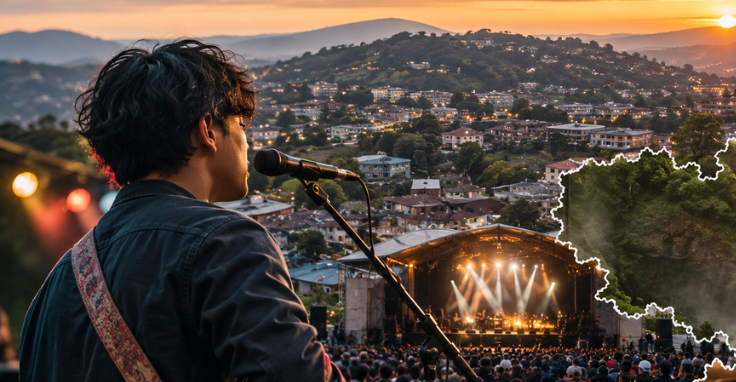
Concerts and festivals are increasingly part of Meghalaya’s tourism economy.
A Meghalaya Tourism Department assessment for 2024–25 found that seven major events, including the Shillong Cherry Blossom Festival and concerts by Bryan Adams and Ed Sheeran, drew nearly 76,000 tourists during a focused 13-day period, while the broader season recorded 3.86 lakh attendees.
The events generated an estimated ₹133.42 crore in economic stimulus against a government investment of ₹23.5 crore, creating up to 5,509 jobs a day. Hotel revenue was estimated at ₹33.78 crore, aviation at ₹16.80 crore and transport and cabs at ₹5.38 crore. For every ₹100 spent on tickets, attendees spent another ₹334 on local services.
The seven events recorded 35,628 visitors at the Shillong Cherry Blossom Festival, 11,928 for Bryan Adams, 13,222 for Ed Sheeran, 6,385 for Me’Gong, 2,460 for Alan Walker, 1,250 for Winter Tales and 4,750 for the Shillong Literary Festival.
The picture has continued to strengthen. The 2026–27 Budget says Meghalaya has crossed 16 lakh tourist arrivals, up from around 12 lakh before the pandemic, while tourism-linked livelihoods have grown from about 50,000 in 2022 to nearly 75,000. Hotel room inventory has increased from around 6,000 to more than 10,000 rooms.
The Governor’s Budget-session address described Meghalaya as one of the top five festival destinations and said its concert economy continues to generate jobs. It also recorded that MGMP has created more than 6,500 direct and indirect livelihood opportunities for young artists.
While these broader figures encompass international festival headliners and general tourism rather than grassroots music alone, they demonstrate the powerful economic multiplier surrounding live entertainment in the state.
Beyond the “Rock Capital” tag
Shillong’s reputation as India’s Rock Capital is now being complemented by efforts to take music beyond the city.
MGMP platforms include street performances in Khyndailad, Laitumkhrah, Mawkdok and Sohra, while café gigs have been developed in Shillong, Jowai and Tura. The programme has also taken local artists to Hard Rock Café venues in Bengaluru, Pune and Hyderabad, while performers have represented Meghalaya at the World Expo Forum in Osaka.
The Tourism Department is positioning music as part of the visitor experience from “a street-side melody in Laitumkhrah, a café gig in Shillong, or a larger event in Polo Grounds”, rather than limiting it to major concerts.
*Can artists make a living all year?
This is where Meghalaya’s experiment will ultimately be measured.
The government’s approach increasingly reflects an understanding that a music economy cannot be built on gigs and mega-concerts alone. Its programmes are being designed to support the wider ecosystem – from studio access, subsidised recording and professional workshops to artist residencies, mentorship and district exchanges, while creating opportunities for managers, technicians, promoters and other creative professionals.
This marks a shift in how Meghalaya sees its musicians: not simply as performers or cultural ambassadors, but as workers in a creative economy. The broader aim is to use the state’s musical capital to build year-round livelihoods, private enterprise and a more self-sustaining music industry.