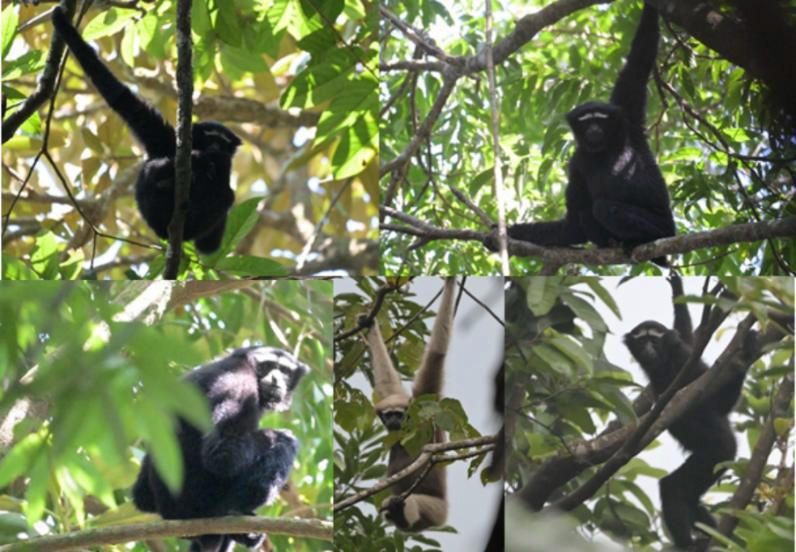

Researchers suggest that fruiting trees within the plantation may have helped provide enough food to support the group
ROOPAK GOSWAMI
Shillong, Aug 19: Hoolock gibbons in Garo Hills are showing a surprising ability to adapt to landscapes increasingly shaped by farming, plantations and human settlements, a new study has found.
Researchers observed three groups of the endangered ape living in markedly different habitats—from continuous forest to jhum-dominated areas and an areca nut plantation—and found that the animals changed the way they used the landscape depending on the level of disturbance.
The study was conducted by Betwonsaoo Passah under the supervision of Dr Salvador Lyngdoh of the Wildlife Institute of India and Dr H.N. Kumara of SACON-WII.
The findings provide a glimpse into how hoolock gibbons are coping with habitat fragmentation in the Garo Hills, where natural forests increasingly exist alongside jhum fields, plantations, orchards and settlements.
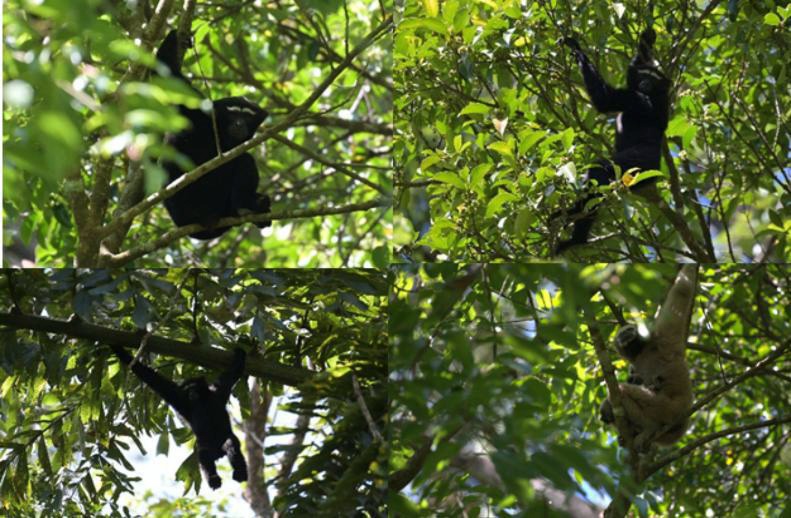
From forest to plantation
The three groups were studied at Daribokgre, Dura Kalakgre and Rensengre.
The Daribokgre group lived in a continuous forest patch adjoining Nokrek National Park. The Dura Kalakgre group occupied a narrow community forest surrounded by active and abandoned jhum, while the Rensengre group lived in an areca nut plantation.
Despite the differences in habitat, their home ranges were broadly similar—about 24 hectares at Daribokgre, 30 hectares at Dura Kalakgre and 23 hectares at Rensengre.
The larger range recorded at Dura Kalakgre, however, appears to reflect the challenges of living in a fragmented landscape.
With the forest patch surrounded by jhum, food resources were more scattered and the gibbons used abandoned jhum areas to supplement the available forest habitat.
The group living in the areca plantation had a smaller home range, almost comparable to that of the group in continuous forest. Researchers suggest that fruiting trees within the plantation may have helped provide enough food to support the group.
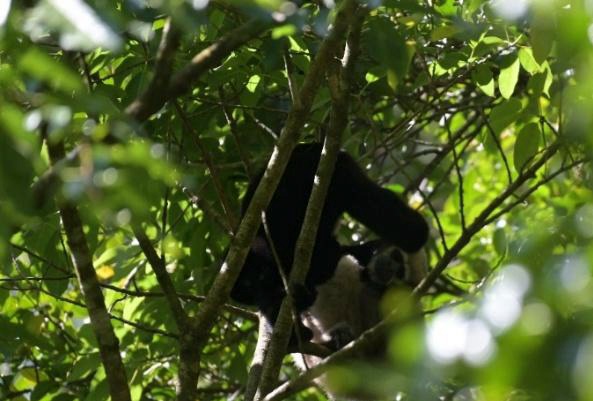
Disturbed habitats changed their behaviour
The differences were more pronounced in how the gibbons spent their time.
The group in continuous forest spent more time calling, feeding and resting, behaviour associated with a relatively stable habitat with better access to resources.
The group living amid jhum spent more time feeding and scouting and less time resting. Researchers suggest the pattern could reflect the need to search for food and remain more alert in a disturbed landscape.
The plantation group also spent more time scouting, indicating another behavioural response to a human-dominated habitat.
The findings suggest that habitat disturbance does not automatically force gibbons out of an area. Instead, the animals can alter their movement and behaviour to cope with changing conditions.
But that flexibility has limits.
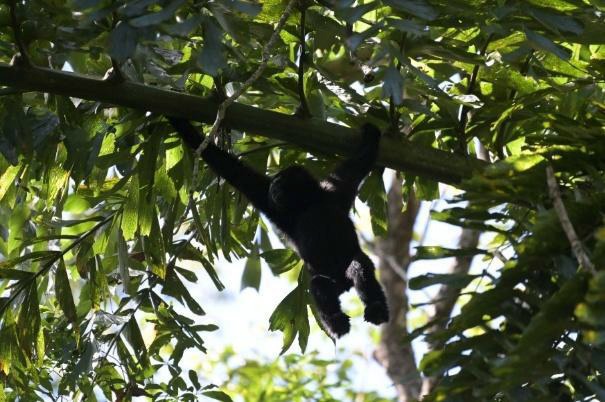
Adaptation is not a substitute for forests
Hoolock gibbons have disappeared from several parts of the Garo Hills because of forest conversion and degradation, hunting, poaching and unplanned development.
Much of their remaining habitat outside protected areas consists of village forests and abandoned jhum areas surrounded by plantations, orchards and cultivated land.
This makes community-managed forests particularly important in Meghalaya, where a relatively small share of the state’s forests is under direct control of the State Forest Department. Large areas are managed by communities, clans or individuals.
The study notes that such forests can provide important habitat for endangered wildlife, but they can also come under pressure from resource extraction and changes in land use.
For hoolock gibbons, the availability of trees is especially critical. The arboreal animals rely on continuous canopy to move through the forest, and fragmentation can leave them isolated in increasingly small patches.
A sacred forest offers a possible lifeline
One of the study’s more interesting observations came from the landscape around the areca plantation.
Researchers identified a small sacred forest patch, locally known as “Kosi” in Garo, as an important feature within an otherwise human-dominated landscape.
Such traditional forest patches could play a larger role in conservation as agricultural and plantation areas expand, the study suggests.
The findings do not mean that areca plantations can replace natural forests. Instead, they show that hoolock gibbons can make use of modified landscapes when suitable trees and food sources remain available.
For the Garo Hills, the conservation message is therefore straightforward: protecting the remaining forest patches, maintaining tree diversity and keeping canopy connections intact could be crucial for the long-term survival of the species.